
MIRA
INFORM REPORT
|
Report Date : |
07.06.2007 |
IDENTIFICATION DETAILS
|
Name : |
ABN
AMRO BANK |
|
|
|
|
Registered Office : |
DLF Centre, Sansad Marg, |
|
|
|
|
Country : |
|
|
|
|
|
Financials (as on) : |
31.03.2005 |
|
|
|
|
Date of Incorporation : |
1919 |
|
|
|
|
TAN No.: [Tax
Deduction & Collection Account No.] |
DELA03709G |
|
|
|
|
Legal Form : |
Commercial
Bank |
|
|
|
|
Line of Business : |
Subject
is engaged in all kinds of Banking Business.
|
RATING & COMMENTS
|
MIRA’s Rating : |
Aa |
|
RATING |
STATUS |
PROPOSED CREDIT LINE |
|
|
71-85 |
Aa |
Possesses adequate working capital. No
caution needed for credit transaction. It has above average (strong)
capability for payment of interest and principal sums |
Large |
|
Maximum Credit Limit : |
USD 64000000 |
|
|
|
|
Status : |
Good |
|
|
|
|
Payment Behaviour : |
Regular |
|
|
|
|
Litigation : |
Clear |
|
|
|
|
Comments : |
Subject
is a well established commercial bank having multi-national operations. It is incorporated in The Netherlands with
limited liability. Available
information indicates high financial responsibility of the bank. Trade relations are fair. Financial position is good. Payments are usually correct and as per
commitments. |
LOCATIONS
|
Registered Office : |
DLF Centre, Sansad Marg, |
|
Tel. No.: |
91-11-2375 5130 / 5230 |
|
Fax No.: |
91-11-2375 5401 |
|
E-Mail : |
|
|
Website : |
|
|
|
|
|
Corporate
Office : |
302, Dalamal House,
Nariman Point, Mumbai - 400 021, |
|
Tel.
No.: |
91-22-2285 5098 / 99 |
|
Fax
No.: |
91-22-2285 2092 |
|
|
|
|
Branches
: |
ABN AMRO Bank N.V.
Chennai
Gurgaon
Kolkata
Mangalore
Mumbai
Noida
Pune
Tirupur
Panipat
Sakhar
Bhavan, 3rd Floor, Nariman Point, Mumbai – 400 021, Tel.No.
91-22-22852093/ 94/ 95 Fax
No. 91-22-22852092 DLF
Centre, Sansad Marg, Tel.
No. 91-11-23755130 / 423 /407 Fax
No. 91-11-23755401 / 23357155 Ruby
House 8, Tel.
No. 91-33-2210 7770 / 2210 7070 Fax
no. 91-33-2242 7142 Tel.
No. 91-33-2246 6767 / 2210 7070 Fax
No. 91-33-2246 6262 Tel.
No. 91-33-22466767 Fax
No. 91-33-22466262 ITC
Centre, 4, Tel.
No. 91-33-22260853/ 55/ 57 Fax
No. 91-33-22448157 7,
Alkapuri, Tel.
No. 91-265-2357002 / 2341341 Fax
No. 91-265-2355900 |
DIRECTORS
|
Name : |
Mr.
Vishnu Deuskar |
|
Designation : |
Managing Director |
|
|
|
|
Name : |
Mr.
Paul Abraham |
|
Designation : |
Chief Operating Officer |
|
|
|
|
Name : |
Mr.
Sanjiv Vohra |
|
Designation : |
Director |
|
|
|
|
Name : |
Mr.
Ramesh Sobti |
|
Designation : |
General
Manager & Chief Executive Officer |
|
|
|
|
Name : |
Mrs.
Meera H Sanyal |
|
Designation : |
Chief
Financial Officers |
|
|
|
|
Name : |
Mr.
Vishnu Deeskar |
|
Designation : |
Chief
Executive Officers |
BUSINESS DETAILS
|
Line of Business : |
Subject
is engaged in all kinds of Banking Business.
|
GENERAL INFORMATION
|
No. of Employees : |
340 |
|
|
|
|
Bankers : |
Reserve
Bank of |
|
|
|
|
|
|
|
Banking Relations : |
Good |
|
|
|
|
Auditors : |
S. R.
Batliboi and Company Chartered
Accountants |
|
|
|
|
Membership: |
Confederation
of Indian Industry |
CAPITAL STRUCTURE
Authorised
Capital :
|
No.
of Shares |
Type |
Value |
Amount |
|
Not Available |
|||
Issued,
Subscribed & Paid-up Capital :
|
No.
of Shares |
Type |
Value |
Amount |
|
169015100 |
Equity
Shares |
Rs. 10/- each |
Rs. 1690.151 Millions |
FINANCIAL DATA
[all figures are in Rupees Millions]
ABRIDGED
BALANCE SHEET
|
SOURCES OF FUNDS |
31.03.2006 |
31.03.2005 |
31.03.2004 |
|
LIABILITIES |
|
|
|
|
Share Capital |
1690.200 |
1690.200 |
1690.200 |
|
Reserves & Surplus |
14195.700 |
11778.800 |
9826.600 |
|
|
|
|
|
|
Deposits |
118637.700 |
70767.800 |
58564.400 |
|
Borrowings |
71299.000 |
49153.800 |
29249.300 |
|
Other Liabilities and Provisions |
29615.300 |
20635.400 |
6843.800 |
|
|
|
|
|
|
GRAND TOTAL |
235437.900 |
154026.000 |
106174.300 |
|
|
|
|
|
|
ASSETS |
|
|
|
|
|
|
|
|
|
Cash & Balances with RBI |
7609.500 |
4900.400 |
5087.300 |
|
Balances with Banks and money at Call & Short
Notice |
6130.400 |
1035.800 |
466.300 |
|
Investments |
48254.500 |
33305.900 |
29174.800 |
|
Advances |
150732.200 |
98364.500 |
66965.900 |
|
Fixed Assets |
1197.200 |
840.500 |
866.100 |
|
Other Assets |
21514.100 |
15578.900 |
3613.900 |
|
|
|
|
|
|
GRAND TOTAL |
235437.900 |
154026.000 |
106174.300 |
PROFIT
& LOSS ACCOUNT
|
PARTICULARS |
31.03.2006 |
31.03.2005 |
31.03.2004 |
|
Interest Earned |
13515.000 |
9073.900 |
7613.700 |
|
Other Income |
6682.900 |
5100.400 |
3799.800 |
|
Total
Income |
20197.900 |
14146.300 |
11413.500 |
|
|
|
|
|
|
Profit/(Loss) Before Tax |
2416.800 |
1952.300 |
1948.000 |
|
Provision for Taxation |
0.000 |
0.000 |
0.000 |
|
Profit/(Loss) After Tax |
2416.800 |
1952.300 |
1948.000 |
|
|
|
|
|
|
Total Expenditure |
17781.100 |
12222.000 |
9465.500 |
KEY
RATIOS
|
PARTICULARS |
31.03.2006 |
31.03.2005 |
31.03.2004 |
|
Credit
Deposit Ratio |
131.87 |
128.34 |
111.63 |
|
Investment
Deposit Ratio |
43.18 |
48.31 |
54.26 |
|
Cash
Deposit Ratio |
6.62 |
7.72 |
8.03 |
|
Interest
Expended/Interest Earned |
48.77 |
36.79 |
41.01 |
|
Other
Income/Total Income |
33.09 |
35.86 |
33.29 |
|
Operating
Expense/Total Income |
38.55 |
45.15 |
41.25 |
|
Interest
Income/Total Funds |
6.94 |
6.97 |
7.61 |
|
Interest
Expended /Total Funds |
3.38 |
2.57 |
3.12 |
|
Net
Interest Income/Total Funds |
3.56 |
4.41 |
4.49 |
|
Non
Interest Income/Total Funds |
3.43 |
3.90 |
3.80 |
|
Operating
Expense/Total Income |
4.00 |
4.91 |
4.71 |
|
Profit
Before Provisions/Total Funds |
2.99 |
3.40 |
3.58 |
|
Net
Profit/Total Funds |
1.24 |
1.50 |
1.95 |
|
Return
On Net Worth(%) |
16.47 |
15.63 |
18.66 |
LOCAL AGENCY FURTHER INFORMATION
BUSINESS
Subject
is engaged in all kinds of banking business.
Subject
ranks among the top 10 banks in the world in size and strength. The bank's international network comprises
3568 branches and offices in over 320 cities and 76 countries and territories
with over 100000 highly qualified staff.
The bank enjoys a strong image as a corporate bank with a base of more
than 500 corporate clients. Its
investment banking services are delivered through ABN AMRO (
The bank
is a leading provider of Forex and Money Market products. It is now emerging as a consumer bank with a
unique range of products.
The
Transaction Banking Group at bank offers cash management, trade finance,
securities, correspondent bank services and bullion services, to corporate and
institutional clients in the Asia Pacific Region.
The bank
employs around 340 persons in its' set up.
Network
The Bank
has more than 3,500 branches in over 70 nations across the globe. ABN AMRO, the Network Bank caters to its
customers needs both at home and abroad.
The Bank
has an eight decade long experience of the Indian business scenario.
The Bank
is traditionally known as strong “diamond financing Bank”.
The Bank
has branches in Mumbai,
The Bank
offers financial needs through various channels including ATMs, Doorstep
Banking and NetBanking.
The Bank
enjoys a strong image as a corporate bank with comprehensive Global Transaction
Services. Its investment banking services are delivered through ABN AMRO (
The Bank
has launched its Private Banking Services in
The Bank
has an 81 year long experience of the Indian business scenario.
It has
turned into a Bank providing a comprehensive range of services with a
difference.
The Bank
has had a long – standing presence in
Their Achievements
·
“Best at Cash Management Award in September 2001” – The Banker
·
Corporate Finance
·
ABN AMRO Securities
·
Top Bank on “Management Quality” parameter: Business India 'Best Banks
Survey 2000’.
·
7th Most Admired Commercial Bank in the World: Fortune
Magazine, 2000.
·
Top Foreign Bank in
·
Second overall in Banking Industry: Financial Express – BRIS survey
1999.
industry
The financial system functions as
anintermediary and facilitates the flow of funds from the areas of surplus to
areas ofdeficit. A financial system is a composition of various institutions,
markets regulationsand laws, practices, money managers, analysts, transactions
and claims and liabilities.
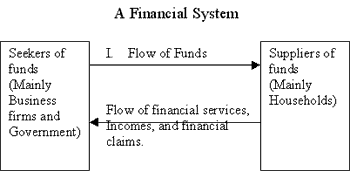
The financial system helps determine both the cost and volume of credit.
Following are thevarious functions performed by a financial system:
- The Savings Function
- Liquidity Function
- Payment Function
- Risk Function
- Policy Function
Financial
Markets:
A financial market can be defined as
amarket in which financial assets are created or transferred. These markets ate
classifiedas Money Market (where the instruments dealt are of short-term
maturity) and CapitalMarket (the instruments dealt are of long-term maturity).
- Money Market:
2.
These markets deal with instruments that
have a maturity period of less than 1 year. These are further sub-divided into
following:
- Call Money Market:
2.
It is in this market that banks and other
participants borrow loans for a very short period, i.e., for 1 to 15 days.
- Treasury Bills or Government
Securities Market:
4.
This is a market for trading in
instruments issued by the Central Government, State Government, Securities
guaranteed by the Central or State Government and Treasury Bills issued by the
RBI.
- Market for Commercial Paper (CP) and
Certificates of Deposit (CD):
6.
Commercial Paper are short term,
unsecured promissory notes issued at a discount to the face value by well known
companies that are financially strong and carry a high rating.
Certificates of
Deposits are defined as short-term deposits by way of usance promissory notes
having a short maturity of not less than 3 months and not more than one year.
- Money Market Mutual Funds (MMMF):
MMMFs are mutual funds
that invest primarily in the money market. This helps even a small investor to
invest in the money markets.
- Capital Market:
4.
This market deals with instruments that
have a maturity period greater than one year.
It is further divided
in to:
- Primary Market:
2.
This is the market where new securities
are issued by Companies and are purchased by the investors.
- Secondary Market:
This market deals with trading of
outstanding securities. This market operates via the medium of Stock Exchanges.
Banks can be broadly analysed on the followingparameters:
2.
Size
of a Bank:
3.
Usually the thumb rule is- all other
things remaining constant- bigger the size of a bank, the better it is. This is
judged by following:
1.
Deposits:
2.
This includes the Demand, Time as well as
savings deposits from all the sources-within and outside
3.
Net Profits:
This is the final free profit available
for appropriation. This can either be ploughed back or distributed as dividend.
4.
Operational
Efficiency:
5.
This refers to how efficiently a bank
manages its business. An efficient bank will manage the same asset size at a
lower cost than an inefficient one.
1.
Interest Income/Average Working Funds:
2.
This refers to how much interest income,
or operating income a bank can earn for every rupee spent on the working funds.
The higher the ratio the better. Average Working Funds are the total resources
(total assets or liabilities) employed by a bank
3.
Non Interest Income/Average Working
Funds:
4.
This refers to how much other income or
fee-based income or income from non fund-based activities a bank can earn for
each rupee spent on the working funds. The higher the ratio the better. This
also denotes a bank’s capability to work on low spreads.
5.
Operating Expenses/Operating Income:
6.
This ratio denotes how much a bank has to
spend on operating expenses for every rupee earned. The lesser the ratio, the
better.
7.
Cost of Deposits:
This is the ratio of Total Interest
Expended /Total Deposits. This indicates the cost of funds to a bank. Thus a
bank that can obtain funds at a lower cost is in a position to earn better
profits in the future.
6.
Earnings
Quality:
7.
This parameter lays importance on how a
bank earns its profits. This also explains the sustainability and growth in
earnings in the future.
1.
Income Spread/Average Working Funds.
2.
Income Spread is the difference between
Interest Income earned and Interest Expended. This ratio shows how much a bank
can earn for every rupee of working fund spent. The higher the ratio the
better.
3.
Operating Profit/ Average Working Funds:
4.
This ratio indicates how much a bank can
earn from its operations net of the operating expenses for every rupee spent on
working funds. The higher the ratio, the better.
5.
Net Profit/Assets:
6.
This ratio measures the net free profits
earned for every rupee of asset owned. A higher ratio means better income
generating capacity of the assets. A higher ratio indicates better earning
potential in the future.
7.
Net Profit/Net Worth:
8.
This ratio measures the return on net
worth or the return on equity. This is a very important ratio for the
shareholders. A higher ratio means that the shareholder’s funds are utilised in
a better manner than would have been elsewhere. Also, only a high return on
equity justifies retention of profits.
9.
Other income/Net interest income:
Other income includes fee-based income,
income from non-core activities, income from non fund-based exposures and other
activities. This ratio determines the future ability to work on low spreads.
This also indicates whether the bank is solely reliant on interest income for
its profits or are there other sources of income as well.
8.
Productivity:
9.
This parameter indicates how efficient
are the banks employee and branches in generating business and profits.
1.
Business per Branch:
2.
Business of a bank is equal to sum of
Deposits and Advances. This ratio indicates whether the branches of bank are
used optimally or not.
3.
Business per Employee:
4.
This ratio is used to find out whether a
bank is relatively over or under staffed. The higher the ratio, the better.
5.
Operating Profits per Employee:
6.
This is also a ratio to check whether a
bank is over or under staffed. The higher the ratio, the better.
7.
Operating Profits per Branch:
This ratio also denotes the profitability
per Branch. The higher the ratio, the better.
10.
Capital
Adequacy:
11.
Capital Adequacy indicates whether the
bank has enough capital to absorb unexpected losses. It is required to maintain
depositor confidence and preventing the bank from going bankrupt.
1.
Capital Adequacy Ratio (CAR):
2.
The banks have to maintain the Capital
Adequacy Ratio (CAR) specified by RBI from time to time. Capital Adequacy Ratio
is equal to the ratio of TIER-I and TIER-II Capital to the Aggregate of Risk
Weighted Assets (RWA).
Thus CAR= (TIER-I + TIER-II)/RWA
Higher CAR indicates ability to comply
with future tighter CAR norms. Also high CAR denotes high safety against
bankruptcy. However a CAR over 2-3% above the statutory norms indicate that the
funds are not deployed properly by the banks. The current requirement is 9%
which is to be raised to 10% by March 2002.
3.
TIER-I Capital:
4.
This refers to the core capital that
provides the most permanent and ready support against unexpected losses. Equity
investments in subsidiaries, intangible assets, losses in current period and
those brought forward from previous years, will be deducted from TIER-I
Capital.
TIER-I Capital consists of the following
components:
Paid-up Equity Capital, Statutory
Reserves Other, Undisclosed Reserves.
5.
Debt-Equity ratio:
6.
This is calculated as the proportion of
total outside liability to net worth. Thus this ratio is equal to (Capital +
Reserves)/(Deposits + Borrowings + Other Liabilities). This ratio thus
indicates the bank’s financial leverage.
7.
Advances/Assets:
8.
This ratio indicates a bank’s
aggressiveness in lending which ultimately results in better profitability.
Higher ratio of advances/deposits is preferred to a lower one.
9.
G-secs to investments :
10.
This ratio indicates a bank’s strategy as
being high-profits high-risk or low profits-low risk. Government securities are
generally considered as the most safe debt instrument, which as a result
carries the lowest return.
11.
G-secs to Assets:
This ratio again shows whether a bank is
conservative or aggressive in its approach towards making profit. Higher ratio
indicates conservatism and a lower ratio indicates aggressiveness.
12.
Asset
Quality:
13.
This indicates what types of advances the
bank has made to generate interest income. When loans are given to highly rated
blue chip corporate, the rates attracted are lower than that by lower rated
doubtful corporates. Thus asset quality indicates the type of debtors of the
bank.
1.
Non-Performing Assets:
2.
These are the assets that are doubtful to
return the principal and/or interest due in the near future. This results in
huge losses to a bank. Thus a bank with a low profit but at the same time low
NPA is preferable to the one having higher profits and higher NPA.
3.
Contingent Liabilities/Total Assets:
4.
This is the ratio of non-funded exposure
of a bank to the total assets. Such exposures result in high losses in cases of
default. Thus the lower the ratio, the better.
5.
Advances growth:
6.
This indicates the increase in the
lending activity Year on Year (yoy). If this ratio is greater than the average
ratio for the industry, it indicates that the bank is aggressively trying to
increase its profits by increasing its advances. This may also result in higher
losses due to loans turning bad (NPA)
7.
Advances yield:
8.
This indicates the interest income earned
by the bank from its lending activity. Generally, Yield increases with the
increase in the risk perception of the assets. Thus a high Yield indicates that
the bank has invested in more risky assets, which may be harmful for the future
profitability of the banks.
9.
Investments/Assets:
This ratio indicates the proportion of
investments to the total assets of a bank. A higher ratio means that the bank
has conservatively kept a high cushion of investments to guard against NPA.
However this affects its profitability adversely.
14.
Management
Quality:
15.
This parameter is used to evaluate
management quality so as to assign premium to better quality banks and discount
poorly managed ones.
1.
Credit/Deposit Ratio:
2.
This indicates the total advance as
proportion of total deposits. It indicates the management’s aggressiveness to
improve income by higher lending operation.
3.
Return on Average Net Worth:
4.
This indicates the return on shareholders
funds. It should be reasonably be above the cost of capital to warrant
ploughing back of the profits. This ratio is very important from share
valuation point of view. Average net-worth is the simple average of opening and
closing balances of net-worth.
5.
Asset growth:
This is the balance sheet growth
indicating an aggressive attitude towards growth.
16.
Liquidity:
17.
Banks are in a business where liquidity
is of prime importance. Among assets Cash and Investments are the most liquid
of a bank’s assets.
1.
Liquid Assets/Total Assets:
2.
Liquid assets consist of cash balance and
investments. This proportion indicates the overall liquidity position of a bank
3.
Cash Assets/Total Assets:
4.
Cash has the highest liquidity and safety
among all assets. This ratio measures cash as a proportion of total assets.
5.
Investments/Total Assets:
6.
Investments are the second most liquid
assets. This ratio measures investments as a proportion of total assets.
7.
G-Secs/Total Assets:
G-secs are the most liquid and safe investments. This ratio
measures G-Secs as a proportion of total assets.
AS
PER WEBSITE:
About
Us
 With assets over US $504 billion
and an AA credit rating, ABN AMRO Bank ranks among the top 10 banks in the
world in size and strength. Their international network comprises 3,568
branches and offices in over 320 cities and 76 countries and territories, with
over 100,000 highly qualified staff. As a global bank, they can handle the most
complicated cross-border transactions, yet they also understand the subtleties
of local markets.
With assets over US $504 billion
and an AA credit rating, ABN AMRO Bank ranks among the top 10 banks in the
world in size and strength. Their international network comprises 3,568
branches and offices in over 320 cities and 76 countries and territories, with
over 100,000 highly qualified staff. As a global bank, they can handle the most
complicated cross-border transactions, yet they also understand the subtleties
of local markets.
ABN AMRO in
ABN AMRO Bank (
Traditionally known as a strong "diamond financing
bank", it has turned into a bank providing a comprehensive range of
services with a difference.
ABN AMRO (
Consumer Banking offers a suite of products for the personal
financial needs offered through various channels including ATMs, Doorstep
Banking and NetBanking.
ABN AMRO Bank in
ABN AMRO Bank has launched its Private Banking Services in
ABN AMRO Bank has also launched its
microfinance program in
Clients
Their local expertise is backed
by the strength of ABN AMRO Bank's vast international network. This enables us
to offer you the most innovative financial products and services across banking
segments, to help achieve the company's strategic local, regional and
international goals and fulfil the personal investment needs. They call this
Universal Banking.
Which of their core businesses
are you interested in?
Core Business Clients
- Mobile Banking
- Debit Card
- NetBanking
- Express Cash
- ATM Services
- 24 Hour Bank by Phone
- Bill Payment
- Doorstep Banking
- Depository Services
- National Access
- 365 Days Banking
Corporate
& Institutional
Banking
- Trade Services
- Cash Management
- Correspondent Banking
- Electronic Banking
- Custodial & Security Services
·
Currency Cum Interest Rate Swaps - Calculator
Economics
Research
The Economist's Desk at ABN AMRO
comprises of a team of experts who keep a continuous track on the changing
trends in the Indian and the world economy.
This Economics Research section is a valuable source
of information and analysis presented by their Economist. It includes the two
pager commentary Ecodesk™, a one page concise data monitor Datatrends™, reports
on selected industries and sectors, and occasional notes.
Watch this section for regular updates and new
features.
"ABN AMRO's mission is to create
maximum economic value for their shareholders through a constant relationship
focus on the financial services needs of their chosen client segments and a
strict adherence to their financial targets. They are operating in three
principal customer segments, whereby the objective is to maximise the value of
each of these businesses as well as the synergies between them. Excellence of
service to their clients and leadership in their chosen markets are of
paramount importance to their long-term success. The Bank's corporate values
play an integral role in the fulfilment of their mission."
History
On 29 March 1824 King Willem-I issued a
royal decree creating the Nederlandsche Handel-Maatschappij with the aim of
reviving trade between the
Network
As an international bank, they have more
than 3,500 branches in over 70 nations across the globe. ABN AMRO, the Network
Bank caters to the needs both at home and abroad.
ABN
AMRO in
ABN AMRO Bank (
ABN AMRO (
Their Achievements
- "Best at Cash Management Award in
September 2001" - The Banker
- Corporate Finance
- ABN AMRO Securities
- Top Bank on "Management
Quality" parameter: Business India 'Best Banks Survey 2000'.
- 7th Most Admired Commercial Bank in the
World: Fortune Magazine, 2000.
- Top Foreign Bank in
- Second overall in Banking Industry:
Financial Express - BRIS survey 1999.
Corporate
& Institutional Banking
ABN AMRO's traditional strength
lies in its leadership in providing a gamut of services to corporates and
institutions, combining its corporate and investment banking activities in one
integrated business unit - Corporate & Institutional Banking.
Corporate & Institutional Banking delivers a full range of tailored
advisory, financing and operational services to selected client groups on a
global and local basis. As an ABN AMRO Corporate & Institutional client,
you have access to the top-class skills, expertise and experience of more than
20,000 staff and an extensive international network of offices.
You can leverage on the in-depth knowledge of their specialists covering the
following key sectors:
- Telecom, media and
technology
- Automotive, consumer and
diversified Industries
- Energy, chemicals and
pharmaceuticals
- Financial institutions
- Public sector
Structured Products
The value-adding adviser and arranger in complex project financing
transactions.
Trade Services
Innovative solutions offering Trade Finance and Trade Services solutions.
Cash Management
Integrated cash management solutions to assist you achieve the strategic
business goal
Correspondent Banking
Global
Financial Markets
With 66 dealing rooms worldwide
covering every time zone, ABN AMRO offers the widest range of Treasury
services.
ABN AMRO Bank's network of Treasury desks in India have demonstrated a
commitment to a high quality and consistency in execution, providing a wide
range of products and competitive prices, with professional handling of both
large and small orders.
These services are offered out of the Central Treasury in Mumbai and a dealing
room in each of other branches, viz,
Foreign Exchange
The Interbank FX desk of the Bank is one of the leading market makers in the
spot and forward Indian Rupee (INR) market; besides providing prices on all
major currencies to all the branches. It also has a dedicated night desk which
takes care of client requirements across various trading time zones.
The Corporate FX services are offered out of all the branches in
Money Markets
The Money Market desk of the Bank is one of the leading interbank players in
the area of government securities and money market instruments like Treasury
Bills, Certificates of Deposit and Commercial Paper. It also has dedicated
personnel servicing the money market requirements of its clients, which include
distribution and advisory services.
Derivatives
The
Derivatives Desk is a market leader in providing various risk management
products to the Bank's corporate customers. The desk is actively involved in
structuring products to suit the specific risk profile, currency and interest
rate view of their clients. The product portfolio includes complex, structured
derivative instruments, besides the vanilla interest rate and currency swaps
and options.
Fx Rates and Products
Rupee Rates and Products
Global Economies Update
Emerging Markets Update
Structured Corporate Products
CMT REPORT [Corruption, Money laundering & Terrorism]
The
Public Notice information has been collected from various sources including but
not limited to: The Courts,
1] INFORMATION
ON DESIGNATED PARTY
No exist designating subject or any of its beneficial owners,
controlling shareholders or senior officers as terrorist or terrorist
organization or whom notice had been received that all financial transactions
involving their assets have been blocked or convicted, found guilty or against
whom a judgement or order had been entered in a proceedings for violating
money-laundering, anti-corruption or bribery or international economic or
anti-terrorism sanction laws or whose assets were seized, blocked, frozen or
ordered forfeited for violation of money laundering or international
anti-terrorism laws.
2] Court
Declaration :
No records exist to suggest that subject is or was the subject of any
formal or informal allegations, prosecutions or other official proceeding for
making any prohibited payments or other improper payments to government
officials for engaging in prohibited transactions or with designated parties.
3] Asset
Declaration :
No records exist to suggest that the property or assets of the subject
are derived from criminal conduct or a prohibited transaction.
4] Record
on Financial Crime :
Charges or conviction registered
against subject: None
5] Records
on Violation of Anti-Corruption Laws :
Charges or investigation registered
against subject: None
6] Records
on Int’l Anti-Money Laundering Laws/Standards :
Charges or investigation registered
against subject: None
7] Criminal
Records
No
available information exist that suggest that subject or any of its principals
have been formally charged or convicted by a competent governmental authority
for any financial crime or under any formal investigation by a competent
government authority for any violation of anti-corruption laws or international
anti-money laundering laws or standard.
8] Affiliation
with Government :
No record
exists to suggest that any director or indirect owners, controlling
shareholders, director, officer or employee of the company is a government
official or a family member or close business associate of a Government
official.
9] Compensation
Package :
Our market
survey revealed that the amount of compensation sought by the subject is fair
and reasonable and comparable to compensation paid to others for similar
services.
10] Press Report :
No press reports / filings exists on
the subject.
CORPORATE GOVERNANCE
MIRA
INFORM as part of its Due Diligence do provide comments on Corporate Governance
to identify management and governance. These factors often have been predictive
and in some cases have created vulnerabilities to credit deterioration.
Our
Governance Assessment focuses principally on the interactions between a
company’s management, its Board of Directors, Shareholders and other financial
stakeholders.
CONTRAVENTION
Subject
is not known to have contravened any existing local laws, regulations or
policies that prohibit, restrict or otherwise affect the terms and conditions
that could be included in the agreement with the subject.
FOREIGN EXCHANGE RATES
|
Currency |
Unit
|
Indian Rupees |
|
US
Dollar |
1 |
Rs.40.63 |
|
|
1 |
Rs.81.01 |
|
Euro |
1 |
Rs.54.89 |
RATING EXPLANATIONS
|
RATING |
STATUS |
PROPOSED CREDIT LINE |
|
|
>86 |
Aaa |
Possesses an extremely sound financial
base with the strongest capability for timely payment of interest and
principal sums |
Unlimited |
|
71-85 |
Aa |
Possesses adequate working capital. No
caution needed for credit transaction. It has above average (strong)
capability for payment of interest and principal sums |
Large |
|
56-70 |
A |
Financial & operational base are
regarded healthy. General unfavourable factors will not cause fatal effect.
Satisfactory capability for payment of interest and principal sums |
Fairly Large |
|
41-55 |
Ba |
Overall operation is considered normal.
Capable to meet normal commitments. |
Satisfactory |
|
26-40 |
B |
Unfavourable & favourable factors
carry similar weight in credit consideration. Capability to overcome
financial difficulties seems comparatively below average/normal. |
Small |
|
11-25 |
Ca |
Adverse factors are apparent. Repayment of
interest and principal sums in default or expected to be in default upon
maturity |
Limited with full security |
|
<10 |
C |
Absolute credit risk exists. Caution
needed to be exercised |
Credit not recommended |