MIRA
INFORM REPORT
|
Report Date : |
18.04.2013 |
IDENTIFICATION DETAILS
|
Name : |
SO FINE JEWELS CO., LTD. |
|
|
|
|
Registered Office : |
14th Floor, Itf-Silom Palace, 160/226-227 Silom Road, Suriyawongse, Bangrak, Bangkok 10500, |
|
|
|
|
Country : |
Thailand |
|
|
|
|
Financials (as on) : |
31.12.2011 |
|
|
|
|
Date of Incorporation : |
10.06.2002 |
|
|
|
|
Com. Reg. No.: |
0105545059040 |
|
|
|
|
Legal Form : |
Private Limited Company |
|
|
|
|
Line of Business : |
Importer, Distributor and Exporter of Diamonds and Jewelry |
|
|
|
|
No. of Employees : |
6 |
RATING & COMMENTS
|
MIRA’s Rating : |
Ba |
|
RATING |
STATUS |
PROPOSED CREDIT LINE |
|
|
41-55 |
Ba |
Overall operation is considered normal. Capable to meet normal
commitments. |
Satisfactory |
|
Status : |
Satisfactory |
|
Payment Behaviour : |
Slow but correct |
|
Litigation : |
Clear |
NOTES :
Any query related to this report can be made
on e-mail: infodept@mirainform.com
while quoting report number, name and date.
ECGC Country Risk Classification List – June 30th, 2012
|
Country Name |
Previous Rating (31.03.2011) |
Current Rating (30.06.2012) |
|
Thailand |
B1 |
B1 |
|
Risk Category |
ECGC
Classification |
|
Insignificant |
A1 |
|
Low |
A2 |
|
Moderate |
B1 |
|
High |
B2 |
|
Very High |
C1 |
|
Restricted |
C2 |
|
Off-credit |
D |
THAILAND - ECONOMIC OVERVIEW
With a well-developed infrastructure, a free-enterprise
economy, generally pro-investment policies, and strong export industries,
Thailand achieved steady growth due largely to industrial and agriculture
exports - mostly electronics, agricultural commodities, automobiles and parts,
and processed foods. Thailand is trying to maintain growth by encouraging
domestic consumption and public investment to offset weak exports in 2012.
Unemployment, at less than 1% of the labor force, stands as one of the lowest
levels in the world, which puts upward pressure on wages in some industries.
Thailand also attracts nearly 2.5 million migrant workers from neighboring
countries. The Thai government is implementing a nation-wide 300 baht ($10) per
day minimum wage policy and deploying new tax reforms designed to lower rates
on middle-income earners. The Thai economy has weathered internal and external
economic shocks in recent years. The global economic severely cut Thailand's
exports, with most sectors experiencing double-digit drops. In 2009, the
economy contracted 2.3%. However, in 2010, Thailand's economy expanded 7.8%,
its fastest pace since 1995, as exports rebounded. In late 2011 growth was
interrupted by historic flooding in the industrial areas in Bangkok and its
five surrounding provinces, crippling the manufacturing sector. Industry
recovered from the second quarter of 2012 onward with GDP growth at 5.5% in
2012. The government has approved flood mitigation projects worth $11.7
billion, which were started in 2012, to prevent similar economic damage, and an
additional $75 billion for infrastructure over the next seven years with a plan
to start in 2013.
Source
: CIA
Company name
SO
FINE JEWELS CO.,
LTD.
SUMMARY
BUSINESS
ADDRESS : 14th FLOOR,
ITF-SILOM PALACE,
160/226-227 SILOM
ROAD, SURIYAWONGSE,
BANGRAK, BANGKOK
10500, THAILAND
TELEPHONE : [66] 2634-4415-6
FAX :
[66] 2634-4417
E-MAIL
ADDRESS : -
REGISTRATION
ADDRESS : SAME
AS BUSINESS ADDRESS
ESTABLISHED
: 2002
REGISTRATION
NO. : 0105545059040 [Former
: 10154500699]
TAX
ID NO. : 3030589934
CAPITAL REGISTERED : BHT. 12,000,000
CAPITAL PAID-UP : BHT.
12,000,000
SHAREHOLDER’S PROPORTION : THAI :
51%
INDIAN
: 49%
FISCAL YEAR CLOSING DATE : DECEMBER 31
LEGAL
STATUS : PRIVATE LIMITED
COMPANY
EXECUTIVE : MR. ASHISH VASANTLAL
SAVANI, INDIAN
MANAGING DIRECTOR
NO. OF
STAFF : 6
LINES
OF BUSINESS : DIAMONDS AND
JEWELRY
IMPORTER, DISTRIBUTOR
AND EXPORTER
CORPORATE PROFILE
OPERATING
TREND : STABLE
PRESENT
SITUATION : OPERATING NORMALLY
REPUTATION : GOOD
WITH NORMAL BUSINESS
ENGAGEMENT
MANAGEMENT
STANDARD : MANAGEMENT WITH
FAIR PERFORMANCE
HISTORY
The
subject was established
on June 10,
2002 as a
private limited company
under the name
style SO FINE
JEWELS CO., LTD.,
by Thai and
Indian groups, in
order to be engaged
in diamonds and
jewelry trading business.
It currently employs
6 staff.
The
subject’s registered address
was initially located
at 322/18 Surawongse Rd., Siphraya,
Bangrak, Bangkok 10500.
On
March 12, 2010,
subject’s registered address
was relocated to 14th
Flr., ITF-Silom Palace, 160/226-227
Silom Rd., Suriyawongse,
Bangrak, Bangkok 10500,
and this is
the subject’s current
operation address.
THE BOARD
OF DIRECTORS
|
Name |
|
Nationality |
Age |
|
|
|
|
|
|
Mr. Ashish Vasantlal Savani |
|
Indian |
44 |
|
Mr. Sameer Daga |
|
Indian |
33 |
AUTHORIZED PERSON
One of the
above directors can
sign on behalf
of the subject
with company’s affixed.
MANAGEMENT
Mr. Ashish Vasantlal Savani
is the Managing
Director.
He is Indian
nationality with the
age of 44
years old.
BUSINESS OPERATIONS
The subject is
engaged in importing
and distributing various
kinds of diamonds,
gemstones and pearl,
as well as
exporting jewelry products.
IMPORT
Most
of the products
are imported from
India, Hong Kong,
Belgium and Africa.
SALES
Diamonds are sold
locally to traders
and manufacturers.
EXPORT
Jewelry
products are exported
to India, Hong
Kong, Japan, France,
U.S.A., Republic of
China and Korea.
SUBSIDIARY AND
AFFILIATED COMPANY
The subject is not found
to have any
subsidiary or affiliated
company here in Thailand.
LITIGATION
Bankruptcy and Receivership
There are no
litigation on bankruptcy
and receivership cases
filed against the
subject found at
Legal Execution Department
for the past
five years.
Others
There are no
legal suits filed
against the subject
for the past
two years.
CREDIT
Sales are by
cash or on
the credits term
of 30-60 days.
Local bills are
paid by cash
or on the
credits term of
30-60 days.
Imports are by
T/T.
Exports are against
T/T.
BANKING
Kasikornbank Public Co.,
Ltd.
EMPLOYMENT
The
subject employs 6
staff.
LOCATION DETAILS
The
premise is rented
for administrative office
at the heading
address. Premise is
located in a
prime commercial area.
COMMENT
Domestic consumption and sales
are depending on market
situation which currently
appeals to be
slowing down both
domestic and overseas
from sluggish economy
in EU and slow
consumption in domestic
market.
FINANCIAL INFORMATION
The
capital was initially
registered at Bht.
2,000,000 divided into
20,000 shares of
Bht. 100 each.
The
capital was increased
later as follows:
Bht. 6,000,000
on September 1,
2004
Bht. 8,000,000
on May 8,
2006
Bht. 12,000,000
on November 9,
2009
The latest
registered capital was
increased to Bht. 12,000,000 divided
into 120,000 shares of
Bht. 100 each
with fully paid.
THE
SHAREHOLDERS LISTED WERE
: [as at
April 30, 2012]
|
NAME |
HOLDING |
% |
|
|
|
|
|
Mr. Ashish Vasantlal Savani Nationality: Indian Address : 322/18
Surawongse Rd., Siphraya,
Bangrak, Bangkok |
58,800 |
49.00 |
|
Mrs. Juthathip Siri Nationality: Thai Address : 175/1
Moo 1, Bankhai,
Muang, Chaiyaphum |
20,400 |
17.00 |
|
Mrs. Natthida Angkavorapanich Nationality: Thai Address : 7
Petchkasem Rd., Pasicharoen, Bangkok |
20,400 |
17.00 |
|
Ms. Pichanant Saengvichien Nationality: Thai Address : 12
Mahesak Rd., Suriyawongse, Bangrak, Bangkok |
20,400 |
17.00 |
Total Shareholders : 4
Share Structure [as
at April 30,
2012]
|
Nationality |
Shareholders |
No. of Share |
% Shares |
|
|
|
|
|
|
Thai |
3 |
61,200 |
51.00 |
|
Foreign - Indian |
1 |
58,800 |
49.00 |
|
Total |
4 |
120,000 |
100.00 |
NAME OF AUDITOR
& CERTIFIED PUBLIC
ACCOUNTANT NO. :
Ms. Sirirat Adam No.
8820
BALANCE SHEET [BAHT]
The
latest financial figures
published for December
31, 2011, 2010
& 2009 were:
ASSETS
|
Current Assets |
2011 |
2010 |
2009 |
|
|
|
|
|
|
Cash and cash
equivalents |
73,982.42 |
12,415.43 |
305,265.32 |
|
Trade account and
other receivables |
23,777,225.79 |
19,693,726.33 |
23,725,768.16 |
|
Inventories |
50,067,523.62 |
36,148,313.07 |
15,024,918.17 |
|
Other current assets |
- |
- |
62,598.33 |
|
|
|
|
|
|
Total Current Assets
|
73,918,731.83 |
55,854,454.83 |
39,118,549.98 |
|
Non-Current Assets |
|
|
|
|
Property, plant and
equipment-net |
3,745,234.71 |
3,947,106.22 |
19,960.24 |
|
Other non-current
assets |
100,334.00 |
100,334.00 |
192,314.00 |
|
Total Assets |
77,764,300.54 |
59,901,895.05 |
39,330,824.22 |
LIABILITIES &
SHAREHOLDERS' EQUITY [BAHT]
|
Current
Liabilities |
2011 |
2010 |
2009 |
|
|
|
|
|
|
Short-term loan from
financial institution |
18,022,678.63 |
17,884,111.60 |
17,896,100.00 |
|
Trade account and
other payable |
20,237,763.25 |
18,436,298.96 |
3,440,583.31 |
|
Current portion of long-term loans |
- |
491,451.07 |
33,404.62 |
|
Short-term Loan |
26,270,997.00 |
8,120,997.00 |
5,376,997.00 |
|
Income tax |
203,288.15 |
75,176.55 |
- |
|
Other current liabilities |
- |
- |
150,298.76 |
|
|
|
|
|
|
Total Current Liabilities |
64,734,727.03 |
45,008,035.18 |
26,897,383.69 |
|
Long-term loans from
financial institution |
- |
2,328,014.92 |
64,025.51 |
|
Total Liabilities |
64,734,727.03 |
47,336,050.10 |
26,961,409.20 |
|
|
|
|
|
|
Shareholders' Equity |
|
|
|
|
|
|
|
|
|
Share capital : Baht 100
par value authorized, issued
and fully paid share
capital 120,000 shares |
12,000,000.00 |
12,000,000.00 |
12,000,000.00 |
|
|
|
|
|
|
Capital Paid |
12,000,000.00 |
12,000,000.00 |
12,000,000.00 |
|
Retained Earnings (Deficit)
|
1,029,573.51 |
565,844.95 |
369,415.02 |
|
Total Shareholders' Equity |
13,029,573.51 |
12,565,844.95 |
12,369,415.02 |
|
Total Liabilities & Shareholders' Equity |
77,764,300.54 |
59,901,895.05 |
39,330,824.22 |
PROFIT &
LOSS ACCOUNT
|
Revenue |
2011 |
2010 |
2009 |
|
|
|
|
|
|
Sales |
35,052,161.08 |
41,319,110.15 |
44,958,990.55 |
|
Other income |
333,806.81 |
841,247.17 |
40,776.75 |
|
Total Revenues |
35,385,967.89 |
42,160,357.32 |
44,999,767.30 |
|
Expenses |
|
|
|
|
|
|
|
|
|
Costs of sale |
31,499,475.11 |
38,066,336.88 |
41,772,758.76 |
|
Selling expenses |
61,122.45 |
331,491.69 |
183,852.50 |
|
Administrative expenses |
1,810,262.59 |
2,034,833.66 |
2,182,673.08 |
|
Total Expenses |
33,370,860.15 |
40,432,662.23 |
44,139,284.34 |
|
|
|
|
|
|
Profit / [loss] before financial
cost and corporate income
tax |
2,015,107.74 |
1,727,695.09 |
860,482.96 |
|
Financial cost |
1,288,091.03 |
[1,381,088.61] |
[685,284.01] |
|
|
|
|
|
|
Profit / [loss] before corporate income tax |
727,016.71 |
346,606.48 |
175,198.95 |
|
Corporate income tax |
[263,288.15] |
[150,176.55] |
[141,722.98] |
|
Net Profit / [Loss] |
463,728.56 |
196,429.93 |
33,475.97 |
FINANCIAL ANALYSIS
|
ITEM |
UNIT |
2011 |
2010 |
2009 |
|
|
|
|
|
|
|
LIQUIDITY RATIO |
|
|
|
|
|
CURRENT RATIO |
TIMES |
1.14 |
1.24 |
1.45 |
|
QUICK RATIO |
TIMES |
0.37 |
0.44 |
0.89 |
|
|
|
|
|
|
|
ACTIVITY RATIO |
|
|
|
|
|
FIXED ASSETS TURNOVER |
TIMES |
9.36 |
10.47 |
2,252.43 |
|
TOTAL ASSETS TURNOVER |
TIMES |
0.45 |
0.69 |
1.14 |
|
INVENTORY CONVERSION PERIOD |
DAYS |
580.16 |
346.61 |
131.28 |
|
INVENTORY TURNOVER |
TIMES |
0.63 |
1.05 |
2.78 |
|
RECEIVABLES CONVERSION PERIOD |
DAYS |
247.59 |
173.97 |
192.62 |
|
RECEIVABLES TURNOVER |
TIMES |
1.47 |
2.10 |
1.89 |
|
PAYABLES CONVERSION PERIOD |
DAYS |
234.50 |
176.78 |
30.06 |
|
CASH CONVERSION CYCLE |
DAYS |
593.25 |
343.80 |
293.84 |
|
|
|
|
|
|
|
PROFITABILITY
RATIO |
|
|
|
|
|
COST OF GOODS SOLD |
% |
89.86 |
92.13 |
92.91 |
|
SELLING & ADMINISTRATION |
% |
5.34 |
5.73 |
5.26 |
|
INTEREST |
% |
3.67 |
3.34 |
1.52 |
|
GROSS PROFIT MARGIN |
% |
11.09 |
9.91 |
7.18 |
|
NET PROFIT MARGIN BEFORE EX. ITEM |
% |
5.75 |
4.18 |
1.91 |
|
NET PROFIT MARGIN |
% |
1.32 |
0.48 |
0.07 |
|
RETURN ON EQUITY |
% |
3.56 |
1.56 |
0.27 |
|
RETURN ON ASSET |
% |
0.60 |
0.33 |
0.09 |
|
EARNING PER SHARE |
BAHT |
3.86 |
1.64 |
0.28 |
|
|
|
|
|
|
|
LEVERAGE RATIO |
|
|
|
|
|
DEBT RATIO |
TIMES |
0.83 |
0.79 |
0.69 |
|
DEBT TO EQUITY RATIO |
TIMES |
4.97 |
3.77 |
2.18 |
|
TIME INTEREST EARNED |
TIMES |
1.56 |
1.25 |
1.26 |
|
|
|
|
|
|
|
ANNUAL GROWTH |
|
|
|
|
|
SALES GROWTH |
% |
(15.17) |
(8.10) |
|
|
OPERATING PROFIT |
% |
16.64 |
100.78 |
|
|
NET PROFIT |
% |
136.08 |
486.78 |
|
|
FIXED ASSETS |
% |
(5.11) |
19,674.84 |
|
|
TOTAL ASSETS |
% |
29.82 |
52.30 |
|
ANNUAL GROWTH :
SATISFACTORY
An annual sales growth is -15.17%. Turnover has decreased from THB
41,319,110.15 in 2010 to THB 35,052,161.08 in 2011. While net profit has
increased from THB 196,429.93 in 2010 to THB 463,728.56 in 2011. And total
assets has increased from THB 59,901,895.05 in 2010 to THB 77,764,300.54 in
2011.
PROFITABILITY :
EXCELLENT
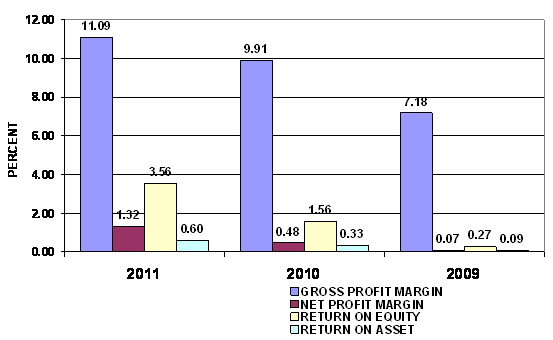
PROFITABILITY
RATIO
|
Gross Profit Margin |
11.09 |
Impressive |
Industrial
Average |
9.66 |
|
Net Profit Margin |
1.32 |
Impressive |
Industrial
Average |
(0.20) |
|
Return on Assets |
0.60 |
Impressive |
Industrial
Average |
(0.27) |
|
Return on Equity |
3.56 |
Impressive |
Industrial
Average |
(0.72) |
Gross Profit Margin used to assess a firm's financial health by
revealing the proportion of money left over from revenues after accounting for
the cost of goods sold. Gross profit margin serves as the source for paying
additional expenses and future savings. Gross Profit Margin is 11.09%. When
compared with the industry average, the ratio of the company was higher. This indicated that company was more
profitable than the same industry.
Net Profit Margin is the indicator of the company's efficiency in that
net profit takes into consideration all expenses of the company. A low profit
margin indicates a low margin of safety, higher risk that a decline in sales
will erase profits and result in a net loss. Net Profit Margin ratio is 1.32%,
higher figure when compared with those of its average competitors in the same
industry, indicated that business was an efficient operator in a dominant
position within its industry.
Return on Assets measures how efficiently profits are being generated
from the assets employed in the business when compared with the ratios of firms
in a similar business. A low ratio in comparison with industry averages
indicates an inefficient use of business assets. Return on Assets ratio is
0.6%, higher figure when compared with those of its average competitors in the
same industry, indicated that business was an efficient profit in a dominant
position within its industry.
Return on Equity indicates how profitable a company is by comparing its
net income to its average shareholders' equity, ROE measures how much the
shareholders earned for their investment in the company. Return on Equity ratio
is 3.56%, higher figure when compared with those of its average competitors in
the same industry, indicated that business was an efficient profit in a
dominant position within its industry.
Trend of the
average competitors in the same industry for last 5 years
Return on Assets Uptrend
Return on Equity Stable
LIQUIDITY : RISKY
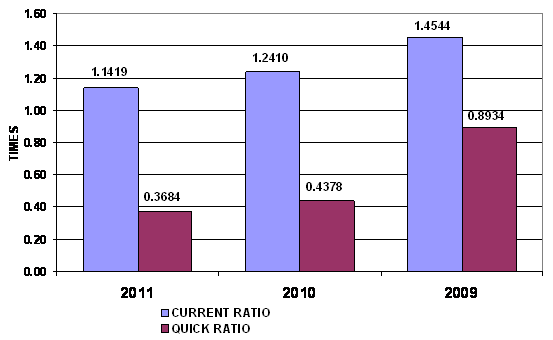
LIQUIDITY RATIO
|
Current Ratio |
1.14 |
Acceptable |
Industrial
Average |
1.72 |
|
Quick Ratio |
0.37 |
|
|
|
|
Cash Conversion Cycle |
593.25 |
|
|
|
The Current Ratio is to ascertain whether a company's short-term assets
are readily available to pay off its short-term liabilities. The company's
figure is 1.14 times in 2011, decreased from 1.24 times, then it is generally
considered to have good short-term financial strength. When compared with the
industry average, the ratio of the company was lower.
The Quick Ratio is a liquidity indicator that further refines the
current ratio by measuring the amount of the most liquid current assets there
are to cover current liabilities. The company's figure is 0.37 times in 2011,
decreased from 0.44 times, then the company has not enough current assets that
presumably can be quickly converted to cash for pay financial obligations.
The Cash Conversion Cycle measures the number of days a company's cash
is tied up in the production and sales process of its operations and the
benefit from payment terms from its creditors. It meant the company could
survive when no cash inflow was received from sale for 594 days.
Trend of the
average competitors in the same industry for last 5 years
Current Ratio Downtrend
LEVERAGE :
ACCEPTABLE
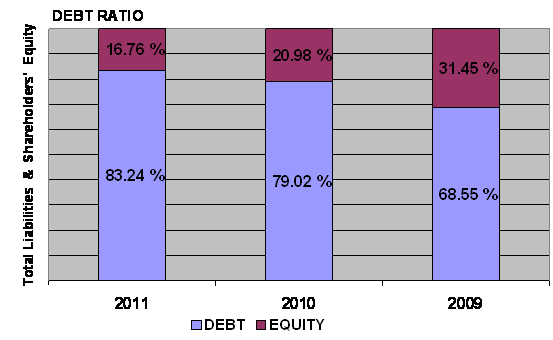
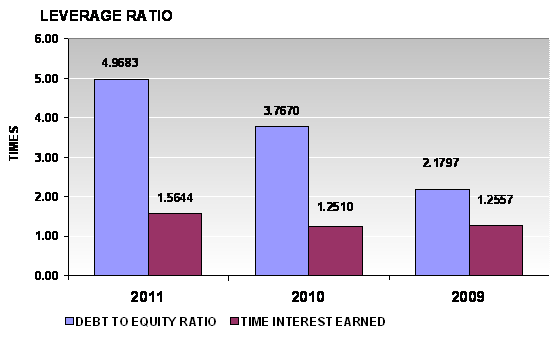
LEVERAGE RATIO
|
Debt Ratio |
0.83 |
Acceptable |
Industrial
Average |
0.60 |
|
Debt to Equity Ratio |
4.97 |
Risky |
Industrial
Average |
1.67 |
|
Times Interest Earned |
1.56 |
Impressive |
Industrial
Average |
0.63 |
Debt to Equity Ratio a measurement of how much suppliers, lenders,
creditors and obligors have committed to the company versus what the
shareholders have committed. A lower the percentage means that the company is
using less leverage and has a stronger equity position.
Times Interest Earned measuring a company's ability to meet its debt obligations.
Ratio is 1.57 higher than 1, so the company can pay interest expenses on
outstanding debt.
Debt Ratio shows the proportion of a company's assets which are financed
through debt. The company's figure is 0.83 greater than 0.5, most of the
company's assets are financed through debt.
Trend of the
average competitors in the same industry for last 5 years
Debt Ratio Uptrend
Times Interest Earned Uptrend
ACTIVITY : RISKY
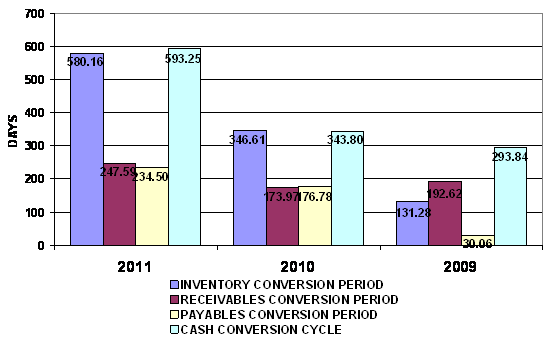
ACTIVITY RATIO
|
Fixed Assets Turnover |
9.36 |
Satisfactory |
Industrial
Average |
10.73 |
|
Total Assets Turnover |
0.45 |
Deteriorated |
Industrial
Average |
1.47 |
|
Inventory Conversion Period |
580.16 |
|
|
|
|
Inventory Turnover |
0.63 |
Deteriorated |
Industrial
Average |
2.17 |
|
Receivables Conversion Period |
247.59 |
|
|
|
|
Receivables Turnover |
1.47 |
Deteriorated |
Industrial
Average |
3.31 |
|
Payables Conversion Period |
234.50 |
|
|
|
The company's Account Receivable Ratio is calculated as 1.47 and 2.10 in
2011 and 2010 respectively. This ratio measures the efficiency of the company
in managing its trade debtors to generate revenue. A lower ratio may indicate
over extension and collection problems. Conversely, a higher ratio may indicate
an overtly stringent policy. In this case, the company's A/R ratio in 2011
decreased from 2010. This would suggest the company had deteriorated in the
management of its debt collections.
Inventory Turnover in Days Ratio indicates the liquidity of inventory.
It estimates the number of days that it will take to sell the current
inventory. Inventory is particularly sensitive to change in business
activities. The inventory turnover in days has increased from 347 days at the
end of 2010 to 580 days at the end of 2011. This represents a negative trend.
And Inventory turnover has decreased from 1.05 times in year 2010 to 0.63 times
in year 2011.
The company's Total Asset Turnover is calculated as 0.45 times and 0.69
times in 2011 and 2010 respectively. This ratio is determined by dividing total
assets into total sales turnover. The ratio measures the activity of the assets
and the ability of the firm to generate sales through the use of the assets.
Trend of the
average competitors in the same industry for last 5 years
Fixed Assets Turnover Uptrend
Total Assets Turnover Downtrend
Inventory Turnover Downtrend
Receivables Turnover Downtrend
DIAMOND INDUSTRY – INDIA
-
From time immemorial, India is well known in the world as the birthplace
for diamonds. It is difficult to trace the origin of diamonds but history
says that in the remote past, diamonds were mined only in India. Diamond
production in India can be traced back to almost 8th Century B.C.
India, in fact, remained undisputed leader till 18th Century
when Brazilian fields were discovered in 1725 followed by emergence of S.
Africa, Russia and Australia.
-
The achievement of the Indian diamond industry was possible only due to
combination of the manufacturing skills of the Indian workforce and the
untiring and unflagging efforts of the Indian diamantaires, supported by
progressive Government policies.
-
The area of study of family owned diamond businesses derives its
importance from the huge conglomerate of family run organizations which operate
in the diamond industry since many generations.
-
Some of the basic traits of family run business enterprises include
spirit of entrepreneurship, mutual trust lowers transaction costs, small,
nimble and quick to react, information as a source of advantage and
philanthropy.
-
Family owned diamond businesses need to improve on many fronts including
higher standard of corporate governance, long-term performance – focused
strategies, modern management and technology.
-
Utmost caution is to be exercised while dealing with some medium and
large diamond traders which are usually engaged in fictitious import – export,
inter-company transactions, financially assisted by banks. In the process,
several public sector banks lost several hundred million rupees. They mostly
diverted borrowed money for diamond business into real estate and capital
markets.
-
Excerpts from Times of India dated 30th October 2010 is as
under –
-
Gem & Jewellery Export Promotion Council in its statistical data has
shown the export of polished diamonds to have increase by 28 % in February
2013. Compared to $ 1.4 bn worth of polished diamond export in February, 2012,
India exported $ 1.84 billion worth of polished diamonds in February 2013. A
senior executive of GJEPC said, “Export of cut and polished diamonds started
falling month-wise after the imposition of 2 % of import duty on the polished
diamonds. But February, 2013 has given a new ray of hope to the industry as the
export of polished diamonds has actually increased by 28 %. It means the
industry is on the track of recovery and round tripping of diamonds has
stopped completely.” Demand has started coming from the US, the UK, Japan and
China. India’s polished diamond export is expected to cross $ 21 bn in 2013-14.
-
The banking sector has started exercising restraint while following
prudent risk management norms when lending money to gems and jewellery sector.
This follows the implementation of Basel III accord – a global voluntary
regulatory standard on bank capital adequacy, stress testing and market
liquidity.
FOREIGN EXCHANGE RATES
|
Currency |
Unit
|
Indian Rupees |
|
US Dollar |
1 |
Rs.53.94 |
|
|
1 |
Rs.82.76 |
|
Euro |
1 |
Rs.71.04 |
INFORMATION DETAILS
|
Report
Prepared by : |
PRL |
RATING EXPLANATIONS
|
RATING |
STATUS |
PROPOSED CREDIT LINE |
|
|
>86 |
Aaa |
Possesses an extremely sound financial base with the strongest
capability for timely payment of interest and principal sums |
Unlimited |
|
71-85 |
Aa |
Possesses adequate working capital. No caution needed for credit
transaction. It has above average (strong) capability for payment of interest
and principal sums |
Large |
|
56-70 |
A |
Financial & operational base are regarded healthy. General
unfavourable factors will not cause fatal effect. Satisfactory capability for
payment of interest and principal sums |
Fairly Large |
|
41-55 |
Ba |
Overall operation is considered normal. Capable to meet normal
commitments. |
Satisfactory |
|
26-40 |
B |
Capability to overcome financial difficulties seems comparatively
below average. |
Small |
|
11-25 |
Ca |
Adverse factors are apparent. Repayment of interest and principal sums
in default or expected to be in default upon maturity |
Limited with
full security |
|
<10 |
C |
Absolute credit risk exists. Caution needed to be exercised |
Credit not
recommended |
|
-- |
NB |
New Business |
-- |
This score serves as a reference to assess SC’s credit risk
and to set the amount of credit to be extended. It is calculated from a
composite of weighted scores obtained from each of the major sections of this
report. The assessed factors and their relative weights (as indicated through
%) are as follows:
Financial
condition (40%) Ownership
background (20%) Payment
record (10%)
Credit history
(10%) Market trend
(10%) Operational
size (10%)
This report is issued at your request without any
risk and responsibility on the part of MIRA INFORM PRIVATE LIMITED (MIPL)
or its officials.