MIRA
INFORM REPORT
|
Report Date : |
19.12.2013 |
IDENTIFICATION DETAILS
|
Name : |
P. T. EMBEE PLUMBON TEKSTIL |
|
|
|
|
Registered Office : |
Jalan Raya Cirebon Bandung Km. 12, Plumbon,
Cirebon, 45155, West Java |
|
|
|
|
Country : |
Indonesia |
|
|
|
|
Date of Incorporation : |
22.07.1998 |
|
|
|
|
Com. Reg. No.: |
No. AHU-24616.AH.01.02.TH.2010 |
|
|
|
|
Legal Form : |
Limited Liability Company |
|
|
|
|
Line of Business : |
Integrated Textile Mills |
|
|
|
|
No. of Employees : |
1,100 |
RATING & COMMENTS
|
MIRA’s Rating : |
Ba |
|
RATING |
STATUS |
PROPOSED CREDIT LINE |
|
|
41-55 |
Ba |
Overall operation is considered normal. Capable to meet normal
commitments. |
Satisfactory |
|
Status : |
Satisfactory |
|
|
|
|
Payment Behaviour : |
No complaints |
|
|
|
|
Litigation : |
Clear |
NOTES:
Any query related to this report can be made
on e-mail: infodept@mirainform.com
while quoting report number, name and date.
ECGC Country Risk Classification List – March, 31st, 2013
|
Country Name |
Previous Rating (31.12.2012) |
Current Rating (31.03.2013) |
|
Indonesia |
B1 |
B1 |
|
Risk Category |
ECGC
Classification |
|
Insignificant |
A1 |
|
Low |
A2 |
|
Moderate |
B1 |
|
High |
B2 |
|
Very High |
C1 |
|
Restricted |
C2 |
|
Off-credit |
D |
INDONESIA - ECONOMIC OVERVIEW
Indonesia, a vast polyglot nation, grew more than 6% annually in 2010-12. The government made economic advances under the first administration of President YUDHOYONO (2004-09), introducing significant reforms in the financial sector, including tax and customs reforms, the use of Treasury bills, and capital market development and supervision. During the global financial crisis, Indonesia outperformed its regional neighbors and joined China and India as the only G20 members posting growth in 2009. The government has promoted fiscally conservative policies, resulting in a debt-to-GDP ratio of less than 25%, a fiscal deficit below 3%, and historically low rates of inflation. Fitch and Moody's upgraded Indonesia's credit rating to investment grade in December 2011. Indonesia still struggles with poverty and unemployment, inadequate infrastructure, corruption, a complex regulatory environment, and unequal resource distribution among regions. The government in 2013 faces the ongoing challenge of improving Indonesia''s insufficient infrastructure to remove impediments to economic growth, labor unrest over wages, and reducing its fuel subsidy program in the face of high oil prices.
|
Source
: CIA |
BASIC SEARCH
Name of Company
P.T. EMBEE PLUMBON TEKSTIL
Address :
Head Office &
Factory
Jalan Raya Cirebon Bandung Km. 12
Plumbon, Cirebon, 45155
West Java
Indonesia
Phones -
(62-231) 321 421 (Hunting)
Fax - (62-231) 321 473
E-mail - embee@indo.net.id
Website - www.embeetex.com
Land Area - 180,000 sq.
meters
Building Space - 120,000 sq.
meters
Region - Industrial
Zone
Status - Owned
Branch and
Marketing Office
Wisma SMR 8th Floor Unit 801
Jalan Yos Sudarso Kav. 89
Jakarta Utara, 14350
Indonesia
Phones -
(62-21) 650 7792, 6507793
Fax - (62-21) 65020518
E-mail - embeejkt@indo.net.id
Building Area - 14 storey
Office Space - 100 sq. meters
Region - Commercial
Status - Rent
Date of
Incorporation :
22 July 1998
Legal Form :
P.T. (Perseroan Terbatas) or Limited Liability Company
Company Reg. No. :
The Ministry of Law and Human Rights
- No.
C2-11.440.HT.01.01.TH.98
Dated 18 August 1998
- No.
AHU-24616.AH.01.02.TH.2010
Dated 14 May 2010
Company Status :
Foreign Investment (PMA) Company
Permit by the Government Department :
The Department of Finance
NPWP No. 01.824.703.1-057.000
The Department of Industry and Trade
TDP No. 10221300368
Dated 29 August 1998
The Capital Investment Coordinating Board
- No. 405/I/PMA/1998
Dated 21 July 1998
- No. 206/T/INDUSTRI/1999
Dated 19 April 1999
- No. 635/III/PMA/1999
Dated 18 May 1999
- No. 116/II/PMA/1999
Dated 24 June 1999
- No. 456/III/PMA/2000
Dated 31 March 2000
- No. 330/III/PMA/2001
Dated 27 March 2001
- No.
07/32/T/Industri/2004
Dated 5 February 2004
- No. 21/II/PMA/2004
Dated 16 February 2004
Related Company :
None
CAPITAL AND OWNERSHIP
Capital Structure :
Authorized Capital : US$
14,000,000.-
Issued Capital : US$
14,000,000.-
Paid up Capital : US$
14,000,000.-
Shareholders/Owners :
a. Mr. Vishamber Sunderdas Badlani` -
US$ 7,000,000.-
Address : C/O Modella Footwear Abid Road
Hyderabad, India
b. Mr. Amit Kumar Badlani -
US$ 7,000,000.-
Address : C/O Modella Footwear Abid Road
Hyderabad, India
BUSINESS ACTIVITIES
Lines of Business :
Integrated Textile Mills
Production Capacity :
a. Yarns -
42,000
bales p.a.
b. Grey Fabrics - 11,000,000
meters p.a.
c. Polyester Yarn -
24,000 bales p.a.
d. Rayon Yarns -
23,000 bales p.a.
Total Investment :
a. Equity Capital - US$
14.0 million
b. Loan Capital - US$
21.9 million
c. Total Investment -
US$ 35.9 million
Started Operation :
1999
Brand Name :
Embee Plumbon Tekstil
Technical Assistance :
None
Number of Employee :
1,100 persons
Marketing Area :
Local - 40%
Export - 60%
Main Customer :
Buyers in Asian and European countries
Market Situation :
Very Competitive
Main Competitors :
a. P.T. GISTEX CHEWON SYSNTHETICS
b. P.T. GOLDEN TATEX INDONESIA
c. P.T. GRAND PINTALAN TEXTILE INDUSTRIES
d. P.T. GLORINDO FILATEX
e. Etc.
Business Trend :
Growing
BANKER, AUDITOR & LITIGATION
Bankers :
a. P.T. Bank DANAMON
INDONESIA Tbk
Jalan Prof. Dr. Satrio Kav.
E-IV /6
Jakarta Selatan, 12930
Indonesia
b. DEUTSCHE Bank AG
Wisma Deutsche Bank
Jalan Imam Bonjol 85
Jakarta Pusat
Indonesia
c. P.T. Bank SBI INDONESIA
Gedung Graha Mandiri
Jalan Imam Bonjol No. 61
Jakarta Pusat
Indonesia
Auditor :
Internal Auditor
Litigation :
No litigation record in our database
FINANCIAL FIGURE
Annual Sales (estimated) :
2010 – Rp. 321.7 billion
2011 – Rp. 344.0 billion
2012 – Rp. 366.0 billion
2013 – Rp. 190.0 billion (January – June)
Net Profit (estimated) :
2010 – Rp. 22.5 billion
2011 – Rp. 27.5 billion
2012 – Rp. 30.0 billion
2013 – Rp. 16.5 billion (January – June)
Payment Manner :
Average
Financial Comments :
Satisfactory
KEY EXECUTIVES
Board of Management :
President Director - Mr. Vishamber Sunderdas Badlani
Directors - a. Mr. Priya Vishamber Badlani
b. Mr. Amit Kumar Badlani
Board of Commissioners :
President Commissioner -
Mr. Vijay Agarwal
Commissioner - Mr. Suresh Belani
Signatories :
President Director (Mr. Vishamber
Sunderdas Badlani) or one of the Directors (Mr. Priya Vishamber Badlani or Mr.
Amit Kumar Badlani) which must be approved by Board of Commissioner
CAPABILITIES
Management Capability :
Good
Business Morality :
Good
Credit Risk :
Average
Credit Recommendation :
Credit should be proceeded with monitor
Proposed Credit Limit :
Small amount – periodical review
OVERALL PERFORMANCE
P.T. EMBEE PLUMBON TEKSTIL (P.T. EPT) was established in Jakarta, o22 n July 1998, with an authorized capital of US$ 12,000,000 and issued capital of US$ 3,000,000 fully paid up. The founding shareholders of the company are Mr. Vishamber Sunderdas Badlani and Mr. Devidas Sunderdas Badlani, both are of India. The company notary deed had been changed a couple of times and according to the latest revision of notary deed Mr. Agus Madjid, SH., No. 18 dated 15 March 2010 the company authorized capital was increased to US$ 14,000,000 wholly issued and paid up. With this time the composition of its shareholders has been changed to become Mr. Vishamber Sunderdas Badlani (50%) and Mr. Amit Kumar Badlani (50%). The deed of amendments was approved by the Ministry of Law and Human Rights in its decision letter No. AHU-24616.AH.01.02.TH.2010 dated May 14, 2010.
P.T. EPT is a
Foreign Capital Investment Company (PMA) dealing integrated textile industry by
managing a plant located at Jalan Raya Cirebon Bandung Km. 12, Plumbon,
Cirebon, West Java, on a land of some 18.0 hectares. The plant has been
commenced commercial production since 1999 by taking over the plant of P.T.
KOPRIMATEX. The plant has been expanding frequently to increase production capacity
in yarns, grey fabrics, polyester yarn and rayon yarns. It has absorbed an
investment of US$ 35.9 million consisting of US$ 14.0 million own capital and
the rest is loan. We heard that initially the plant was owned by
P.T. KOPRIMATEX, which then taken over by P.T. EPT in early 1998. The company’s
production was only reached 80% of its installed capacity and up to present has
yet to reach full capacity. The plant is equipped with modern and
“state-of-the-art technology” to service the high growth demand of textile
industries in the global market. The 3rd generation of textile machinery with
latest intelligent software had established the new standard in quality. P.T.
EPT customer oriented approach and continuous up gradation in technology,
skillful execution, comprehensive training program are setting the new
standards in product and process development. P.T. EPT is certified with
ISO-9001 and Oeko-Tex Standard 100. Since 2004 EMBEE is certified by USTER to
mark all products as USTERIZED.
The machinery are Trutzschler Blow Room with contamination detector for
cotton, Trutzschler Carding DK 903/ TC 03, Rieter Auto-Leveller Draw Frame,
Rieter Combers, Howa and Toyoda auto doffing ring frame, Automatic Link Orion
Savio Winders with Electronic Yarn Clearers and Schlaforst autoconers with
electronic yarn clearer, Murata TFO Doublers, Rieter Comforjet Machines,
Schlaforst Open end Machines. Some 50%
to 60% of the company’s products are exported to some countries in Europe like
Denmark and others. We observe that the
operation of P.T. EPT has been growing and developing well in the last three
years.
The global economic crisis followed by fast rising local bank interest
rates has also had a negative impact on the company's. Meanwhile, the local TPT
(Textile and Textile Products) industries and other factors causing the
declining competitive ability of the national TPT products are the increasing
production costs, high interest rates, expensive customs office costs, illegal
retributions, textile and garment machinery restructuring costs and the rising
prices of production components (oil fuel prices and electric base tariffs). We
observe the operation of P.T. GI has been growing and developing well in the
last three years.
Polyester fiber is the most used synthetic fiber worldwide, with a
market share of about 72%. In fact, not only is its production cost reasonably
low, but it is also successfully used in many industrial and textile
applications, as well as in the automotive industry. For many years, the world
market for polyester fiber has enjoyed sustained annual growth rates of 7–9%.
However, since mid-2008, consumption has significantly slowed, mainly as a
consequence of the global economic recession. In 2008, world consumption of
polyester fiber was about 1.8% less than in 2007. However, in 2009, world
consumption recovered and was back to the 2007 level again, mainly as a result
of Chinese consumption growth. In Europe, North America and Japan in 2008 and
2009, the market decreased by more than 15% annually; however, during the same
period, consumption in China increased at a rate of over 4% per year. In the
rest of the world, consumption decreases have mostly occurred, although of
variable extent from region to region.
The following pie chart
shows world consumption of polyester fibers:
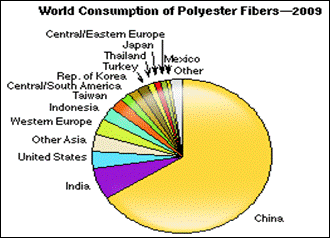
China consumes about 64% of the polyester fiber produced worldwide, principally
for textile applications. The country consumes fibers in a chain of textile
weaving, dyeing and apparel-making industries, then exports large amounts of
finished goods, including apparel, curtains and bedding, around the world.
Moreover, since the abolition of textile quotas in 2004, Chinese exports of
apparel and other textile products have been increasing very rapidly.
Threatened by this large volume of low-cost fabrics entering their countries,
many producers in the more economically developed countries have been forced to
restructure their businesses. China accounts for over 66% of the global output
of polyester fibers, up from only 27% in 2000. This extraordinary increase has
led to surplus in the worldwide supply for the past few years.
Indonesia is the 6th largest producer world to
polyester with a production capacity of 1.4 million tons per year.
Manufacturers of synthetic in Indonesia domestic market oriented, PSF and PFY
90% 65%. The main raw material 100% polyester is the PTA supplied the domestic
industry and MEG supplied 30% of the domestic industry, 70% of imports.
Caprolactam as raw material Nylon 100% imported. Demand for polyester textile raw materials
in the country (Indonesia) is still high because organic textile
raw material such as cotton is difficult to grow in Indonesia. So the polyester
is still an option for the textile industry in Indonesia.
National Polyester
Production, 2007 – 2012
|
Year |
Polyester Staple
Fiber (PSF) |
Polyester
Filament Yarns (PFY) |
Nylon Yarns (NY) |
|
2007 2008 2009 2010 2011 2012 |
497715 500,670 505,674 515,680 529,700 556,000 |
715,000 670,000 674,000 680,000 700,000 725,000 |
16,360 17,443 18,556 19,740 21,000 32,000 |
Until this time P.T. EPT has not been registered with Indonesian Stock
Exchange, so that they had not obliged to announce their financial statement.
The management of P.T. EPT is very reclusive towards outsiders and rejected to
disclose its financial condition. We observed that total sales turnover of the
company in 2010 amounted to Rp. 321.7 billion rose to Rp. 344.0 billion in 2011
increased to Rp. 366.0 billion in 2012. As from January to June 2013 the sales
turnover has amounted at Rp. 190.0 billion with a net profit of Rp. 16.5
billion and the sales it’s projected to go on rising by at least 6% in 2014.
The company has an estimated total networth of at least Rp. 130.0 billion. We
observe that P.T. EPT is supported by foreign partner with has financially
strong and sound behind it. So far, we did not heard that the company having
been black listed by the Central Bank (Bank Indonesia). The company usually
pays its debts punctually to suppliers.
The management of P.T. EPT is led by Mr. Vishamber Sunderdas Badlani
(57) a businessman and professional manager of India with experience in
integrated textile mills. In his daily activity he is assisted by Mr. Priya
Vishamber Badlani (53) and Mr. Amit Kumar Badlani (29) as Directors. The
company's management is handled by professional staff in the above business.
They have wide relations with private businessmen within and outside the
country. So far, we did not hear that the management of the company being filed
to the district court for detrimental cases or involved in any business
malpractices. The company’s litigation record is clean and it has not
registered with the black list of Bank of Indonesia. P.T. EMBEE PLUMBON TEKSTIL
is sufficiently fairly good for business transaction.
FOREIGN EXCHANGE RATES
|
Currency |
Unit
|
Indian Rupees |
|
US Dollar |
1 |
Rs.61.92 |
|
|
1 |
Rs.100.83 |
|
Euro |
1 |
Rs.85.27 |
INFORMATION DETAILS
|
Report Prepared
by : |
NNA |
RATING EXPLANATIONS
|
RATING |
STATUS |
PROPOSED CREDIT LINE |
|
|
>86 |
Aaa |
Possesses an extremely sound financial base with the strongest
capability for timely payment of interest and principal sums |
Unlimited |
|
71-85 |
Aa |
Possesses adequate working capital. No caution needed for credit
transaction. It has above average (strong) capability for payment of interest
and principal sums |
Large |
|
56-70 |
A |
Financial & operational base are regarded healthy. General
unfavourable factors will not cause fatal effect. Satisfactory capability for
payment of interest and principal sums |
Fairly Large |
|
41-55 |
Ba |
Overall
operation is considered normal. Capable to meet normal commitments. |
Satisfactory |
|
26-40 |
B |
Capability to overcome financial difficulties seems comparatively below
average. |
Small |
|
11-25 |
Ca |
Adverse factors are apparent. Repayment of interest and principal sums
in default or expected to be in default upon maturity |
Limited with
full security |
|
<10 |
C |
Absolute credit risk exists. Caution needed to be exercised |
Credit not
recommended |
|
---- |
NB |
New Business |
---- |
This score serves as a reference to assess SC’s credit risk and
to set the amount of credit to be extended. It is calculated from a composite
of weighted scores obtained from each of the major sections of this report. The
assessed factors and their relative weights (as indicated through %) are as
follows:
Financial
condition (40%) Ownership
background (20%) Payment
record (10%)
Credit history
(10%) Market trend
(10%) Operational
size (10%)
This report is issued at your request without any
risk and responsibility on the part of MIRA INFORM PRIVATE LIMITED (MIPL)
or its officials.