MIRA INFORM REPORT
|
Report Date : |
22.04.2014 |
IDENTIFICATION DETAILS
|
Name : |
ZAEIM ELECTRONIC INDUSTRIES |
|
|
|
|
Registered Office : |
No.21, Nilou St, Brezil St, Vanak Sq Tehran 14155-1434, |
|
|
|
|
Country : |
Iran |
|
|
|
|
Date of Incorporation : |
22.04.1966 |
|
|
|
|
Com. Reg. No.: |
713 |
|
|
|
|
Legal Form : |
Limited Liability Company |
|
|
|
|
Line of Business : |
Manufacture and supply
of electronic and telecommunication equipment. |
|
|
|
|
No. of Employees |
145 |
RATING & COMMENTS
|
MIRA’s Rating : |
B |
|
RATING |
STATUS |
PROPOSED CREDIT LINE |
|
|
26-40 |
B |
Capability to overcome financial difficulties seems comparatively
below average. |
Small |
|
Status : |
Moderate |
|
Payment Behaviour : |
No complaints |
|
Litigation : |
Clear |
NOTES :
Any query related to this report can be made
on e-mail : infodept@mirainform.com
while quoting report number, name and date.
ECGC Country Risk Classification List – March 31, 2014
|
Country Name |
Previous Rating (31.12.2013) |
Current Rating (31.03.2014) |
|
Iran |
B1 |
B1 |
|
Risk Category |
ECGC
Classification |
|
Insignificant |
A1 |
|
Low Risk |
A2 |
|
Moderate Low Risk |
B1 |
|
Moderate Risk |
B2 |
|
Moderate High Risk |
C1 |
|
High Risk |
C2 |
|
Very High Risk |
D |
IRAN ECONOMIC OVERVIEW
Iran's economy is marked by statist policies, an inefficient state sector, and reliance on oil, a major source of government revenues. Price controls, subsidies, and other distortions weigh down the economy, undermining the potential for private-sector-led growth. Private sector activity is typically limited to small-scale workshops, farming, some manufacturing, and services. Significant informal market activity flourishes and corruption is widespread. New fiscal and monetary constraints on Tehran, following the expansion of international sanctions in 2012 against Iran's Central Bank and oil exports, significantly reduced Iran's oil revenue, forced government spending cuts, and fueled a 60% currency depreciation. Economic growth turned negative in 2012 and 2013, for the first time in two decades. Iran continues to suffer from double-digit unemployment and underemployment. Lack of job opportunities has convinced many educated Iranian youth to seek jobs overseas, resulting in a significant "brain drain." However, the election of President Hasan RUHANI in June 2013 brought about widespread expectations of economic improvements and greater international engagement among the Iranian public, and early in Ruhani's term the country saw a strengthened national currency and a historic boost to market values at the Tehran Stock Exchange
|
Source
: CIA |
Company
name and address
Company Name: Zaeim Electronic Industries
Also Trade as:
-
Address: No.21, Nilou St, Brezil St, Vanak Sq, Tehran 14155-1434, Iran
Tel: + 98 21 88773211-3
, 88778055, 88792102 / 8873551-2
Fax: + 98 21 88792102
Website:
www.zaeim.com
Email:
info@zaeim.com
Company was originally started as an
on 1966
Registration & Legal Details
Current Legal Form: Limited Liability Company
Registration Address:
No.21,
Nilou St, Brezil St, Vanak Sq
Tehran
14155-1434, Iran
Registration Number: 713
Registration Date: 22/07/1966
Registration Town: Tehran
National id:
110100092484
Capital:
99,000,000 Iranian Rials
Shareholders
Shareholders:
|
Shareholder Name |
Share % |
|
Mr. Seyed Sabahoddin
Firouzabadi |
45% |
|
Mr. Ablhassan Firouzabadi |
20% |
|
Mr. Mostafa Nourbakhsh |
5% |
|
Mr. Mohammad
Ehsan Hamidia |
5% |
|
Mr. Reza Salehi |
25% |
Principals
Name: Mr. Seyed
Sabahoddin Firouzabadi
Position within the company: Chairman
Country of Birth: Iran
Nationality: Iranian
Can fluently speak: Farsi-English
Name: Mr. Ablhassan
Firouzabadi
Position within the company: Vice Chairman
Country of Birth: Iran
Nationality: Iranian
Can fluently speak: Farsi- English
Name: Mr. Reza Salehi
Position within the company: Managing Director
Country of Birth: Iran
Nationality: Iranian
Can fluently speak: Farsi, English
Name: Mr. Reza Husseini
Position within the company: Manager
Country of Birth: Iran
Nationality:
Iranian
Can fluently speak: Farsi, English
Activations
It specializes in the manufacture and supply of
electronic and telecommunication equipment.
Local Reporters consider the investigated company to be
LARGE
in their field of concern
Operations
Company Employs: 145
Sales: 100%
Nationally
Sales to: Group companies, General Public
Sales Term: Cash, Bank
Transfer, accept credit, Letter of credit
Vehicles: 8
HQ Premises
Operates Form:
Owned: Office, Factory
Location: Central
Business Area, Main Road,
Bankers
Bank Mellat
Iran
Financial
Auditor: Mr. Ali Ghanavati
Solicitor: Mr. Ashkan Salehi
Imports
Imports From: China
Importing Terms: Bank
Transfer
Import % and type of product: 100% Finished Goods
Export
Export % and type of product: Subject does not export
Related
Companies
It doesn’t have any related companies.
Payment
Subject's payments reported to be: NO COMPLAINTS
Interview & Reporter Comments
Following to the
interview with Mr. Reza Salehi ( Managing Director), he
refused to cooperate with us.
Note: the company and the shareholders are strong relationship with Iran Military.
Conclusions
Local Reputation:
The company being investigated is considered by local reporters to be a High
Trade Risk and To Be Secured.
Owner/Shareholders Comments: Some of the owners / shareholders have an active participation in the running of the
business.
Age of Business: Old business
NEWS
Source: The Wall Street Journal
Date: Oct 27, 2011
Chinese Tech Giant Aids Iran
When Western companies pulled back from Iran after the government's
bloody crackdown on its citizens two years ago, a Chinese telecom giant filled
the vacuum.
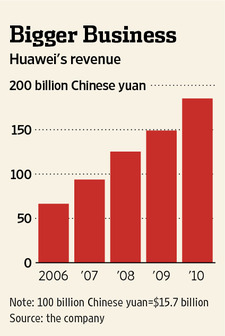
Huawei Technologies Co. now dominates Iran's government-controlled
mobile-phone industry. In doing so, it plays a role in enabling Iran's state
security network.
WSJ's Steve Stecklow has the story of Chinese telecom firm Huawei, which
dominates Iran's government-controlled mobile industry. Photo: AP Photo/Kin
Cheung
Huawei recently signed a contract to install equipment for a system at
Iran's largest mobile-phone operator that allows police to track people based
on the locations of their cellphones, according to interviews with telecom
employees both in Iran and abroad, and corporate bidding documents reviewed by
The Wall Street Journal. It also has provided support for similar services at
Iran's second-largest mobile-phone provider. Huawei notes that nearly all
countries require police access to cell networks, including the U.S.
Huawei's role in Iran demonstrates the ease with which countries can
obtain foreign technology that can be used to stifle dissent through censorship
or surveillance. Many of the technologies Huawei supports in Iran—such as
location services—are available on Western networks as well. The difference is
that, in the hands of repressive regimes, it can be a critical tool in helping
to quash dissent.
See a screenshot of an article about
Huawei reprinted on the website of the Chinese embassy in Tehran. It first appeared in August 2009, two months after
mass demonstrations erupted in Iran. The article notes that Huawei's clients
include "military industries."
Last year, Egyptian state security intercepted conversations among
pro-democracy activists over Skype using a system provided by a British company.
In Libya, agents working for Moammar Gadhafi spied on emails and chat messages
using technology from a French firm. Unlike in Egypt and Libya, where the
governments this year were overthrown, Iran's sophisticated spying network
remains intact.
In Iran, three student activists described in interviews being arrested
shortly after turning on their phones. Iran's government didn't respond to
requests for comment.
Iran beefed up surveillance of its citizens after a controversial 2009
election spawned the nation's broadest antigovernment uprising in decades.
Authorities launched a major crackdown on personal freedom and dissent. More
than 6,000 people have been arrested and hundreds remain in jail, according to
Iranian human-rights organizations.

This year Huawei made a pitch to Iranian government officials to sell
equipment for a mobile news service on Iran's second-largest mobile-phone
operator, MTN Irancell. According to a person who attended the meeting, Huawei
representatives emphasized that, being from China, they had expertise censoring
the news.
The company won the contract and the operator rolled out the service,
according to this person. MTN Irancell made no reference to censorship in its
announcement about its "mobile newspaper" service. But Iran routinely
censors the Internet using sophisticated filtering technology. The Journal
reported in June that Iran was planning to create its own domestic Internet to
combat Western ideas, culture and influence.
In winning Iranian contracts, Huawei has sometimes partnered with Zaeim
Electronic Industries Co., an Iranian electronics firm whose website says its
clients include the intelligence and defense ministries, as well as the
country's elite special-forces unit, the Islamic Revolutionary Guards Corps.
This month the U.S. accused a branch of the Revolutionary Guards of plotting to
kill Saudi Arabia's ambassador to the U.S. Iran denies the claim.
Huawei's chief spokesman, Ross Gan, said, "It is our corporate
commitment to comply strictly with all U.N. economic sanctions, Chinese
regulations and applicable national regulations on export control. We believe
our business operations in Iran fully meet all of these relevant
regulations."
William Plummer, Huawei's vice president of external affairs in
Washington, said the company's location-based-service offerings comply with
"global specifications" that require lawful-interception
capabilities. "What we're doing in Iran is the same as what we're doing in
any market," he said. "Our goal is to enrich people's lives through
communications.
Huawei has about 1,000 employees in Iran, according to people familiar
with its Iran operations. In an interview in China, a Huawei executive played
down the company's activities in Iran's mobile-phone industry, saying its
technicians only service Huawei equipment, primarily routers.
But a person familiar with Huawei's Mideast operations says the
company's role is considerably greater, and includes a contract for
"managed services"—overseeing parts of the network—at MTN Irancell,
which is majority owned by the government. During 2009's demonstrations, this
person said, Huawei carried out government orders on behalf of its client, MTN
Irancell, that MTN and other carriers had received to suspend text messaging
and block the Internet phone service, Skype, which is popular among dissidents.
Huawei's Mr. Plummer disputed that the company blocked such services.
Huawei, one of the world's top makers of telecom equipment, has been
trying to expand in the U.S. It has met resistance because of concerns it could
be tied to the Chinese government and military, which the company denies.
Last month the U.S. Commerce Department barred Huawei from participating
in the development of a national wireless emergency network for police, fire
and medical personnel because of "national security concerns." A
Commerce Department official declined to elaborate.
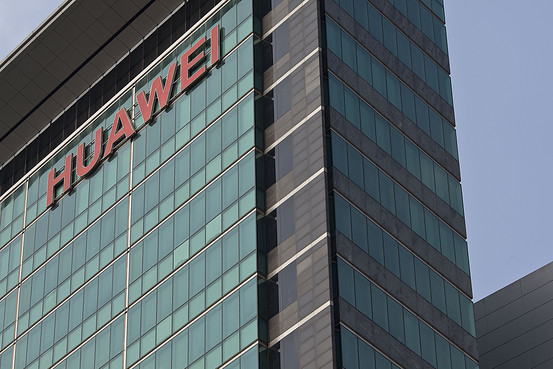
Building F1, home to the exhibition hall, stands at the Huawei
Technologies Co. campus in Shenzhen, Guangdong Province, China, on Thursday,
May 19, 2011. Bloomberg News
In February, Huawei withdrew its attempt to win U.S. approval for
acquiring assets and server technology from 3Leaf Systems Inc. of California,
citing opposition by the Committee on Foreign Investment in the United States.
The panel reviews U.S. acquisitions by foreign companies that may have
national-security implications. Last year, Sprint Nextel Corp. excluded Huawei
from a multibillion-dollar contract because of national-security concerns in
Washington, according to people familiar with the matter.
Huawei has operated in Iran's telecommunications industry since 1999,
according to China's embassy in Tehran. Prior to Iran's political unrest in
2009, Huawei was already a major supplier to Iran's mobile-phone networks,
along with Telefon AB L.M. Ericsson and Nokia Siemens Networks, a joint venture
between Nokia Corp. and Siemens AG, according to MTN Irancell documents.
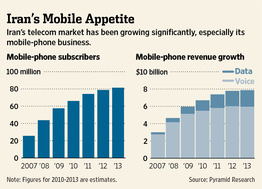
Iran's telecom market, which generated an estimated $9.1 billion in
revenue last year, has been growing significantly, especially its mobile-phone
business. As of last year, Iran had about 66 million mobile-phone subscribers
covering about 70% of the population, according to Pyramid Research in
Cambridge, Mass. In contrast, about 36% of Iranians had fixed-line phones.
As a result, mobile phones provide Iran's police network with far more
opportunity for monitoring and tracking people. Iranian human-rights
organizations outside Iran say there are dozens of documented cases in which
dissidents were traced and arrested through the government's ability to track
the location of their cellphones.
Many dissidents in Iran believe they are being tracked by their
cellphones. Abbas Hakimzadeh, a 27-year-old student activist on a committee
that published an article questioning the actions of Iran's president, said he
expected to be arrested in late 2009 after several of his friends were jailed.
Worried he could be tracked by his mobile phone, he says he turned it off,
removed the battery and left Tehran to hide at his father's house in the
northeastern city of Mashhad.
A month later, he turned his cellphone back on. Within 24 hours, he
says, authorities arrested him at his father's house. "The interrogators
were holding my phone, SMS and emails," he said.
He eventually was released and later fled to Turkey where he is seeking
asylum. In interviews with the Journal, two other student activists who were
arrested said they also believe authorities found them in hiding via the
location of their cellphones.
In early 2009, Siemens disclosed that its joint venture with Nokia, NSN,
had provided Iran's largest telecom, government-owned Telecommunications
Company of Iran, with a monitoring center capable of intercepting and recording
voice calls on its mobile networks. It wasn't capable of location tracking. NSN
also had provided network equipment to TCI's mobile-phone operator, as well as
MTN Irancell, that permitted interception. Like most countries, Iran requires
phone networks to allow police to monitor conversations for crime prevention.
NSN sold its global monitoring-center business in March 2009. The
company says it hasn't sought new business in Iran and has established a
human-rights policy to reduce the potential for abuse of its products.
A spokesman for Ericsson said it delivered "standard"
equipment to Iranian telecom companies until 2008, which included built-in
lawful-interception capabilities. "Products can be used in a way that was
not the intention of the manufacturer," the spokesman said. He said
Ericsson began decreasing its business in Iran as a result of the 2009
political upheaval and now doesn't seek any new contracts.
As NSN and Ericsson pulled back, Huawei's business grew. In August 2009,
two months after mass protests began, the website of China's embassy in Tehran
reprinted a local article under the headline, "Huawei Plans Takeover of
Iran's Telecom Market." The article said the company "has gained the
trust and alliance of major governmental and private entities within a short
period," and that its clients included "military industries."
The same month the Chinese embassy posted the article, Creativity
Software, a British company that specializes in "location-based
services," announced it had won a contract to supply a system to MTN
Irancell. "Creativity Software has worked in partnership with Huawei,
where they will provide first and second level support to the operator,"
the company said.
The announcement said the system would enable "Home Zone
Billing"—which encourages people to use their cellphones at home (and give
up their land lines) by offering low rates—as well as other consumer and
business applications that track user locations. In a description of the
service, Creativity Software says its technology also enables mobile-phone
operators to "comply with lawful-intercept government legislation,"
which gives police access to communications and location information.
A former telecommunications engineer at MTN Irancell said the company
grew more interested in location-based services during the antigovernment
protests. He said a team from the government's telecom-monitoring center
routinely visited the operator to verify the government had access to people's
location data. The engineer said location tracking has expanded greatly since
the system first was installed.
An official with Creativity Software confirmed that MTN Irancell is a
customer and said the company couldn't comment because of "contractual
confidentiality."
A spokesman for MTN Group Ltd., a South African company that owns 49% of
the Iranian operator, declined to answer questions, writing in an email,
"The majority of MTN Irancell is owned by the government of Iran." He
referred questions to the telecommunications regulator, which didn't respond.
In 2008, the Iranian government began soliciting bids for location-based
services for the largest mobile operator, TCI's Mobile Communication Co. of
Iran, or MCCI. A copy of the bidding requirements, reviewed by the Journal,
says the contractor "shall support and deliver offline and real-time
lawful interception." It also states that for "public security,"
the service must allow "tracking a specified phone/subscriber on
map."
Ericsson participated in the early stages of the bidding process, a
spokesman said. Internal company documents reviewed by the Journal show
Ericsson was partnering with an Estonian company, Reach-U, to provide a
"security solution" that included "Monitor Security—application
for security agencies for locating and tracking suspects."
The Ericsson spokesman says its offering didn't meet the operator's
requirements so it dropped out. An executive with Reach-U said, "Yes, we
made an offer but this ended nowhere."
One of the ultimate winners: Huawei. According to a Huawei manager in
Tehran, the company signed a contract this year to provide equipment for
location-based services to MCCI in the south of Iran and is now ramping up
hiring for the project.
One local Iranian company Huawei has done considerable business with is
Zaeim Electronic Industries. "Zaeim is the security and intelligence wing
of every telecom bid," said an engineer who worked on several projects
with Zaeim inside the telecom ministry. Internal Ericsson show that Zaeim was
handling the "security part" of the lawful-interception capabilities
of the location-based services contract for MCCI.
On its Persian-language website, Zaeim says it launched its
telecommunications division in 2000 in partnership with Huawei, and that they
have completed 46 telecommunications projects together. It says they now are
working on the country's largest fiber-optic transfer network for Iran's
telecom ministry, which will enable simultaneous data, voice and video
services.
Zaeim's website lists clients including major government branches such
as the ministries of intelligence and defense. Also listed are the
Revolutionary Guard and the president's office.
Mr. Gan, the Huawei spokesman, said: "We provide Zaeim with
commercial public use products and services." Zaeim didn't respond to
requests for comment.
Source: National Post
Date: 17/04/2014
Terry Glavin: Let’s be honest about our new best buddies in Beijing
To get just
a glimpse into the perilous territory where Ottawa’s clever China enthusiasts
have led us lately, you’d do well to know something about the unsettling tale
of Huawei Technologies Co. Ltd., headquartered in the Special Economic Zone of
Shenzhen in the Chinese province of Guangdong. Huawei has more than 120 staff
at its gleaming new Canada Research & Development Centre in Ottawa, a head
office in Markham, branch offices in Montreal and Edmonton and partnerships
with the University of Ottawa and Carleton University. It plans to double its
Ottawa staff in the next year.
You can read
more on the Huwei stituation here. In the
United States, the State Department has just begun an investigation into
charges that Huawei has broken the 2010 U.S. Comprehensive Iran Sanctions law.
In Canada, Huawei’s clients include Telus, Bell Canada, Wind Mobile and
Sasktel. In Iran, Huawei’s partners in Zaeim Electronic Industries count the
Khomeinist regime’s defence ministry and the Iranian secret police on their
client list, along with the fanatical and violently pro-regime Islamic
Revolutionary Guards Corps.
I’ve always
thought it was odd that the Islamic Revolutionary Guards Corps is considered a
terrorist entity in the U.S., but not in Canada. Very odd. To be clear,
I’m an agnostic on the whole question about whether Huawei is a conduit for
Chinese spies or whether anyone in the company has violated American sanctions
laws on Iran. My heart goes out particularly to Huawei’s 400-plus Canadian
workers who’ve had to put up with suspicions about the telecom giant’s global
operations. In India not long ago there were even nasty allegations that Huawei
technology was finding its way into the hands of the Taliban.
But getting
investigated is one thing, and getting busted is another. This brings us to the
Beijing money behind the proposed $6.5 billion Enbridge pipeline from Alberta’s
oilsands to awaiting supertankers at Kitimat. That money brings us to Sinopec,
also known as the China Petroleum & Chemical Corporation, and if there are
suspicions Ottawa would like to clear up a good place to start would be to let
everybody in on where all of Enbridge’s up-front pipeline cash is coming from.
We’re not allowed to know. Seriously. Try asking Enbridge some time.
Another
thing that has never been clearly explained is why Ottawa thinks Sinopec is
suddenly Canada’s lifeline to economic prosperity in China. I can’t find anyone
who knows anything about the oilsands who thinks so. Inconveniently, Sinopec is
also the Khomenist regime’s lifeline to a nuclear bomb. I can’t find anyone in
the oil industry or anywhere else who doesn’t think so.
Sinopec is
the biggest buyer of Iranian oil, directly and through its subsidiary Unipec,
and also via its main Iranian oil buyer, Zhuhai Zhenrong. Only last month the
State Department busted Zhuhai Zhenrong under
the 2010 Comprehensive Iran Sanctions law. Zhuhai Zhenrong immediately went
looking for greener pastures. One of the first places it started looking was
Alberta’s oilpatch. Howdy, neighbour.
But there’s
a whole lot more to this. For starters: Sinopec Engineering Inc. is deeply
integrated within Iran’s energy infrastructure, in oilfield operations,
refineries, and gas plants. So is, just for instance, the Islamic Revolutionary
Guards Corps. The IRGC has lately been scrambling like crazy to cover its
ownership and control over huge Iranian energy-sector enterprises and
construction monoliths like Oriental Oil Kish, Sahel Consultant Engineering,
and Khatam al-Anbia.
Let’s give
our heads a shake for a moment, shall we? No matter what the Americans want,
and no matter what Beijing might say, Beijing has been crystal clear that it
opposes sanctions. And besides, Chinese oil giants aren’t going to give any
backchat to President Mahmoud Ahmedinejad when he instructs them that the price
of doing business in Iran’s energy sector includes the costs of circuitous
arrangements with Revolutionary Guardsmen who show up to meetings in business
suits. And more besides, that’s exactly the way business is done back in
Beijing anway.
When
Communist Party bigshot Su Shulin was appointed Sinopec chairman, it wasn’t
considered a blot on his record that he’d amassed troops to mobilize against
the thousands of Daqing Oilfield workers he’d stiffed out of back pay in 2002,
or that he’d seen to it that western journalists were kept away during the
whole thing. Last year, the party reassigned Comrade Su
to take a firm hand in the riot-prone province of Fujian. He’s governor there
now.
The
politburo only recently reassigned Zhou Yongkang from his job as president of
China National Petroleum to the top command post of Minister of Public
Security, where he immediately set about the work of ramping up internet censorship. At the
moment, Comrade Yongkang is busy shooting Tibetans.
It should go
without saying that you need to give your head another really big shake if you
have actually bought into the new party line in Canada that Beijing’s
state-owned and party-commanded entities are uninterested in politics and will
behave according to strictly “commercial” motives. As if there is a difference
in those upper echelons anyway. It is a foundational operating principle at the
very core of the thing that still calls itself the Chinese Communist Party that
no distinctions are to be tolerated between commerce and politics.
Washington
reckons that if Beijing-owned conglomerates like Sinopec and Zhuhai Zhenrong
and their various subsidiaries and intermediaries and trading arms and clients
are allowed to banjax the U.S.-led sanctions against Iran, then it will mean
war, maybe as soon as April. The last big play before war would be a
Euro-American oil embargo. The one thing that would cost Sinopec even more
dearly than effective sanctions is an oil embargo.
So far, it
hasn’t mattered much that Tehran is losing oil customers every day, because
Sinopec has been happily picking up the slack (thanks, friend). The business
wires have been buzzing with reports about the ways Beijing has been signing contracts
and making big spot-buys for Saudi oil to put the big squeeze on Iran, hoping
the ayatollahs will cave in and cough up major discounts. We are meant to find
all this just fascinating. And it is, truth be told. It also doesn’t change a
thing.
Canada talks
tough on sanctions, and so to handle any impudent questions about Sinopec and
Enbridge, a deft spin is required. Here’s the latest: Wouldn’t you rather have
China buy Canadian oil than Iranian oil? It’s a dodge that is crafted to take
your eye off the fact that life simply doesn’t work that way. Canadian oil
doesn’t compete with Iranian oil for China’s affections. Oil markets don’t work
like that, and neither do the laws of logic or physics or economics. If Canada
surrendered every last drop of its vast bitumen resources to China for free,
Beijing will still want Iranian oil. It wouldn’t change a thing.
Here’s a
question that changes the subject back to what we were talking about. If Canada
is suddenly happy to sit down with the degenerate thugs in command of the
Chinese Communist Party to conclude trade pacts that are enforceable here in
Canada, why should Canada scruple about doing a little business with the
degenerate thugs in command of Tehran’s Party of God?
The other
thing about the “Wouldn’t you rather have China buy Canadian oil?” question is
that the pro-Beijing lobby in Canada has formally allowed it as a “legitimate”
question we might ask. Well, how too generous of them. Try asking how one of
Beijing’s overseas energy-acquisition syndicates ended up with a deciding-vote
seat at the board table of Canada’s oilsands giant Syncrude. Try asking why the
Investment Canada Act was amended in 2009 to make that kind of move not just
perfectly legal but beyond the bounds of a proper regulatory review.
Ask
questions like that and they’ll call you a Sinophobe. Getting quarantined in
this way is not as bad as getting hauled up on an unanswerable subversion
warrant in Beijing for writing a poem that might offend President Hu Jintao
(come to think of it, you can end up in prison in Iran for writing the same sort
of poem), but the Asia-Pacific Foundation of Canada is counting on
that kind of disgusting innuendo to work just as efficiently in shutting people
up here in Canada.
Everybody
wants to play Junior Geostrategist these days. Well, count me out. I will not
be told to apologize for preferring to side with the Chinese people and against
their tormentors in Beijing, or preferring that things should not go so far as
an oil embargo that would cause the Iranian people immeasurably greater
suffering than they’re already expected to put up with. I’d rather sanctions
worked so we could skip the whole thing. I’d also rather my Israeli friends and
my Iranian friends were not expecting the skies to grow dark with missiles any
day now.
I’d really
very much rather that Canadians who want to have conversations amongst
themselves about what the hell is happening in Ottawa these days were not
suddenly finding themselves bullied and quarantined by filthy insinuations
about Sinophobia or subjected to insane allegations that they must be taking
bribes from somebody named Al Gore.
It’s gotten
just like a Hockey Night in Canada play by play. There’s Foreign Affairs
Minister John Baird jetting off to Tel Aviv to renew Canada’s claim to be
Israel’s best friend in the world – which isn’t even high-sticking, by the way,
because it’s sad but true. Here’s Prime Minister Stephen Harper jetting off to
Beijing to take tea with President Hu Jintao, who will have to step out of the
parlour for a moment to declare war on Tibetan monks. There goes
President Obama into the Oval Office on a Sunday to sign his new head-breaking
executive order on sanctions: you can do business with the United States or you
can do business with Iran. Your call.
All that
within 72 hours. It’s a fast-paced game, and to be allowed within cheering
distance of the Prime Minister’s office you must first loudly observe how
clever they must be in there, doing whatever it is they do behind those doors,
the way they have been so canny as to apply their new parliamentary majority so
quickly to bring us back up from the minors. How exciting it is to be playing
in the big leagues. Even the Prime Minister’s most ardent fans can’t tell the
players without a program anymore, and nobody even knows whose damn team we’re
on.
Source: Iranwatch
Date: March 2, 2011
Added to the
Specially Designated Nationals (SDN) list maintained by the U.S. Treasury
Department's Office of Foreign Assets Control (OFAC) on February 1, 2011,
freezing its assets under U.S. jurisdiction and prohibiting transactions with
U.S. parties, pursuant to Executive Order 13382, which targets proliferators of
weapons of mass destruction (WMD) and their delivery systems; one of several
companies in Turkey and Iran involved in a procurement network "providing
direct support to Iran's missile program," according to the U.S. Treasury
Department; also designated for involvement in the procurement network were
Milad Jafari, Mohammad Javad Jafari, Mahin Falsafi (who allegedly operates the
network's bank accounts at the Export Development Bank of Iran), Mani Jafari,
Turkish nationals Muammer Kuntay Duransoy and Cagri Duransoy, and the companies
Macpar Makina San Ve Tic A.S., Carvana Company, Multimat, Ltd. (Multimat Import
and Export, and Machine Pardazan Company; provided support for Aerospace
Industries Organization (AIO) subordinates and was linked to transactions with
front companies for Sanam Industrial Group and Shahid Hemmat Industrial Group
(SHIG).
Allegedly
involved in attempted exports of items with aerospace applications, including
660 pounds of D6AC welding wire to Sanam Industrial Group and 4,410 pounds of
temperature-resistant, hardened stainless steel to Heavy Metals Industries
(HMI) in Tehran; also involved in completed exports to Iran, allegedly
including three kilograms of Palnicro brazing alloy to Sahand Aluminum Parts
Industrial Company (SAPICO) in Tehran, 621 kilograms of commercial bronze bars
to Alborz Rotating Machines Co. and Heavy Metals Industries, and a Keithley
digital multimeter to Electronic Equipment Company; in 2004, allegedly involved
in the exports of fiber optic testing and measuring equipment, including an
Optical Time Domain Reflectometer mainframe, to Heavy Metals Industries, and
266 aerosol generators, which can be used in fire suppression systems, to Zaeim
Electronic Industries Co. in Tehran.
According to
media citations of a Turkish customs inspectors' report issued on May 12, 2006,
alleged to have illegally shipped guided missile parts and dual-use
nuclear-related material, including aluminum, steel and iron products and
electronic equipment, to Iran; reportedly alleged to have falsified documents
to hide the nature of the exported material and listed its destination as
Turkey; reportedly exported dual-use aluminum tubes to Iran in early 2006;
reportedly served as an intermediary in the attempted transfer to Iran of three
aluminum containers, suitable for nuclear use and produced by the Fond company
headquartered in Milan, Italy; reportedly, the ostensible recipient of the
containers was to be Shadi Oil Industries of Iran, but the transaction was
reportedly interdicted by the U.S. Central Intelligence Agency (CIA) and the
Turkish National Intelligence Organization (MIT) at Gurbulak in late 2005;
reportedly also ordered dual-use, heat resistant aluminum containers (one of
which went to Iran through Turkey in late 2005 or early 2006) from the
Hungarian factory of the American company ALCOA Inc.; reportedly, according to
the customs inspectors' report, purchased gyros, which are capable of improving
missile guidance systems, from France and transferred them directly to Iran in
2004; reportedly also showed "Turkey" on the end-user certificate
when ordering "Bearing SP3181" ball bearings, allegedly used in
rocket and missile guidance units, from France's ADR company through Italy's
Frusca Company; the bearings were reportedly exported to Iran's ANA Trading
Company.
Operated by
Milad Jafari; reportedly owned by Mohammad Javad Jafari (Mohammed Javad Jegari)
and Mahin Falsafi; other "partners" reportedly include Mani Jafari,
and Turkish nationals Haluk Ozcan, Renan Zeynep Ozcan and Oya Zeynep Kurtoglu;
shares contact information with the Tehran offices of Carvana Company, Machine
Pardazan Co., Multimat, and Macpar Makina San Ve Tic A.S.; Step's owners
reportedly also set up Multimat Trading Company.
FOREIGN EXCHANGE RATES
|
Currency |
Unit
|
Indian Rupees |
|
US Dollar |
1 |
Rs.60.34 |
|
|
1 |
Rs.101.41 |
|
Euro |
1 |
Rs.83.38 |
INFORMATION DETAILS
|
Analysis Done by
: |
SUB |
|
|
|
|
Report Prepared
by : |
NIS |
RATING EXPLANATIONS
|
RATING |
STATUS |
PROPOSED CREDIT LINE |
|
|
|
>86 |
Aaa |
Possesses an extremely sound financial base with the strongest
capability for timely payment of interest and principal sums |
Unlimited |
|
|
71-85 |
Aa |
Possesses adequate working capital. No caution needed for credit
transaction. It has above average (strong) capability for payment of interest
and principal sums |
Large |
|
|
56-70 |
A |
Financial & operational base are regarded healthy. General unfavourable
factors will not cause fatal effect. Satisfactory capability for payment of
interest and principal sums |
Fairly Large |
|
|
41-55 |
Ba |
Overall operation is considered normal. Capable to meet normal
commitments. |
Satisfactory |
|
|
26-40 |
B |
Capability to
overcome financial difficulties seems comparatively below average. |
Small |
|
|
11-25 |
Ca |
Adverse factors are apparent. Repayment of interest and principal sums
in default or expected to be in default upon maturity |
Limited with
full security |
|
|
<10 |
C |
Absolute credit risk exists. Caution needed to be exercised |
Credit not
recommended |
|
|
-- |
NB |
New Business |
-- |
|
This score serves as a reference to assess SC’s
credit risk and to set the amount of credit to be extended. It is calculated
from a composite of weighted scores obtained from each of the major sections of
this report. The assessed factors and their relative weights (as indicated
through %) are as follows:
Financial
condition (40%) Ownership
background (20%) Payment
record (10%)
Credit history
(10%) Market trend (10%) Operational size
(10%)
This report is issued at your request without any
risk and responsibility on the part of MIRA INFORM PRIVATE LIMITED (MIPL) or
its officials.