MIRA INFORM REPORT
|
Report Date : |
22.02.2014 |
IDENTIFICATION DETAILS
|
Name : |
MOHANA COTTON GINNING PRIVATE LIMITED |
|
|
|
|
Registered
Office : |
D.No.3-153, Garapadu (Post), Vatticherukuru (Mandal), Guntur District,
Guntur- 522017, Andhra Pradesh |
|
|
|
|
Country : |
India |
|
|
|
|
Financials (as
on) : |
31.03.2013 |
|
|
|
|
Date of
Incorporation : |
26.03.2013 |
|
|
|
|
Com. Reg. No.: |
01-086614 |
|
|
|
|
Capital
Investment / Paid-up Capital : |
Rs. 51.100 Millions |
|
|
|
|
CIN No.: [Company Identification
No.] |
U17291AP2013PTC086614 |
|
|
|
|
Legal Form : |
Private Limited Liability Company |
|
|
|
|
Line of Business
: |
Manufacturer and Exporter of Raw Cotton |
|
|
|
|
No. of Employees
: |
65 (Approximately) |
RATING & COMMENTS
|
MIRA’s Rating : |
B (30) |
|
RATING |
STATUS |
PROPOSED CREDIT LINE |
|
|
26-40 |
B |
Capability to overcome financial difficulties seems comparatively
below average. |
Small |
|
Maximum Credit Limit : |
USD 280000 |
|
|
|
|
Status : |
Moderate |
|
|
|
|
Payment Behaviour : |
Slow but correct |
|
|
|
|
Litigation : |
Clear |
|
|
|
|
Comments : |
Subject is a successor of partnership concern established in the year October,
2010 as “Mohana Cotton Ginning”. Later on March 26, 2013 it got converted into private limited company.
Mr. Vinayak, Chief executive officer provided complete information and
confirmed about the conversion of legal status. As per previous, the subject has performed on an average basis and has
achieved a decent profitability during 2012. However, trade relations are fair. Business is active. Payment terms
are reported as slow but correct. The company can be considered for business dealings with some caution.
|
NOTES :
Any query related to this report can be made
on e-mail : infodept@mirainform.com
while quoting report number, name and date.
ECGC Country Risk Classification List – December 1, 2013
|
Country Name |
Previous Rating (30.09.2013) |
Current Rating (01.12.2013) |
|
India |
A1 |
A1 |
|
Risk Category |
ECGC
Classification |
|
Insignificant |
A1 |
|
Low |
A2 |
|
Moderate |
B1 |
|
High |
B2 |
|
Very High |
C1 |
|
Restricted |
C2 |
|
Off-credit |
D |
INDIAN ECONOMIC OVERVIEW
The worst is over for India’s economy with gross domestic product likely
to expand 5 %to 5.5 % this year and more than 6 % in 2015, according to Moody’s
Analytics. Concerns over the rupee and current account deficit are under
control, said the agency. Ratings firm Crisil has forecast 6 % growth for
2014/15 up from the estimated 4.8 % for 2013/14. Total economic growth,
infrastructure bottlenecks and lack of transparency and consistency in foreign
direct investment policies seem to have taken a toll on India’s attractiveness
as an investment destination, says an Ernst & Young survey. Projects
with FDI component fell 16.4 % across the globe in 2012 from the previous
year. The drop in India was steeper at 21 %. State run carrier Air India
is doling out free tickets to its 24000 employees, even as it expects to incur
a loss of Rs 39000 mn this financial year and has a debt of Rs 350000 mn.
550000 number of jobs generated across India in 2013, a fall of 0.4 % as compared
to with a year earlier. The National Capital Region has a one-fourth share
in total jobs created, according to a study by industry lobby group Assochem,
Banks, real estate, automobile and telecommunications sectors are showing a
rise of job creation. $ 805 mn investments by venture capital firms in India
during 2013, registering a drop of about 18 % over the previous year. The
Information Technology and IT-Enabled Services Industry retained its
status as the favourable venture capital investors in 2013. Pakistan has
temporarily banned gold imports for the second time in six months, as it tries
to stem smuggling into India. India’s import duty on gold is 10 % and curbs on
purchases have dried up legal imports into what used to be the world’s biggest
bullion buyers. The World Gold Council puts the amount smuggled into India at
upto 200 tonnes in 2013. The Reserve Bank of India has proposed that unclaimed
bank deposits estimated to be about Rs 35000 mn be used for education and
awareness among depositors. According to the plan, deposits that have not
been claimed for at least 10 years will be transferred to the scheme.
EXTERNAL AGENCY RATING
|
Rating Agency Name |
CRISIL |
|
Rating |
Long Term rating = B |
|
Rating Explanation |
High risk of default regarding timely
servicing of financial obligations. |
|
Date |
05.03.2013 |
RBI DEFAULTERS’ LIST STATUS
Subject’s name is not enlisted as a defaulter
in the publicly available RBI Defaulters’ list.
EPF (Employee Provident Fund) DEFAULTERS’ LIST STATUS
Subject’s name is not enlisted as a defaulter
in the publicly available EPF (Employee Provident Fund) Defaulters’ list as of
31-03-2012.
INFORMATION PARTED BY
|
Name : |
Mr. Manmohan |
|
Designation : |
Export Department |
|
Contact No.: |
91-08790911151 |
|
Date : |
18.02.2014 |
|
|
|
|
Name : |
Mr. Vinayak |
|
Designation : |
Chief Executive Officer |
LOCATIONS
|
Registered Office / Factory /
Admin / Warehouse : |
D.No.3-153, Garapadu (Post), Vatticherukuru (Mandal), Guntur District,
Guntur- 522017, Andhra Pradesh, India |
|
Tel. No.: |
91-863-2287516 |
|
Mobile No.: |
91-08790911151 (Mr. Vinayak) |
|
Fax No.: |
91-863-2287518 |
|
E-Mail : |
|
|
Website : |
|
|
Area : |
4 Acres |
|
Location : |
Owned |
DIRECTORS
As on 26.03.2013
|
Name : |
Mrs. Banda Shobha |
|
Designation : |
Director |
|
Address : |
D.No. 3-318, Vijayalakshmipuram, Bapatla - 522101, Andhra Pradesh, India |
|
Date of Birth/Age : |
19.071979 |
|
Qualification : |
MBA |
|
Date of Appointment : |
05.04.2013 |
|
DIN No.: |
06475958 |
|
|
|
|
Name : |
Mr. Subrahamanyam Amuendi |
|
Designation : |
Managing Director |
|
Address : |
House No. 1-28-8, Abbaraju Vari Street, Nazar Peta, Ward No. 9, Tenali
-523001, Andhra Pradesh India |
|
Date of Birth/Age : |
01.06.1950 |
|
Date of Appointment : |
05.04.2013 |
|
DIN No.: |
06423240 |
|
|
|
|
Name : |
Mr. Naga Manjulatha Bhargavi Pitchoonoori |
|
Designation : |
Whole-Time Director |
|
Address : |
D. No. 2-81, 82, Flat. No. 507, Adarsh Grand Residency, Chaitanyapuri,
Hyderabad – 500060, Andhra Pradesh, India
|
|
Date of Birth/Age : |
23.08.1983 |
|
Date of Appointment : |
05.04.2013 |
|
DIN No.: |
06475964 |
KEY EXECUTIVES
|
Name : |
Mr. Manmohan |
|
Designation : |
Export Department |
|
|
|
|
Name : |
Mr. Vinayak |
|
Designation : |
Chief Executive Officer |
MAJOR SHAREHOLDERS
As on 26.03.2013
|
Names of Shareholders |
No. of Shares |
% of Holding |
|
Banda Shoda |
284100 |
55.60 |
|
Manda Vijaya Prasad |
27850 |
5.45 |
|
Pathan Khadar |
38420 |
7.52 |
|
Komaravolu Naga Manju Lalitha |
32280 |
6.32 |
|
Pitchoonoori Naga Indira Priyadarsini |
33890 |
6.63 |
|
Ammundi Subrahamanyam |
16200 |
3.17 |
|
Mopidevi Aruna |
28820 |
5.64 |
|
Y.V. Ramana Rao |
27890 |
5.46 |
|
Kola Syam Badu |
21550 |
4.22 |
|
Total |
511000 |
100.00 |
As on 30.03.2013
|
Names of Allottee |
|
No. of Shares
Allotted |
|
Banda Shoda |
|
45000 |
|
Komaravolu Naga Manju Lalitha |
|
35000 |
|
Mopidevi Aruna |
|
6600 |
|
Ammundi Subrahamanyam |
|
40000 |
|
Kola Syam Badu |
|
5600 |
|
Manda Vijaya Prasad |
|
6600 |
|
Pitchoonoori Naga Indira Priyadarsini |
|
36000 |
|
Pathan Khadar Khan |
|
7500 |
|
Y. venkata Ramana Rao |
|
6500 |
|
Shakunthala Maniyar |
|
100 |
|
I. Basavaiah |
|
100 |
|
Total |
|
189000 |
BUSINESS DETAILS
|
Line of Business : |
Manufacturer and Exporter of Raw Cotton |
|
|
|
|
Exports : |
|
|
Products : |
Finished Cotton |
|
Countries : |
|
|
|
|
|
Terms : |
|
|
Selling : |
L/C / Cash / Credit (10 to 15 Days) |
|
|
|
|
Purchasing : |
Cash / Credit (10 to 15 Days) |
GENERAL INFORMATION
|
Customers : |
End Users |
|
|
|
|
No. of Employees : |
65 (Approximately) |
|
|
|
|
Bankers : |
|
|
|
|
|
Facilities : |
Total Facility Rs.115.000 Millions (From State Bank of India) |
|
|
|
|
Banking
Relations : |
--- |
|
|
|
|
Auditors : |
|
|
Name : |
CTI Veera Baba And Company Chartered Accountants |
CAPITAL STRUCTURE
As on 31.03.2013
Authorised Capital :
|
No. of Shares |
Type |
Value |
Amount |
|
|
|
|
|
|
750000 |
Equity Shares |
Rs.100/- each |
Rs.75.000 Millions |
Issued, Subscribed & Paid-up Capital :
|
No. of Shares |
Type |
Value |
Amount |
|
|
|
|
|
|
700000 |
Equity Shares |
Rs.100/-
each |
Rs.70.000
Millions |
MOHANA
COTTON GINNING (Partnership Firm)
Partner’s Fixed
Capital
|
Particular |
|
Rs. In Millions |
|
Banda Shoda |
|
28.410 |
|
Manda Vijaya Prasad |
|
2.785 |
|
Pathan Khadar |
|
3.842 |
|
Komaravolu Naga Manju Lalitha |
|
3.228 |
|
Pitchoonoori Naga Indira Priyadarsini |
|
3.389 |
|
Ammundi Subrahamanyam |
|
1.620 |
|
Mopidevi Aruna |
|
2.882 |
|
Y.V. Ramana Rao |
|
2.789 |
|
Kola Syam Badu |
|
2.155 |
|
Total |
|
51.100 |
Partner’s Current
Capital
|
Particular |
|
Rs. In Millions |
|
Banda Shoda |
|
5.165 |
|
Komaravolu Naga Manju Lalitha |
|
3.958 |
|
Mopidevi Aruna |
|
0.598 |
|
Ammundi Subrahamanyam |
|
4.304 |
|
Kola Syam Badu |
|
0.518 |
|
Manda Vijaya Prasad |
|
0.587 |
|
Pitchoonoori Naga Indira Priyadarsini |
|
4.244 |
|
Pathan Khadar Khan |
|
0.702 |
|
Y.V. Ramana Rao |
|
0.587 |
|
Total |
|
20.663 |
FINANCIAL DATA
[all figures are
in Rupees Millions]
ABRIDGED BALANCE
SHEET
MOHANA
COTTON GINNING (Partnership Firm)
|
SOURCES OF FUNDS |
|
|
31.03.2013 |
|
|
SHAREHOLDERS FUNDS |
|
|
|
|
|
1] Partner’s Fixed Capital |
|
|
51.100 |
|
|
2] Partner’s Current Capital |
|
|
20.663 |
|
|
3] Reserves & Surplus |
|
|
0.000 |
|
|
4] (Accumulated Losses) |
|
|
0.000 |
|
|
NETWORTH |
|
|
71.763 |
|
|
LOAN FUNDS |
|
|
|
|
|
1] Secured Loans |
|
|
134.280 |
|
|
2] Unsecured Loans |
|
|
28.400 |
|
|
TOTAL BORROWING |
|
|
162.680 |
|
|
DEFERRED TAX LIABILITIES |
|
|
0.000 |
|
|
|
|
|
|
|
|
TOTAL |
|
|
234.443 |
|
|
|
|
|
|
|
|
APPLICATION OF FUNDS |
|
|
|
|
|
|
|
|
|
|
|
FIXED ASSETS [Net Block] |
|
|
102.836 |
|
|
Capital work-in-progress |
|
|
0.000 |
|
|
|
|
|
|
|
|
INVESTMENT |
|
|
0.000 |
|
|
DEFERREX TAX ASSETS |
|
|
0.000 |
|
|
|
|
|
|
|
|
CURRENT ASSETS, LOANS & ADVANCES |
|
|
|
|
|
|
Inventories |
|
|
63.830 |
|
|
Sundry Debtors |
|
|
88.713 |
|
|
Cash & Bank Balances |
|
|
19.991 |
|
|
Other Current Assets |
|
|
9.585 |
|
|
Loans & Advances |
|
|
0.804 |
|
Total
Current Assets |
|
|
182.923 |
|
|
Less : CURRENT
LIABILITIES & PROVISIONS |
|
|
|
|
|
|
Sundry Creditors |
|
|
49.721 |
|
|
Other Current Liabilities |
|
|
1.206 |
|
|
Provisions |
|
|
0.389 |
|
Total
Current Liabilities |
|
|
51.316 |
|
|
Net Current Assets |
|
|
131.607 |
|
|
|
|
|
|
|
|
MISCELLANEOUS EXPENSES |
|
|
0.000 |
|
|
|
|
|
|
|
|
TOTAL |
|
|
234.443 |
|
PROFIT & LOSS
ACCOUNT
MOHANA
COTTON GINNING (Partnership Firm)
|
|
PARTICULARS |
31.03.2013 |
31.03.2012 |
31.03.2011 |
|
|
|
SALES |
|
|
|
|
|
|
|
Income |
608.131 |
770.197 |
317.359 |
|
|
|
Other Income |
43.568 |
9.857 |
5.422 |
|
|
|
TOTAL |
651.699 |
780.054 |
322.781 |
|
|
|
|
|
|
|
|
Less |
EXPENSES |
|
|
|
|
|
|
|
Cost of Goods Sold |
565.140 |
758.764 |
301.846 |
|
|
|
AMC Paid |
1.114 |
0.000 |
0.000 |
|
|
|
Commission and Brokerage |
2.977 |
2.225 |
1.051 |
|
|
|
Debit Note |
4.584 |
0.822 |
2.826 |
|
|
|
Freight |
8.601 |
0.000 |
0.000 |
|
|
|
Salaries and Other Benefits |
2.615 |
0.028 |
0.373 |
|
|
|
Power and Fuel |
15.612 |
0.000 |
0.000 |
|
|
|
VAT Paid |
17.329 |
0.000 |
0.000 |
|
|
|
Other Expenses |
19.150 |
15.399 |
15.530 |
|
|
|
TOTAL |
637.122 |
777.238 |
321.626 |
|
|
|
|
|
|
|
|
|
PROFIT
BEFORE DEPRECIATION AND AMORTISATION |
14.577 |
2.816 |
1.155 |
|
|
|
|
|
|
|
|
|
Less |
DEPRECIATION/
AMORTISATION |
10.831 |
0.403 |
0.138 |
|
|
|
|
|
|
|
|
|
|
NET PROFIT |
3.746 |
2.413 |
1.017 |
|
Expected Sales (2013-14): Rs. 750.000 Millions
The above information has been parted by Mr. Vinayak
KEY RATIOS
|
PARTICULARS |
|
31.03.2013 |
31.03.2012 |
31.03.2011 |
|
PAT / Total Income |
(%) |
0.62
|
0.31 |
0.32 |
|
|
|
|
|
|
|
Net Profit Margin (PBT/Sales) |
(%) |
0.62
|
0.31 |
0.32 |
|
|
|
|
|
|
|
Return on Total Assets (PBT/Total Assets} |
(%) |
1.31
|
NA |
NA |
|
|
|
|
|
|
|
Return on Investment (ROI) (PBT/Networth) |
|
0.05
|
NA |
NA |
|
|
|
|
|
|
|
Debt Equity Ratio (Total Debt /Networth) |
|
2.27
|
NA |
NA |
|
|
|
|
|
|
|
Current Ratio (Current Asset/Current Liability) |
|
3.56
|
NA |
NA |
FINANCIAL ANALYSIS
[all figures are
in Rupees Millions]
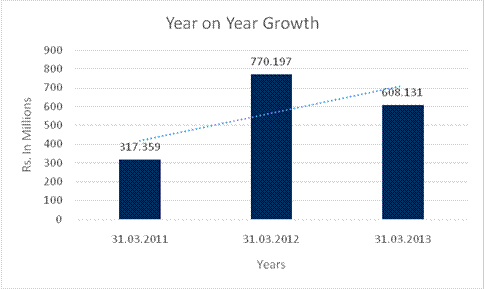
YEAR-ON-YEAR GROWTH
|
Year
on Year Growth |
31.03.2011 |
31.03.2012 |
31.03.2013 |
|
|
Rs.
In Millions |
Rs.
In Millions |
Rs.
In Millions |
|
Sales |
317.359 |
770.197 |
608.131 |
|
|
|
142.690 |
(21.042) |
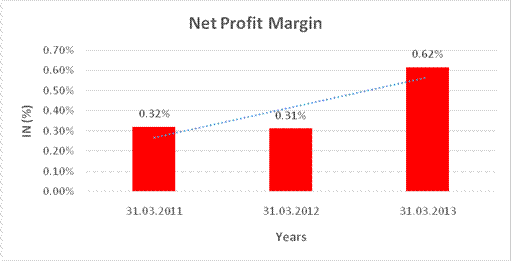
NET PROFIT MARGIN
|
Net
Profit Margin |
31.03.2011 |
31.03.2012 |
31.03.2013 |
|
|
Rs.
In Millions |
Rs.
In Millions |
Rs.
In Millions |
|
Sales
|
317.359 |
770.197 |
608.131 |
|
Profit |
1.017 |
2.413 |
3.746 |
|
|
0.32% |
0.31% |
0.62% |
LOCAL AGENCY FURTHER INFORMATION
|
Sr. No. |
Check List by Info
Agents |
Available in Report (Yes / No) |
|
1] |
Year of Establishment |
Yes |
|
2] |
Locality of the firm |
Yes |
|
3] |
Constitutions of the firm |
Yes |
|
4] |
Premises details |
Yes |
|
5] |
Type of Business |
Yes |
|
6] |
Line of Business |
Yes |
|
7] |
Promoter's background |
Yes |
|
8] |
No. of employees |
Yes |
|
9] |
Name of person contacted |
Yes |
|
10] |
Designation of contact person |
Yes |
|
11] |
Turnover of firm for last three years |
Yes |
|
12] |
Profitability for last three years |
Yes |
|
13] |
Reasons for variation <> 20% |
---------------------- |
|
14] |
Estimation for coming financial year |
No |
|
15] |
Capital in the business |
Yes |
|
16] |
Details of sister concerns |
No |
|
17] |
Major suppliers |
Yes |
|
18] |
Major customers |
Yes |
|
19] |
Payments terms |
Yes |
|
20] |
Export / Import details (if applicable) |
Yes |
|
21] |
Market information |
---------------------- |
|
22] |
Litigations that the firm / promoter involved in |
---------------------- |
|
23] |
Banking Details |
Yes |
|
24] |
Banking facility details |
Yes |
|
25] |
Conduct of the banking account |
---------------------- |
|
26] |
Buyer visit details |
---------------------- |
|
27] |
Financials, if provided |
Yes |
|
28] |
Incorporation details, if applicable |
Yes |
|
29] |
Last accounts filed at ROC |
Yes |
|
30] |
Major Shareholders, if available |
Yes |
|
31] |
Date of Birth of Proprietor/Partner/Director, if available |
Yes |
|
32] |
PAN of Proprietor/Partner/Director, if available |
No |
|
33] |
Voter ID No of Proprietor/Partner/Director, if available |
No |
|
34] |
External Agency Rating, if available |
Yes |
INDEX OF CHARGES: NO
CHARGES EXIST FOR THE COMPANY
TRADE REFERENCES
- Sri Sai Vijay Laxmi Catton Mills
- Kohinoor Trxtile Mill, Pakistan
PRESS
RELEASE:
COTTON PRICING BEST LEFT TO
THE MARKET
The Government should not intervene at the behest of
textile mills.
Prices of popular cotton
varieties in India have spiked by 7-8 per cent in February-March 2013 due to
bullishness of the domestic and overseas market. Textile mills are crying,
“wolf” and seeking Government intervention to rein in this escalation. There
are many stakeholders in cotton business — farmers, aggregators, ginners,
traders, government trading entities such as Cotton Corporation of India (CCI)
and NAFED, merchant exporters, mills, skilled and unskilled labour.
The supply-demand matrix
and market volatility are inherently interwoven. High demand benefits producers
when prices go up, and signals them to produce more. But it discounts interests
of consumers in the short run. When demand diminishes, lower values discourage
higher production by producers; they are eventually losers and consumers the
beneficiaries - again in the short term.
Finally, the market
finds its equilibrium, if allowed to operate freely. That is the way a commodity
cycle runs. Therefore, any ad hoc
Government intervention in its own policies can hamper the functioning of
markets, which may not be fair to all stakeholders.
Higher MSP for farmers
The CACP’s (Commission for
Agriculture Costs and Prices) kharif report of 2012-13 noted that “Despite
record production, exports are booming and country has low stocks of cotton;
akin to an excess demand situation. Market price during October 2011-February
2012 was
Rs. 4362/quintal. So a high MSP will not have an inflationary
impact”.
It, therefore,
recommended and Government agreed to fix an MSP of Rs. 3600/quintal for
medium staple (MS) and
Rs. 3900/quintal for long staple which were 28.5 per cent (Rs
2800) and 18 per cent (Rs 3300/quintal) above last year’s MSP.
Ginned cotton output in
2012-13 was 33 million bales (of 170 kg each) against last year’s 35.3 million
bales. Despite this price incentive, overall production dropped by two million
bales, partly due to poor monsoons in Gujarat and Maharashtra. The textile
industry accepted 18-28 per cent higher MSP (due to costlier fertiliser and
farm labour) without a whimper but is now threatened by 7-8 per cent demand
driven inflation!
A November 2, 2012,
press release of the Ministry of Textiles stated “The Cotton Advisory Board has
estimated consumption at 260 lakh bales and an exportable surplus at 70 lakh
bales (on January 23, 2013, it estimated exportable surplus at 80 lakh bales).
Although domestic consumption is showing increasing trends, the sharp decline
in global trade and increase in world stocks have imposed a downward stress on cotton prices, which is
reflected in Indian cotton markets also”. (emphasis added.)
Price stabilisation
The local market
remained bearish and below MSP in October-November 2012. Mills stayed away
anticipating further price decline for speculative profits; then,
traders/exporters came to the rescue of falling prices and CCI/NAFED stepped in
to cover 2.2 million bales at MSP.
The November 2 press
statement also said “that price stabilisation operations would be taken up to
alleviate farmer distress
(emphasis added) both by Cotton Corporation of India and NAFED in coming
months”. With progressive consumption, price stabilisation operations and exports
on track, surpluses are now squeezed and market has logically ascended in
February 2013.
Private industry and
trade generally sermonise that Government should not be in the business of
business. But at the drop of a hat, they see “God” in government and seek its
intermediation for survival, citing local labour and its employment. Industry
has now pleaded that stocks accumulated by CCI/NAFED be destocked at subsidised rates to cool the market.
Disposal by CCI
Going by the very
concept of MSP, it is designed to help farmers rather than the industry.
Cereals are bought at MSP by the Food Corporation of India to alleviate the
risk of farmers. These cereals are then sold to the domestic trade and for
export through domestic or international tenders or at Open Market Sale Scheme
(OMSS) price at the absolute discretion of the Government for best price
realisation.
Subsidised schemes for
APL/BPL beneficiaries cannot be applied in the case of textile mills. For
cotton, the same principle of disposal may be the guiding factor. CCI/NAFED may
sell cotton domestically or for export through a tendered mechanism to industry
and trade at a time when it can realise the best value. They also have the
option of undertaking exports directly. Assuming that acquisition cost of
Sankar 6 “ginned” variety by CCI is about Rs. 35000/candy
(1candy=356 kg each) and is disposed at Rs. 39000/candy, the
profitability is 11 per cent less its carrying cost.
If the market is poised
for a bullish view due to likely tightness in US cotton crop for 2013-14, the
profitability of CCI can be further augmented in coming months. After all,
Sankar 6 variety had seen a high of Rs. 61000/candy in
February/March 2011. An informed decision is needed to liquidate CCI inventory
in a phased manner for optimising value realisation, rather than to destock all
fibre en masse. Should
policymakers succumb to the pressure of the mills and depress market prices
suddenly, not only will CCI/NAFED nurse losses but farmers (still holding 7-8
million bales), ginners, stockists, and exporters will be wiped out. Lower
production of Kapas may be seen in 2013-14 with elevated prices. If cotton
market crashes, CCI could be left with contracted but un-lifted stocks by its
buyers, compounding losses as in 2011-12.
Mills might have erred,
but can cover their immediate requirements from the domestic market or through
imports from African countries (Tanzania, Zambia, Zimbabwe, etc.). Imports will
be foreign-exchange neutral due to higher export intensity of both cotton and yarn.
The Government cannot underwrite potential losses of mills by underselling
cotton cheaper.
Assistance to mills
In September 2012, the
Ministries of Textiles and Finance gave a Rs. 35000-crore
restructuring loan to mills to help them overcome their cash starvation; this
was in the wake of the financial crisis in 2011 when world market plunged from
$2/lb. to 88c/lb.
The RBI is reviewing the
NPAs of some of these mills for financial accommodation extended in 2008-09.
The Textile Upgradation Fund Scheme (TUFS) is already in place. The Government
has attempted to bail out textile mills twice in the last five years.
The solution to the
textile industry's woes is to usher in labour sector reforms, ensure constant
availability of power, and do value addition towards fabrics/ garments. If
China and Bangladesh can have a thriving garments industry by importing raw
cotton from India, why can't India? Gujarat has announced a mantra of ‘farm to
fibre to fabric to fashion to foreign’. The Rest of India needs to learn from
that vision.
As for the macro policy
environment, trading policies have made India the world’s second largest
exporter of cotton (next to US) because all stakeholders are active
participants.
There is no need to tinker
with pre-defined policy, neither is it feasible to bend and mend with daily
market volatility which shall remain in all commodities.
COTTON EXPORT REGISTRATIONS RISE ON HOPES OF
CHINESE DEMAND
Chennai, Feb. 15:
Cotton exports are
showing signs of recovery with registrations for shipments jumping 20 lakh
bales since the beginning of the year.
According to sources,
registration for cotton exports has increased to 58 lakh bales from 38 lakh
bales. However, cotton trade and analysts say that it may be less than 50 lakh
bales only.
Sources said that
exporters are now buying half of the two lakh bales (of 170 kg) that are
arriving daily in the market. While the Cotton Corporation of India is
procuring some 40,000 bales, domestic textile mills are buying 60,000 bales.
However, views of cotton
prices looking are unanimous. Currently, the Shankar-6 variety that is in
demand for exports is quoting at Rs. 35,000 for a candy of 356 kg.
“Till January end, 42-43
lakh bales had been registered for exports. Maybe, it could have touched 50
lakh bales,” said A. Ramani, a cotton trade analyst.
“We are not sure if so
much would have been registered because if that is a case, we would be seeing
unusual movement. That doesn’t seem to be happening,” said Anand Poppat,
Secretary of Saurashtra Ginners Association.
Chinese import
Ramani said exporters
could be buying ahead of the annual import quota that China would release soon
after the Chinese New Year.
“China will be releasing
an import quota of 682,000 tonnes under the tariff rate quota and Indian cotton
could get a sizeable chunk of it,” Ramani said.
China has to
compulsorily release the tariff quota under which cotton imports would be
imposed with 1 per cent Customs duty.
“Otherwise in the normal
course, China imposes 40 per cent duty,” said Poppat.
“Still Indian cotton is
cheaper compared with the prices in the domestic market there,” he said.
Currently, cotton in
Chinese domestic market costs around 19,000-20,000 yuan a tonne. In comparison,
the landed cost of Indian cotton after paying the Customs duty is 17,000 yuan.
“Besides, Pakistan and Bangladesh are seeking some 35 lakh bales. This is
something that can keep prices firm,” Poppat said. Ramani said exporters to
China are taking a calculated risk by buying stocks and moving it to bonded
warehouses in China. “Some Chinese buyers with deep pockets have bought Indian
cotton and moved them closer to their shores,” he said.
On the other hand, a
sizeable quantity of cotton from the US has also been moved close to the
Chinese shores.
“Export buying is
keeping the market firm though there is no flare-up in prices,” Ramani said.
Chinese trick helps
Indian spinners
There is also a shift in
strategy by Chinese textile industry that has begun buying cotton yarn.
“This is because it is
advantageous to import cotton yarn rather than raw cotton. The industry has to
pay 13 per cent value-added tax in China for buying raw cotton. They need not
pay for importing yarn,” said Ramani.
According to sources,
spinning units here are making a margin of at least $1 a kg. “It may not be
true in the case of all units. China is good at negotiating deals. They are
buying 30s count yarn for $3.20 a kg against $5.60 a kg a few days ago,” Ramani
said.
“Also, there is no duty
on yarn imports in China,” said Poppat. The Chinese order is mainly helping
only units to the north of the peninsula. “Power crisis in the South is
affecting spinners,” Ramani said.
A spinning unit having
captive power unit has to spend Rs. 20-30 a kg for a kg of yarn.
Otherwise, it costs
Rs. 4-5 a kg only.
“Mills in North India
are definitely gaining from the yarn export,” Ramani said, adding, “exports are
fantastic and volumes are excellent.”
Sources said that yarn
exports could be a record one billion kg. Already, over 800 million kg have
been exported. This is far higher than the 720 million kg in 2011 when the
Centre imposed a ban on cotton yarn exports.
Besides, domestic
support is helping spinning mills to run at 85-90 per cent capacity.
“In view of the brisk
activity, consumption estimate of cotton may be raised by the Cotton Advisory
Board,” said Ramani.
There is, however, one
spot of bother. “The cloth market is yet to pick up,” said Ramani.
CMT REPORT (Corruption, Money Laundering & Terrorism]
The Public Notice information has been collected from various sources
including but not limited to: The Courts,
1] INFORMATION ON
DESIGNATED PARTY
No exist designating subject or any of its beneficial owners,
controlling shareholders or senior officers as terrorist or terrorist
organization or whom notice had been received that all financial transactions
involving their assets have been blocked or convicted, found guilty or against
whom a judgement or order had been entered in a proceedings for violating
money-laundering, anti-corruption or bribery or international economic or
anti-terrorism sanction laws or whose assets were seized, blocked, frozen or
ordered forfeited for violation of money laundering or international
anti-terrorism laws.
2] Court Declaration :
No records exist to suggest that subject is
or was the subject of any formal or informal allegations, prosecutions or other
official proceeding for making any prohibited payments or other improper
payments to government officials for engaging in prohibited transactions or
with designated parties.
3] Asset Declaration :
No records exist to suggest that the property or assets of the subject
are derived from criminal conduct or a prohibited transaction.
4] Record on Financial
Crime :
Charges or conviction
registered against subject: None
5] Records on Violation of
Anti-Corruption Laws :
Charges or investigation
registered against subject: None
6] Records on Int’l
Anti-Money Laundering Laws/Standards :
Charges or
investigation registered against subject: None
7] Criminal Records
No
available information exist that suggest that subject or any of its principals
have been formally charged or convicted by a competent governmental authority
for any financial crime or under any formal investigation by a competent
government authority for any violation of anti-corruption laws or international
anti-money laundering laws or standard.
8] Affiliation with
Government :
No record
exists to suggest that any director or indirect owners, controlling
shareholders, director, officer or employee of the company is a government
official or a family member or close business associate of a Government
official.
9] Compensation Package :
Our market
survey revealed that the amount of compensation sought by the subject is fair
and reasonable and comparable to compensation paid to others for similar
services.
10] Press Report :
No press reports / filings exists on
the subject.
CORPORATE GOVERNANCE
MIRA INFORM as part of its Due Diligence do provide comments on
Corporate Governance to identify management and governance. These factors often
have been predictive and in some cases have created vulnerabilities to credit
deterioration.
Our Governance Assessment focuses principally on the interactions
between a company’s management, its Board of Directors, Shareholders and other
financial stakeholders.
CONTRAVENTION
Subject is not known to have contravened any existing local laws,
regulations or policies that prohibit, restrict or otherwise affect the terms
and conditions that could be included in the agreement with the subject.
FOREIGN EXCHANGE RATES
|
Currency |
Unit
|
Indian Rupees |
|
US Dollar |
1 |
Rs.62.16 |
|
|
1 |
Rs.103.44 |
|
Euro |
1 |
Rs.85.27 |
INFORMATION DETAILS
|
Information
Gathered by : |
SVA |
|
|
|
|
Report Prepared
by : |
NKT |
SCORE & RATING EXPLANATIONS
|
SCORE FACTORS |
RANGE |
POINTS |
|
HISTORY |
1~10 |
3 |
|
PAID-UP CAPITAL |
1~10 |
4 |
|
OPERATING SCALE |
1~10 |
4 |
|
FINANCIAL CONDITION |
|
|
|
--BUSINESS SCALE |
1~10 |
4 |
|
--PROFITABILIRY |
1~10 |
3 |
|
--LIQUIDITY |
1~10 |
3 |
|
--LEVERAGE |
1~10 |
3 |
|
--RESERVES |
1~10 |
3 |
|
--CREDIT LINES |
1~10 |
3 |
|
--MARGINS |
-5~5 |
-- |
|
DEMERIT POINTS |
|
|
|
--BANK CHARGES |
YES/NO |
NO |
|
--LITIGATION |
YES/NO |
NO |
|
--OTHER ADVERSE INFORMATION |
YES/NO |
NO |
|
MERIT POINTS |
|
|
|
--SOLE DISTRIBUTORSHIP |
YES/NO |
NO |
|
--EXPORT ACTIVITIES |
YES/NO |
YES |
|
--AFFILIATION |
YES/NO |
NO |
|
--LISTED |
YES/NO |
NO |
|
--OTHER MERIT FACTORS |
YES/NO |
YES |
|
DEFAULTER |
|
|
|
--RBI |
YES/NO |
NO |
|
--EPF |
YES/NO |
NO |
|
|
|
|
|
TOTAL |
|
30 |
This score serves as a reference to assess
SC’s credit risk and to set the amount of credit to be extended. It is
calculated from a composite of weighted scores obtained from each of the major
sections of this report. The assessed factors and their relative weights (as
indicated through %) are as follows:
Financial
condition (40%) Ownership
background (20%) Payment
record (10%)
Credit history
(10%) Market trend (10%) Operational size
(10%)
RATING EXPLANATIONS
|
RATING |
STATUS |
PROPOSED CREDIT LINE |
|
|
>86 |
Aaa |
Possesses an extremely sound financial base with the strongest
capability for timely payment of interest and principal sums |
Unlimited |
|
71-85 |
Aa |
Possesses adequate working capital. No caution needed for credit transaction.
It has above average (strong) capability for payment of interest and
principal sums |
Large |
|
56-70 |
A |
Financial & operational base are regarded healthy. General unfavourable
factors will not cause fatal effect. Satisfactory capability for payment of
interest and principal sums |
Fairly Large |
|
41-55 |
Ba |
Overall operation is considered normal. Capable to meet normal
commitments. |
Satisfactory |
|
26-40 |
B |
Capability to overcome financial difficulties seems comparatively
below average. |
Small |
|
11-25 |
Ca |
Adverse factors are apparent. Repayment of interest and principal sums
in default or expected to be in default upon maturity |
Limited with full
security |
|
<10 |
C |
Absolute credit risk exists. Caution needed to be exercised |
Credit not
recommended |
|
-- |
NB |
New Business |
-- |
This report is issued at your request without any
risk and responsibility on the part of MIRA INFORM PRIVATE LIMITED (MIPL) or
its officials.