MIRA
INFORM REPORT
|
Report Date : |
13.05.2014 |
IDENTIFICATION DETAILS
|
Name : |
STATE BANK OF |
|
|
|
|
Registered
Office : |
State
Bank Bhavan, Central Office, 8th Floor, Madame Cama Marg, Nariman
Point, Mumbai – 400021, |
|
|
|
|
Country : |
|
|
|
|
|
Financials (as
on) : |
31.03.2013 |
|
|
|
|
Year of Establishment : |
1806 |
|
|
|
|
Capital
Investment / Paid-up Capital : |
Rs.6840.340 Millions |
|
|
|
|
Legal Form : |
Subject
is a Public Sector Commercial Bank Owned by the Government of India. The
Bank's Shares are Listed on the Stock Exchanges. |
|
|
|
|
Line of Business
: |
Banking
Activities. |
|
|
|
|
No. of Employees
: |
Information Decline by the management |
RATING & COMMENTS
|
MIRA’s Rating : |
Aaa (87) |
|
RATING |
STATUS |
PROPOSED CREDIT LINE |
|
|
>86 |
Aaa |
Possesses an extremely sound financial base with the strongest
capability for timely payment of interest and principal sums |
Unlimited |
|
Maximum Credit Limit : |
USD 3900000000 |
|
|
|
|
Status : |
Excellent |
|
|
|
|
Payment Behaviour : |
Regular |
|
|
|
|
Litigation : |
Exist |
|
|
|
|
Comments : |
Subject is a one of oldest and the largest bank in India. It is a well-established
and reputed bank having excellent track record. The ratings continue to reflect the SBI’s dominant market position in
the Indian banking industry, strong resource profile, and adequate
capitalization. Further ratings also reflects continued strong support that
the bank is expected to receive from its majority owner, the Government of
India. Trade relations are reported as praiseworthy. Business is highly
active. Payments are reported to be regular and as per commitments. The bank can be considered good for normal business dealings at usual
trade terms and conditions. |
NOTES :
Any query related to this report can be made
on e-mail : infodept@mirainform.com
while quoting report number, name and date.
INDIAN ECONOMIC OVERVIEW
US investment bank
Goldman Sachs has upgraded its outlook on Indian markets as it expects
positive impact of the election cycle.
India’s economy may
grow 4.7 % in the current financial year, lower than the official estimate of
4.9 %, Fitch Rating said. The global rating agency expects the economy to pick
up in the next two financial years.
Global ratings
agency Standard & Poor said increasing focus by India Inc on lowering debt
is likely to improve their credit profiles.
Singapore (1.1
million Indian tourists in 2012), Thailand (one million), the United Arab
Emirates ().98 million) and Malaysia ().82 million) emerged as the preferred
holidays hotspots for Indians. The total figure is expected to increase to 1.93
million by 2017, according to the latest Eurmonitor international report.
There is a $29.34 bn
outward foreign direct investment by domestic companies between April and
January of 2013/14 which has seen some signs of recovery according to a Care
Ratings report.
There are 264 number
of new companies being set up every day on average during 2014. Most of them
are registered in Mumbai. India had 1.38 million registered companies at the
end of January, 2014.
Twitter like messaging
service Weibo Corporation has filed to raise $ 500 million via a US initial
public offering. Alibaba, which owns a stake in Weibo is expected to raise
about $ 15 billion New York this year in the highest profile Internet IPO since
Facebook’s in 2012.
Bharti Airtel has
raised Rs.2,453.2 crore (350 million Swiss Francs) by selling six-year bonds at
a coupon rate of three per cent and maturing in 2020. This is the largest ever
bond offering by an Indian company in Swiss Francs. Bharat Petroleum Corporation
raised 175 million Swiss Francs by selling five year bonds at 2.98 % coupon
rate in February.
Indian Oil
Corporation plans to invest Rs 7650 crore in setting up a petrochemical complex
at its almost complete Paradip refinery in Odhisha in three to four years. The
company board is set to consider the setting up of a 700000 tonne per annum
polypropylene plant at an estimated cost at Rs.3150 crore.
Global chief
information officers at gathering in Bangalore in April to meet Indian startups
at an event called Tech50 Watchout for Little Eye Labs-Facebook type deals in
the making.
EXTERNAL AGENCY RATING
|
Rating Agency Name |
CARE |
|
Rating |
Tier II Bonds (Basel III Compliant): “AAA” |
|
Rating Explanation |
Highest degree of safety and carry lowest credit
risk. |
|
Date |
13.01.2014 |
RBI DEFAULTERS’ LIST STATUS
Subject’s name is not enlisted as a defaulter
in the publicly available RBI Defaulters’ list.
EPF (Employee Provident Fund) DEFAULTERS’ LIST STATUS
Subject’s name is not enlisted as a defaulter
in the publicly available EPF (Employee Provident Fund) Defaulters’ list as of
31-03-2012.
INFORMATION DECLINED
Management non-cooperative (Tel. No.: 91-22-22740841/ 842)
LOCATIONS
|
Registered/ Corporate Office : |
State Bank Bhavan, Central
Office, 8th Floor, Madame Cama Marg, Nariman Point, Mumbai –
400021, Maharashtra, India |
|
Tel. No.: |
91-22-22830535/ 22883888/ 22022678/ 22740841-48 |
|
Fax No.: |
91-22-22855348 |
|
E-Mail : |
|
|
Website : |
|
|
|
|
|
Central Office : |
State Bank Bhavan, P. B. No. 12, |
|
Tel No.: |
91-22-22022426 |
|
Fax No.: |
91-22-22852708/ 22040073/ 2385139 |
|
|
|
|
Local Boards : |
Located
at : ·
Kolkata ·
Mumbai ·
Chennai ·
New Delhi ·
Lucknow ·
Ahmedabad ·
Hyderabad ·
Patna ·
Bhopal ·
Bhubaneshwar ·
Chandigarh ·
Guwahati ·
Bangalore |
DIRECTORS
As on 31.03.2013
|
Name : |
Mr. Pradip Chaudhari |
|
Designation : |
Chairman |
|
|
|
|
Name : |
Mr. Hemant G. Contractor |
|
Designation : |
Managing Director |
|
|
|
|
Name : |
Mr. Diwakar Gupta |
|
Designation : |
Managing Director |
|
|
|
|
Name : |
Mr. A. Krishna Kumar |
|
Designation : |
Managing Director |
|
|
|
|
Name : |
Mr. S. Vishvanathan |
|
Designation : |
Managing Director |
|
|
|
|
Name : |
Mr. S. Venkatachalam |
|
Designation : |
Director |
|
|
|
|
Name : |
Mr. D. Sundaram |
|
Designation : |
Director |
|
|
|
|
Name : |
Mr. Parthasarathy Iyengar |
|
Designation : |
Director |
|
|
|
|
Name : |
Mr. Thomas Mathew |
|
Designation : |
Director |
|
|
|
|
Name : |
Mr. Jyoti Bhushan Mohapatra |
|
Designation : |
Workmen Employee Director |
|
|
|
|
Name : |
Mr. S.K. Mukherjee |
|
Designation : |
Officer Employee Director |
|
|
|
|
Name : |
Dr. Rajiv Kumar |
|
Designation : |
Director |
|
|
|
|
Name : |
Mr. Deepak Ishwarbhai Amin |
|
Designation : |
Director |
|
|
|
|
Name : |
Mr. Harichandra Bahadur Singh |
|
Designation : |
Director |
|
|
|
|
Name : |
Mr. Rajiv Takru |
|
Designation : |
Director |
|
|
|
|
Name : |
Mr. Urjit R. Patel |
|
Designation : |
Director |
KEY EXECUTIVES
COMMITTEES OF THE BOARD
|
Executive
Committee of the Central Board (ECCB) |
Mr. R. Sridharan -Managing Directors Mr. Hemant G. Contractor Mr. Diwakar Gupta Mr. A. Krishna Kumar Mr. S. Vishvanathan |
|
|
|
|
Audit
Committee of the Board (ACB) |
Mr. S. Venkatachalam, Director – Chairman of the Committee Mr. D. Sundaram, Director – Member Mr. Thomas Mathew, Director – Member Dr. Rajiv Kumar, Director –Member Mr. Rajiv Takru, GOI Nominee – Member Dr. Urjit R. Patel, RBI Nominee – Member Mr. Hemant G. Contractor, MD and GE (NB) –Member (Ex-Officio Mr. A. Krishna Kumar, MD and GE (NB) –Member (Ex-Officio |
|
|
|
|
Risk
Management Committee of the Board (RMCB) |
Mr. Hemant G. Contractor, MD and GE (IB) – Member (Ex-Officio) Chairman of the Committee Mr. Diwakar Gupta, MD and CFO-Member (Ex-Officio) Mr. S. Venkatachalam, Director – Member Mr. D. Sundaram, Director – Member Mr. Thomas Mathew, Director – Member Dr. Rajiv Kumar, Director – Member Mr. Deepak I. Amin, Director – Member |
|
|
|
|
Shareholders’/Investors’
Grievance Committee of the Board (SIGCB) |
Mr. S. Venkatachalam, Director– Chairman of the Committee Mr. Thomas Mathew, Director – Member Dr. Rajiv Kumar, Director – Member Mr. Harichandra Bahadur Singh, Director – Member Mr. Hemant G. Contractor, MD and GE(IB) – Member (Ex-Officio) Mr. S. Vishvanathan, MD and GE(A and S) - Member (Ex-Officio) |
|
|
|
|
Special
Committee of the Board of Directors for Monitoring of
Large Value Frauds |
Mr. Diwakar Gupta, MD and CFO-Member (Ex-Officio) - Chairman of the Committee Mr. S.Vishvanathan, MD and GE(A and S) - Member (Ex-Officio) Mr. S. Venkatachalam, Director – Member Mr. Parthasarathy Iyengar, Director – Member Mr. Thomas Mathew, Director – Member Dr. Rajiv Kumar, Director – Member Mr. Deepak I. Amin, Director – Member Mr. Harichandra Bahadur Singh, Director – Member |
|
|
|
|
Customer
Service Committee of the Board (CSCB) |
Mr. A. Krishna Kumar, MD and GE(NB) – Member (Ex-Officio) - Chairman of the Committee Mr. S. Vishvanathan, MD and GE(A and S) - Member (Ex-Officio) Mr. S. Venkatachalam, Director – Member Mr. Thomas Mathew, Director – Member Mr. Harichandra Bahadur Singh, Director – Member Mr. Jyoti Bhushan Mohapatra, Director – Member Mr. S. K. Mukherjee, Director – Member |
|
|
|
|
IT Strategy
Committee of the Board (ITSC) |
Mr. D. Sundaram, Director - Chairman of the Committee Mr. S. Venkatachalam, Director – Member Mr. Parthasarathy Iyengar, Director – Member Mr. Deepak I . Amin, Director – Member Mr. Diwakar Gupta, MD and CFO - Member (Ex-Officio) Mr. A. Krishna Kumar, MD and GE(NB) – Member (Ex-Officio) |
|
|
|
|
Remuneration
Committee of the Board |
Mr. Rajiv Takru, GOI Nominee – Member (Ex-Officio) Dr. Urjit R. Patel, RBI Nominee – Member (Ex-Officio) Mr. S. Venkatachalam, Director – Member Mr. D. Sundaram, Director – Member |
|
|
|
|
Board Committee to
Monitor Recovery (BCMR) |
Mr. Pratip Chaudhuri, Chairman Mr. Hemant G. Contractor, MD and GE(IB) – Member Mr. Diwakar Gupta, MD and CFO – Member Mr. A. Krishna Kumar, MD and GE(NB) – Member Mr. S. Vishvanathan, MD and GE (AandS) – Member Mr. Rajiv Takru, GOI Nominee – Member (Ex-Officio) |
MEMBERS OF LOCAL BOARD:
|
Ahmedabad |
Mr. S. A. Ramesh Rangan Chief General Manager (Ex-Officio) |
|
|
|
|
Bangalore |
Mr. Ashwini Mehra Chief General Manager (Ex-Officio) |
|
|
|
|
Bhopal |
Mr. Dinesh K. Khara Chief General Manager (Ex-Officio) Mr. Ramesh Warlyani Mr. G. P. Gupta Mr. Manohar Bothra |
|
|
|
|
Bhubaneswar |
Mr. Praveen Kumar Gupta Chief General Manager (Ex-Officio) |
|
|
|
|
Chandigarh |
Mr. N. Krishnamachari Chief General Manager (Ex-Officio) Mr. Vinod Bihari Sharma Smt. Ravinder Kaur |
|
|
|
|
Chennai |
Mrs. Varsha Purandare Chief General Manager (Ex-Officio) Mr. T. R. Loganathan |
|
|
|
|
Hyderabad |
Mr. Rakesh Sharma Chief General Manager (Ex-Officio) |
|
|
|
|
Kolkata |
Mr. Sunil Srivastava Chief General Manager (Ex-Officio) |
|
|
|
|
Lucknow |
Mr. Sudhir Dubey, Chief General Manager (Ex-Officio) Mr. Harichandra Bahadur Singh* Mr. Madan Mohan Shukla |
|
|
|
|
Mumbai |
Dr. J. N. Misra, Chief General Manager (Ex-Officio) Mr. S. Venkatachalam* Mr. D. Sundaram* Mr. Parthasarathy Iyengar* Mr. Thomas Mathew* Mr. S. M. Lodha |
|
|
|
|
Delhi |
Mr. Kajal Ghose, Chief General Manager (Ex-Officio) Dr. Rajiv Kumar* Mr. Deepak Ishwarbhai Amin* |
|
|
|
|
North Eastern |
Mr. Rajnish Kumar, Chief General Manager (Ex-Officio) Mr. Ashok Kumar Das |
|
|
|
|
Patna |
Mr. Jeevandas Narayan, Chief General Manager (Ex-Officio) Mr. Tanvir Akhtar Mr. Sanjay Mandal |
|
|
|
|
Kerala: |
Dr. M. Sreenatha Sastry, Chief General Manager (Ex-Officio) Mrs. Alphonsa John Mr. Sudhir Abraham Mr. Philip Mathew |
|
|
|
|
MEMBERS OF CENTRAL MANAGEMENT COMMITTEE: |
Mr. Pratip Chaudhuri, Chairman Mr. Hemant G. Contractor, Managing Director and Group Executive, (International Banking) Mr. Diwakar Gupta, Managing Director and Chief Financial Officer Mr. A. Krishna Kumar, Managing Director and Group Executive (National Banking) Mr. S. Vishvanathan, Managing Director and Group Executive (Associates and Subsidiaries) Mr. Shyamal Acharya, Deputy Managing Director and Group Executive (Mid Corporate) Mr. S. B. Nayar, Deputy Managing Director and Group Executive (Corporate Banking) Mr. R. Venkatachalam, Deputy Managing Director and Chief Credit and Risk Officer Mrs. Soundara Kumar, Deputy Managing Director and Group Executive (Stressed Assets Management) Mr. P. Pradeep Kumar, Deputy Managing Director and Group Executive (Global Markets) Mr. R. K. Saraf, Deputy Managing Director (Corporate Strategy and New Businesses) Mr. B. V. Chaubal, Deputy Managing Director and Corporate Development Officer Mr. S. K. Mishra, Deputy Managing Director and Chief Information Officer Mr. V. Murali, Deputy Managing Director (Inspection and Management Audit) |
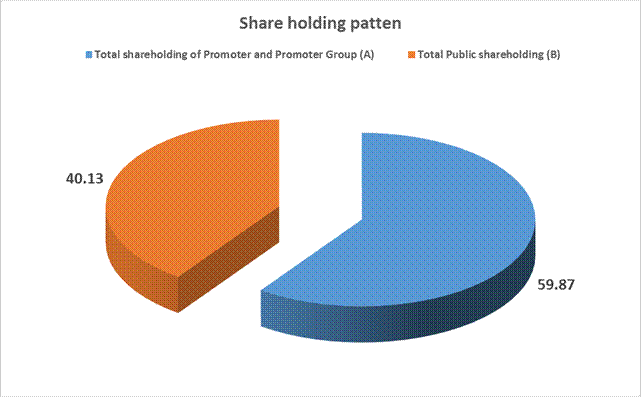
MAJOR SHAREHOLDERS / SHAREHOLDING PATTERN
As on 31.03.2014
|
Category of Shareholders |
No. of Shares |
Percentage of
Holding |
|
(A) Shareholding of
Promoter and Promoter Group |
|
|
|
|
|
|
|
|
437459825 |
59.87 |
|
|
437459825 |
59.87 |
|
|
|
|
|
Total shareholding
of Promoter and Promoter Group (A) |
437459825 |
59.87 |
|
(B) Public
Shareholding |
|
|
|
|
|
|
|
|
28205218 |
3.86 |
|
|
3963378 |
0.54 |
|
|
195316 |
0.03 |
|
|
123279228 |
16.87 |
|
|
72267285 |
9.89 |
|
|
227910425 |
31.19 |
|
|
|
|
|
|
16087356 |
2.20 |
|
|
|
|
|
|
41898788 |
5.73 |
|
|
1469340 |
0.20 |
|
|
5873804 |
0.80 |
|
|
1239893 |
0.17 |
|
|
873588 |
0.12 |
|
|
1000 |
0.00 |
|
|
333 |
0.00 |
|
|
487844 |
0.07 |
|
|
3271146 |
0.45 |
|
|
65329288 |
8.94 |
|
Total Public
shareholding (B) |
293239713 |
40.13 |
|
Total (A)+(B) |
730699538 |
100.00 |
|
(C) Shares held by
Custodians and against which Depository Receipts have been issued |
0 |
0.00 |
|
|
0 |
0.00 |
|
|
15873554 |
0.00 |
|
|
15873554 |
0.00 |
|
Total (A)+(B)+(C) |
746573092 |
0.00 |


Shareholding belonging to the category
"Promoter and Promoter Group"
|
Sl.No. |
Name of the
Shareholder |
Details of Shares held |
|
|
No. of Shares held |
As a % of grand
total (A)+(B)+(C) |
||
|
1 |
President of India |
43,74,59,825 |
58.60 |
|
|
Total |
43,74,59,825 |
58.60 |
Shareholding belonging to the category
"Public" and holding more than 1% of the Total No. of Shares
|
Sl. No. |
Name of the
Shareholder |
No. of Shares held |
Shares as % of Total
No. of Shares |
|
1 |
Life Insurance Corporation Of India |
111922056 |
14.99 |
|
2 |
HDFC Trustee Company Limited - HDFC Top 200 Fund |
12317048 |
1.65 |
|
|
Skagen Kon Tiki Verdipapirfond |
7481682 |
1.00 |
|
|
Total |
131720786 |
17.64 |
Shareholding belonging to the category
"Public" and holding more than 5% of the Total No. of Shares
|
Sl. No. |
Name(s) of the
shareholder(s) and the Persons Acting in Concert (PAC) with them |
No. of Shares |
Shares as % of
Total No. of Shares |
|
1 |
Life Insurance Corporation Of India |
111922056 |
14.99 |
|
|
Total |
111922056 |
14.99 |
Details of Locked-in Shares
|
Sl. No. |
Name of the
Shareholder |
No. of Shares |
Locked-in Shares as
% of |
|
1 |
President Of India |
3,60,45,243 |
4.83 |
|
2 |
President Of India |
1,29,88,697 |
1.74 |
|
3 |
President Of India |
37,72,07,200 |
50.53 |
|
4 |
President Of India |
1,12,18,685 |
1.50 |
|
|
Total |
43,74,59,825 |
58.60 |
Details of Depository Receipts (DRs)
|
Sl. No. |
Type of Outstanding
DR (ADRs, GDRs, SDRs, etc.) |
No. of Outstanding
DRs |
No. of Shares
Underlying |
Shares Underlying
Outstanding DRs as % of Total No. of Shares |
|
1 |
GDR |
79,36,777 |
1,58,73,554 |
2.13 |
|
|
Total |
79,36,777 |
1,58,73,554 |
2.13 |
BUSINESS DETAILS
|
Line of Business : |
Banking Activities |
GENERAL INFORMATION
|
No. of Employees : |
Information Decline by the management |
|
|
|
|
Bankers : |
Reserve Bank of India |
|
|
|
|
Banking
Relations : |
--- |
|
|
|
|
Auditors : |
· Todi Tulsyan and Company Patna, Patna Circle · SCM Associates Bhubaneshwar, Bhubaneshwar Circle · Singhi and Company Kolkata, North Eastern Circle · S. N. Nanda and Company New Delhi, Kerala Circle · T. R. Chadha and Company New Delhi, Mumbai Circle · S. Venkatram and Company Chennai, Chennai Circle · Prakash and Santosh Kanpur, Bhopal Circle · K. B. Sharma and Company Jammu, Chandigarh Circle · Add and Associates Kolkata, Ahmedabad Circle · V. P. Aditya and Company Kanpur, Lucknow Circle · S. Jaykishan Kolkata, Bengal Circle · Dhamija Sukhija and Company Srinagar, Delhi Circle · Sriramamurthy and Company Visakhapatnam, Hyderabad Circle · V. Soundararajan and Company Chennai, Bangalore Circle |
|
|
|
|
Domestic Banking Subsidiaries
: |
1. State Bank of Bikaner and Jaipur 2. State Bank of Hyderabad 3. State Bank of Mysore 4. State Bank of Pati ala 5. State Bank of Travancore |
|
|
|
|
Foreign Banking
Subsidiaries |
1. SBI (Mauriti us) Limited 2. State Bank of India (Canada) 3. State Bank of India (California) 4. Commercial Bank of India LLC, Moscow 5. PT Bank SBI Indonesia 6. Nepal SBI Bank Limited |
|
|
|
|
Domestic
Non-Banking Subsidiaries |
1. SBI Capital Markets Limited 2. SBI DFHI Limited 3. SBI Mutual Funds Trustee Company Private Limited 4. SBICAP Securities Limited 5. SBICAPS Ventures Limited 6. SBICAP Trustees Company Limited 7. SBI Cards and Payment Services Private Limited 8. SBI Funds Management Private Limited 9. SBI Life Insurance Company Limited 10. SBI Pension Funds Private Limited 11. SBI – SG Global Securities Services Private Limited 12. SBI Global Factors Limited 13. SBI General Insurance Company Limited 14. SBI Payment Services Private Limited |
|
|
|
|
Foreign Non-Banking
Subsidiaries |
1. SBICAP (UK) Limited 2. SBI Funds Management (Internati onal) Private Limited 3. SBICAP (Singapore) Limited |
|
|
|
|
Jointly Controlled
Entities : |
1. GE Capital Business Process Management Services Private Limited 2. C-Edge Technologies Limited 3. Macquarie SBI Infrastructure Management Pte. Limited 4. Macquarie SBI Infrastructure Trustees Limited 5. SBI Macquarie Infrastructure Management Private Limited 6. SBI Macquarie Infrastructure Trustees Private Limited 7. Oman India Joint Investment Fund – Management Company Private Limited 8. Oman India Joint Investment Fund – Trustee Company Private Limited |
|
|
|
|
Associates : |
Regional Rural
Banks 1. Andhra Pradesh Grameena Vikas Bank 2. Arunachal Pradesh Rural Bank 3. Kaveri Grameena Bank 4. Chhatti sgarh Gramin Bank 5. Deccan Grameena Bank 6. Ellaquai Dehati Bank 7. Meghalaya Rural Bank 8. Krishna Grameena Bank 9. Langpi Dehangi Rural Bank 10. Madhyanchal Gramin Bank 11. Malwa Gramin Bank 12. Mizoram Rural Bank 13. Marudhara Gramin Bank 14. Nagaland Rural Bank 15. Parvati ya Gramin Bank (upto 14.02.2013) 16. Purvanchal Gramin Bank 17. Samasti pur Kshetriya Gramin Bank (upto 14.10.2012) 18. Saurashtra Gramin Bank 19. Utkal Grameen Bank 20. Utt arakhand Gramin Bank 21. Vananchal Gramin Bank 22. Vidisha Bhopal Kshetriya Gramin Bank (upto 07.10.2012) Others 1. SBI Home Finance Limited 2. The Clearing Corporati on of India Limited 3. Bank of Bhutan Limited |
CAPITAL STRUCTURE
As on 31.03.2013
Authorised Capital :
|
No. of Shares |
Type |
Value |
Amount |
|
|
|
|
|
|
5000000000 |
Equity Shares |
Rs.10/- each |
Rs. 50000.000 millions |
|
|
|
|
|
Issued Capital :
|
No. of Shares |
Type |
Value |
Amount |
|
|
|
|
|
|
684117046 |
Equity Shares |
Rs.10/- each |
Rs. 6841.170 Millions |
|
|
|
|
|
Subscribed & Paid-up Capital :
|
No. of Shares |
Type |
Value |
Amount |
|
|
|
|
|
|
684033971 |
Equity Shares |
Rs.10/- each |
Rs. 6840.340 Millions |
|
|
|
|
|
[The above includes 1,65,21,526 (Previous Year 1,69,77,498) Equity Shares represented by 82,60,763 (Previous Year 84,88,749) Global Depository Receipts]
FINANCIAL DATA
[all figures are
in Rupees Millions]
ABRIDGED BALANCE
SHEET
|
CAPITAL AND
LIABILITIES |
31.03.2013 |
31.03.2012 |
31.03.2011 |
|
SHAREHOLDERS FUNDS |
|
|
|
|
Share Capital |
6840.340 |
6710.448 |
6349.990 |
|
Reserves & Surplus |
981996.514 |
832801.610 |
643510.442 |
|
|
|
|
|
|
Deposits |
12027395.743 |
10436473.623 |
9339328.130 |
|
Borrowings |
1691827.136 |
1270055.680 |
1195689.550 |
|
Other
Liabilities and Provision |
954550.670 |
809150.946 |
1052483.893 |
|
|
|
|
|
|
TOTAL |
15662610.403 |
13355192.307 |
12237362.005 |
|
|
|
|
|
|
ASSETS |
|
|
|
|
|
|
|
|
|
Cash and balances
with Reserve Bank of |
658304.104 |
540759.386 |
943955.020 |
|
Balance with Banks and Money at call and short notice |
489897.541 |
430872.263 |
284786.457 |
|
Investments |
3509272.716 |
3121976.103 |
2956005.690 |
|
Advance |
10456165.531 |
8675788.901 |
7567194.480 |
|
Fixed Assets |
70050.222 |
54665.492 |
47641.893 |
|
Others Assets |
478920.289 |
531130.162 |
437778.465 |
|
|
|
|
|
|
TOTAL |
15662610.403 |
13355192.307 |
12237362.005 |
PROFIT & LOSS
ACCOUNT
|
PARTICULARS |
31.03.2013 |
31.03.2012 |
31.03.2011 |
|
INCOME |
|
|
|
|
Interests Earned |
1196570.990 |
1065214.534 |
813943.638 |
|
Others Income |
160348.433 |
143514.457 |
158245.942 |
|
TOTAL |
1356919.423 |
1208728.991 |
972189.580 |
|
|
|
|
|
|
EXPENDITURE |
|
|
|
|
Interests Expended |
753257.965 |
632303.687 |
488679.561 |
|
Operating Expenses |
292844.223 |
260689.921 |
230154.326 |
|
Provision and Contingencies |
169767.386 |
198662.497 |
170710.503 |
|
TOTAL |
1215869.574 |
1091656.105 |
889544.390 |
|
|
|
|
|
|
PROFIT |
|
|
|
|
Net Profit for the year |
141049.849 |
117072.886 |
82645.190 |
|
Profit brought forward |
3.393 |
3.393 |
3.393 |
|
Profit and Loss Balance of e-SBI Commercial
and International Bank Limited. Transferred on Amalgamation |
0.000 |
57.115 |
-- |
|
TOTAL |
141053.242 |
117133.394 |
82648.583 |
|
|
|
|
|
|
APPROPRIATIONS |
|
|
|
|
|
|
|
|
|
Transfer to Statutory Reserve |
44178.608 |
35169.772 |
24793.557 |
|
Transfer to Capital Reserve |
191.696 |
143.769 |
96.089 |
|
Transfer to Revenue and Other Reserve (Including Transfer to Investment
Reserve Account for 2009-10 Rs.40.556 Millions) |
64532.604 |
55364.960 |
27298.659 |
|
Dividend |
|
|
|
|
Final Dividend Proposed |
28387.409 |
23486.569 |
19049.970 |
|
Tax on dividend |
3759.532 |
2964.931 |
2465.202 |
|
Loss on Amalgamation of State Bank of Indore |
0.000 |
0.000 |
8941.713 |
|
Balance carried over to Balance Sheet |
3.393 |
3.393 |
3.393 |
|
TOTAL |
141053.242 |
117133.394 |
82648.583 |
|
|
|
|
|
|
Basic Earning per Share |
210.06 |
184.31 |
130.16 |
|
|
|
|
|
|
Diluted Earnings Per Share |
210.06 |
184.31 |
130.16 |
LOCAL AGENCY FURTHER INFORMATION
CURRENT MATURITY
OF LONG TERM DEBT DETAILS: NOT AVAILABLE
|
Sr. No. |
Check List by Info
Agents |
Available in Report (Yes / No) |
|
1] |
Year of Establishment |
Yes |
|
2] |
Locality of the firm |
Yes |
|
3] |
Constitutions of the firm |
Yes |
|
4] |
Premises details |
No |
|
5] |
Type of Business |
Yes |
|
6] |
Line of Business |
Yes |
|
7] |
Promoter's background |
No |
|
8] |
No. of employees |
Yes |
|
9] |
Name of person contacted |
No |
|
10] |
Designation of contact person |
No |
|
11] |
Turnover of firm for last three years |
Yes |
|
12] |
Profitability for last three years |
Yes |
|
13] |
Reasons for variation <> 20% |
---------------------- |
|
14] |
Estimation for coming financial year |
No |
|
15] |
Capital in the business |
Yes |
|
16] |
Details of sister concerns |
Yes |
|
17] |
Major suppliers |
No |
|
18] |
Major customers |
No |
|
19] |
Payments terms |
No |
|
20] |
Export / Import details (if applicable) |
No |
|
21] |
Market information |
---------------------- |
|
22] |
Litigations that the firm / promoter involved in |
Yes |
|
23] |
Banking Details |
Yes |
|
24] |
Banking facility details |
No |
|
25] |
Conduct of the banking account |
---------------------- |
|
26] |
Buyer visit details |
---------------------- |
|
27] |
Financials, if provided |
Yes |
|
28] |
Incorporation details, if applicable |
Yes |
|
29] |
Last accounts filed at ROC |
Yes |
|
30] |
Major Shareholders, if available |
No |
|
31] |
Date of Birth of Proprietor/Partner/Director, if available |
No |
|
32] |
PAN of Proprietor/Partner/Director, if available |
No |
|
33] |
Voter ID No of Proprietor/Partner/Director, if available |
No |
|
34] |
External Agency Rating, if available |
Yes |
CASH DETAILS
|
Presentation Date:- |
27/02/2014 |
|
Lodging No: |
WPL/554/2014 |
Filling Date: |
27/02/2014 |
|
Petitioner:- |
M/S. ASIS LOGISTICS LIMITED AND 7ORS. |
Respondent:- |
STATE BANK OF INDIA |
|
Petn.Adv.:- |
LAW FRAME (I4205) |
Resp.Adv.:- |
LALITKUMAR JAIN AND COMPANY (404) |
|
District:- |
Mumbai |
|
|
|
Bench:- |
Division |
|
|
|
Status:- |
Pre-Admission |
Category:- |
Writ Petition (others) |
|
Next Date:- |
23/07/2014 |
Stage:- |
For Rejection Fresh (Original Side Matters) |
|
Coram:- |
According To Sitting List According To Sitting List |
|
|
|
Last Date:- |
01/04/2014 |
Stage:- |
FOR ADMISSION - FRESH [ORIGINAL SIDE MATTERS] |
|
Last Coram:- |
HON'BLE SHRI JUSTICE V.M. KANADE HON'BLE SHRI JUSTICE A. K. MENON |
|
|
|
Act :- |
Securitisation and Reconstruction of Financial Assets Act |
MANAGEMENT DISCUSSION
AND ANALYSIS
ECONOMIC BACKDROP AND
BANKING ENVIRONMENT
GLOBAL ECONOMY
The global economy has entered 2013 with reduced downside risks, as the US fiscal cliff and afl are up of the euro area crisis being averted. With downside risks receding, it is now worth considering the prospects for an improvement in global growth. As per the IMF forecast, global economy is forecast to grow by 3.3% in 2013 (vis-a-vis 3.2% in 2012). The housing sector in the US economy – the epicentre of the downturn - has made considerable progress in repairing its balance sheet. Policy makers in the euro zone area have reconfirmed their commitment to resolution of the euro crisis by working on a common euro area integration framework. Going forward, US economy is supposed to gain continued traction, even though a sustained pick-up in euro area may take a while to materialize. Growth in emerging market and developing economies is projected at 5.3% in 2013 (vis-a-vis 5.1% in 2012). On the whole, an environment of progressively lower global tail risks and continued structural reforms in various economies will favourably impact global growth outlook in 2013.
OUTLOOK
During FY14, economic activity is expected to show a modest improvement over last year, with a pick-up likely in the second half of the year. Conditional upon a normal monsoon, agricultural growth could return to trend levels.
The outlook for industrial activity remains subdued, with a recovery more likely in the later part of FY14. In this context, the National Manufacturing Policy (NMP) sets the framework for revitalization of manufacturing sector of the country. Rapid implementation of the NMP and the creation of National Manufacturing and Investment Zones can be seedbeds not only for manufacturing, but also concomitant development of the service sector. Additionally, continued monetary accommodation by RBI will also support industrial growth. A declining inflation trend, as being witnessed currently will also help to prop up consumption demand to a certain extent as well.
Infrastructure however, remains an area for improvement. It is imperative that they continue to support a meaningful public-private partnership with inclusiveness and sustainability as essential prerequisites for sustained growth rates over the next decade.
On the inflation front, they believe average level of inflation will trend downwards and may be closer to RBI comfort level in FY14, based on the emerging trend of continued soft international commodity prices, and provided the rupee remain stable. Such a development will also reduce the worries on CAD during the course of FY14. Additionally, capital inflows to emerging economies, including India are likely to remain buoyant in FY14 reflecting benign monetary conditions in developed economies.
They also believe that fiscal consolidation will remain a priority, with Government clearly making its intent clear several times. It may be noted that the Government plans to trim the fiscal deficit to 3% by 2016-17.
Exports are unlikely to post significant gains in FY14, as the global economy will witness only a gradual recovery. The import elasticity of their growth remains significant and going forward they would need to develop a new paradigm of a low-carbon economy. It is now becoming clear that the centre of gravity of the world economy is shifting to South and for trade, investment and finance India may have to look more and more to the South.
On the aggregate, they believe GDP to grow by about 5.5%-6% during FY14. Faster resolution of projects currently awaiting regulatory clearances may provide the much needed impetus to domestic investment and reinvigorate growth prospects.
Finally, amidst growth slowdown in emerging Asian economies, fears of a “middle-income trap” are now growing rapidly. Empirical evidences (IMF, 2013) suggest that sound economic institutions, favourable demographics and trade structures can all reduce the likelihood of such a growth trap. Though India is currently poised favourably on demographics and trade structures, the current slowdown may just provide the right occasion for India to move from physical resource intensive growth to human resource intensive growth. Over the medium term, India’s opportunity for accelerated development lies in human capital formation. There are huge opportunities for expansion of service sector provided they can accelerate their programs for skill formation. This is all the more important given that services sector currently contributes to more than 60% of India’s GDP.
The fact that India has a young population also implies that Indian banks are moving towards a right mix of assisted and self serviced channels to provide a rich, unified and consistent banking experience.
For example, Green Channel Counters are the latest innovation in the series for banks to serve its customers in an eco friendly atmosphere. With continued regulatory changes, Indian banks will have more of opportunities in the area of financial inclusion, rural banking and mobile banking in their quest for a new banking paradigm.
FINANCIAL PERFORMANCE
Profit
The Operating Profit of the Bank for 2012-13 stood at Rs. 310817.200 Millions as compared to Rs.315735.400 Millions in 2011-12 registering a marginal decline of 1.56%. The Bank has posted a Net Profit of Rs.141049.800 Millions for 2012-13 as compared to Rs.117072.900 Millions in 2011-12 registering a growth of 20.48%.
While Net Interest Income recorded a growth of 2.40%, the Other Income increased by 11.73%, Operating Expenses increased by 12.33% attributable to higher staff cost and other expenses.
Net Interest Income
The Net Interest Income of the Bank registered a growth of 2.40% from Rs.432910.800 Millions in 2011-12 to Rs. 443313.000 Millions in 2012-13. This was due to higher growth in the advances and investment portfolios.
The gross interest income from global operations correspondingly rose from Rs. 1065214.500 Millions to Rs. 1196571.000 Millions during the year registering a growth of 12.33%.
Interest income on advances in India registered an increase from Rs. 773091.500 Millions in 2011-12 to Rs. 857822.600 Millions in 2012-13 due to higher volumes. The average yield on advances in India has declined from 11.05% in 2011-12 to 10.54% in 2012-13. Interest income on advances at foreign offices has grown by 26.17%.
Income from resources deployed in treasury operations in India increased by 13.82% mainly due to higher average resources deployed. The average yield, which was 7.51% in 2011-12, has increased to 7.54% in 2012-13.
Total interest expenses of global operations increased from Rs. 632303.700 Millions in 2011-12 to Rs. 753258.000 Millions in 2012-13. Interest expenses on deposits in India during 2012-13 recorded an increase of 20.88% compared to the previous year, whereas the average level of deposits in India grew by 14.3%. The average cost of deposits has consequently increased from 5.95% in 2011-12 to 6.29% in 2012-13.
Non-Interest Income
Non-interest income stood at Rs. 160348.400 Millions in 2012-13 as against Rs. 143514.500 Millions in 2011-12 registering an increase of 11.73%.
During the year, the Bank received an income of Rs. 7155.100 Millions (Rs. 7673.500 Millions in the previous year) by way of dividends from Associate Banks/ subsidiaries and joint ventures in India and abroad.
Operating Expenses
There was an increase of 8.29% in the Staff Cost from Rs. 169740.400 Millions in 2011-12 to Rs. 183809.000 Millions in 2012-13. Other Operating Expenses registered an increase of 19.89% mainly due to increase in expenses on rent, taxes and lighting, advertisement and publicity, law charges, postage, telegrams and telephones, insurance and miscellaneous expenditure.
Operating Expenses, comprising both staff cost and other operating expenses, have registered an increase of 12.33% over the previous year.
I CORE OPERATIONS
I. 1. Customer
Service
Their vision statement unambiguously spells out the centricity of the customer in the Bank’s business strategies and operations. A multi -tiered structure of committees constantly review existing services and suggest improvements. Important issues raised by these Committees and action taken thereon, as well as analysis of the consolidated data for customer grievances for all Circles are placed before the Customer Service Committee of the Board every quarter, to identify common systemic and policy issues that require rectification.
The Bank has a well defined and documented Grievance Redressal Policy which provides for:
• A dedicated Customer Care Cell
• Bank’s Web based Complaint Management System (CMS) has been redesigned and launched as a single online Grievance Lodging and Redressing System for the Bank. Customers can lodge their complaints through various channels including written complaint at branch, by calling at the toll free number of Bank’s Contact Centre 1800 425 3800 / 1800 11 22 11, online through Bank’s website www.sbi.co.in, sending SMS message ‘UNHAPPY’ to number 8008 202020 etc. All complaints are lodged through CMS and are acknowledged with a unique ticket number immediately on lodging. Bank has mandated and has been able to redress a majority of the customer grievances within a maximum period of three weeks of receipt, as against the time limit of 30 days prescribed in the BCSBI Code. All ATM related complaints of Bank customers are redressed within the RBI-prescribed 7 days.
• While the Bank strives to achieve the highest standards in customer service, it has also put in place a Board approved Compensation Policy to compensate the customer financially in the unlikely event of any slippage in services extended. The Policy ensures that the aggrieved customer is compensated without having to ask for it.
• Over 70% of the recommendations of the Damodaran Committee have already been implemented.
• Suitable structure has been put in place at the Branches, Regional Business Offices, Local Head Offices, Administrative offices and at the Corporate Centre of the Bank for handling requests and appeals under the RTI Act 2005, Consumer Forums, etc.
I.2. BUSINESS GROUPS
A. GLOBAL MARKETS
OPERATIONS
Global Markets Unit manages the Bank’s rupee liquidity, compliance with reserve requirements and investment portfolio of the Bank besides offering a wide range of foreign exchange and hedging products to the customers. It also offers portfolio management services to large retirement funds. It constantly endeavors to keep liquidity at the optimum level while maximizing the returns.
During the year the Reserve Bank of India reduced Cash Reserve Ratio by 0.75% and Statutory Liquidity Ratio by 1%. The Bank therefore had ample liquidity during the year. This offered the Bank opportunities to invest in short term money market instruments like Commercial Papers (CPs) and Certificate of Deposits (CDs). Bank invested over Rs. 750000.000 Millions in CDs and CPs at an average spread of 65 to 75 basis points (BPs) over applicable yield on Treasury Bills, thereby earning additional interest income.
The yield on Government securities declined during the year responding to the Repo rate cuts of 100 BPs by the RBI and moderation in inflation. Yield on the benchmark 10 year Central Government securities declined from 8.63% in April 2012 to 7.99% by 31st March 2013. This reduction in yield offered opportunities for churning the SLR portfolio of the Bank.
They booked more than Rs. 2000.000 Millions from active management of the portfolio. Despite a fall of 64 BPs in yield on Government Securities, the return on SLR portfolio was only marginally lower by 5 basis points, because of dynamic rebalancing of the portfolio.
As the yields were in a declining trend, the Bank decided to increase duration of the portfolio. The Bank purchased long dated Securities of over Rs. 350000.000 Millions of Central and State Governments. The Bank also invested in high yielding corporate bonds aggregating to more than Rs. 100000.000 Millions during the year. The gross corpus of funds under the management of Global Markets was close to Rs. 4 lac Crores as on 31st March 2013.
Equities witnessed a turnaround this year led by improved economic situation in the USA, reduced stress in Eurozone, pro-reform measures of the Indian Government as well as rate cuts by the RBI. While the Bank remains invested in multiple strategic positions, Global Markets increased proprietary trading in Nifty stocks. The Bank also used Mutual fund schemes for liquidity management and higher returns. The Bank made a profit of about Rs. 6000.000 Millions from Equity and Mutual Funds.
The Bank continued to explore opportunities in the area of private equity and venture capital fund investments. During the year, investments of Rs. 1000.000 Millions were made in different venture capital funds. Bank also partially exited from one of the private equity investments during FY13 resulting in a profit in excess of Rs. 500.000 Millions at an IRR of more than 45.25%. Due to favorable valuations and market conditions, Bank also exited from another strategic investment resulting in a profit of Rs. 650.000 Millions. The Bank also participated in the primary market and disinvestment programme of the Government of India through Offer For Sale (OFS) route by investing about Rs. 13000.000 Millions.
Global Markets provides foreign exchange solutions to the customers in all currencies for managing their currency flows and hedging risks through options, swaps, forwards and bullion services. Given the large presence across the country, the Bank provides a world class technology platform to seamlessly process currency flows between its customers through branches and the dealing room. This is part of their continuous endeavour to provide enhanced services to their customers. The Treasury Marketing outfits complement this by engaging with customers to provide them with inputs about markets and suggest products to suit their requirements. The Bank earned income of over Rs. 16000.000 Millions from covering the customer flows in foreign exchange, hedging, gold, and proprietary trading, registering an increase of 18%. Global Markets also manages FCNR (B) corpus of the Bank and provides funds for Export Finance in Foreign Currency and FCNR (B) loans.
The Bank was also ranked number one in the “Best for FX options” and “Best for FX Products and Services” categories and number two in the “Best for FX Research and Market Coverage” category in the same poll. These help us to consistently improve their service to their esteemed customers.
The Bank provides portfolio management services to an array of retirement funds in the country consistently giving better returns. The Portfolio Management Services section, with an AUM of over Rs. 2380000.000 Millions, has consistently outperformed private sector peers in generating returns for the EPFO funds. Last year, the bank was adjudged the best fund manager for EPFO.
B. CORPORATE BANKING
GROUP
The Bank’s Corporate Banking Group consists of three Strategic Business Units viz. Corporate Accounts Group, Transaction Banking Unit and Project Finance and Leasing SBU.
B.1. Corporate
Accounts Group (CAG)
CAG is the dedicated SBU for handling the large credit portfolio of the Bank. The SBU has Offices in 6 regional centers viz. Mumbai, Delhi, Chennai, Kolkata, Hyderabad and Ahmedabad headed by General Managers. The business model of CAG is centered around the Relationship Management concept and each client is mapped to a Relationship Manager who spear-heads a cross-functional Client Service Team. The Relationship strategy is anchored on delivering integrated and comprehensive solutions to the clients, including structured products, within a strict Turn-Around-Time. The principal objective of the strategy is to make SBI the first choice of the top corporate thereby deepening the wallet-share and improving the Return on Capital Employed. A sustained Account Planning exercise with rigorous review by senior management sets the pace for the Relationship Management in CAG.
While the Fund Based outstandings of CAG constitute 16% of total credit portfolio of the Bank, CAG also handles about 59% of the domestic forex business of the Bank. During the year, CAG handled several high value deals for clients such as Essar Oil, HDFC, Hindalco Industries, Essar Steel, Power Grid Corporation, DVC, JSW Energy etc.
In an environment of depreciating Rupee, several CAG clients prefer to borrow in foreign currency. Significant International business is thus originated from CAG clients like PSU Oil Majors and groups such as Tata, Reliance, Essar, Adani, JSW, etc. In the highly competitive area of Acquisition Funding also, CAG has registered a strong presence through deals such as Hinduja’s acquisition of Houton International Inc, USA and B C Jindal group’s acquisition of Exxon Mobil’s global BOPP business.
In the backdrop of the robust growth of CAG, it is proposed to open additional Offices in major centres beginning with Mumbai and Delhi. All CAG Office sare now headed by General Managers in line with the rising business profile of the Group and to facilitate interaction at senior level with due regard to the high profile of the CAG clients. Keeping in view the critical importance of the delivery platform, the incumbency of the Chief Operating Officer has also been upgraded to the level of Dy. General Manager in all CAG units.
B.2. Transacti on
Banking Unit (TBU)
TBU oversees Cash Management Products, Trade Finance and Supply Chain (Dealer / Vendor) Finance and has expanded its activity during the last three years.
· Cash Management Product (CMP), collection services in the Bank are now offered through 1219 authorized branches located at 722 Centres. Besides usual cheque and cash collections, Doorstep Banking for cash / cheque pickup and collections for Public Issues (IPO/Bonds), are being handled by CMP. Payment services comprising Dividend Warrants, Multi City Cheques, IOIs and e-payment are extended through all branches. CMP Centre has integrated the State Government Payments Systems with the Core Banking Solution of the Bank providing Centralized Payment Solutions to the State Governments in their ambitious National e-Governance Project (NeGP). SBI was the first Bank to use NPCI Aadhar Payment Bridge System (APBS) for transferring LPG subsidy based on Aadhar Numbers.
·
e-Trade SBI, a web-based portal, to enhance
customer comfort and provide easy access to trade finance services, by enabling
customers to lodge Letters of Credit, Bank Guarantees and Bills
Collection/negotiation requirements online from any corner of the world has
been well received, with 1326 Corporates registered under e-Trade SBI as on
31.03.2013 and more than 11000 transactions per month through e-Trade platform.
·
e-VFS ( Electronic Vendor Financing
Scheme) and e-DFS ( Electronic Dealer Financing Scheme) are fully automated and
secured products, designed to ensure efficient management of working capital
cycle of the corporates and sustained growth and profitability of business
partners.
·
Financial Institutions Business
Unit (FIBU), a
dedicated vertical created for capturing potential business opportunities from
financial institutions, has been able to bring on board 15 Insurance Companies,
26 Mutual Fund Companies, 45 NBFCs and 15 Banks.
B.3. Project Finance
and Leasing SBU (PFSBU)
PFSBU deals with the approval and arrangement of funds for large projects in infrastructure sectors like power, telecom, roads, ports, airports, other urban infrastructure as also other non-infrastructure projects in sectors like metals, cement etc., with certain threshold on minmum project cost.
As on 31.03.2013, the portfolio of infrastructure projects under implementation with PFSBU involves Power projects with aggregate capacity of 52,862 MW; Telecom Projects serving 303 million subscribers; Road projects covering 5,386 kms; new Ports to handle 40 MTPA multi -purpose cargo and 1.2 million TEU of container capacity; Metro project in Hyderabad besides a host of projects in steel, cement, Urban Infra, CRE etc. During the year, a total (FB + NFB) of Rs.128840.000 Millions (Rs.154100.000 Millions in FY 12) were disbursed to these projects.
The Bank has constituted a panel of 21 eminent Consultants who are former CEOs/ Directors of leading PSUs with domain expertise in various important sectors. The expert panel has significantly enhanced the capability of PFSBU in evaluating the technoeconomic feasibility of projects in critical sectors like Power, Oil Refining, Metals, Fertilizers, Telecom etc.
C. MID CORPORATE
GROUP
Mid Corporate Group (MCG), through its 13 regional offices at Ahmedabad, Bangalore, Chandigarh, Chennai (2), Hyderabad, Indore, Kolkata, Mumbai (2), New Delhi (2) and Pune, has 60 branches as on 31.03.2013. During the year, the advances grew from Rs.1704420.000 Millions to Rs.2048530.000 Millions.
Looking to the expansion and growth in business, both in number and volumes, an additional Chief General Manager (CGM) was posted in October 2012 at the Mid Corporate Group, Corporate Centre. The distribution of work between the 2 CGMs is based on geographical lines, with one looking after Northern and Southern regions and the other Eastern and Western regions - assisting the DMD and Group Executive in handling the increased number of MCROs/MCG branches and the growing complexities of business. Similarly, an additional General Manager has been posted at Delhi, Mumbai and Chennai Regional Offices during 2012-13, with clear allocation of MCG branches and attendant responsibilities. The doubling of General Managers at these centres has provided customers with greater access to senior officials, and has also resulted in improved credit delivery - with greater thrust on attracting good quality new business. During the year, the incumbency of 16 Mid Corporate branches was upgraded from Assistant General Manager (AGM) to Deputy General Manger (DGM). With these branches now being headed by DGMs, instead of AGMs earlier, the customers would have more effective resolution of their credit and other related problems.
Account Management Team (AMT) Model, with manageable number of accounts in each team, has been implemented at all branches (214 AMTs), for better credit delivery and focused attention to individual accounts. In the AMT set-up, both pre and post-sanction formalities are handled by the same team - consisting of Relationship Manager, Credit Analyst and Service Officer, which helps in having a holistic view of the requirements of customers as also the underlying risks.
The MCG held several conclaves, essentially as brainstorming sessions with the key functionaries to understand and analyse the trends of business. The frank and detailed exchange of views between the top executives and the operating officials on the ground, in these conclaves, were extremely useful in planning business growth and asset management.
As a result of a concerted drive for selecting good quality assets by making pricing and other terms more attractive for top rated customers, the total percentage of assets above investment grade grew from 64.26% as on March 2012 to 68.31% as on March 2013.
The Group also assisted companies in India to acquire assets / companies overseas and provides support for such expansion plans, including by way of external loans to overseas subsidiaries/JVs (backed by LoCs) through the International Banking Group. Over the years, the Group has helped many such acquisitions by Indian companies in USA, Europe, Australia, Africa, etc.
Simultaneously, a conscious attempt was made to improve the asset quality through intense engagement with promoters of weak/stressed accounts. Consequently, the Non Performing Assets (NPAs) of MCG declined from Rs.197770.000 Millions as on December 2012 to Rs.184430.000 Millions as on March 2013, and NPAs as a percentage of total advances were not only contained but also significantly brought down in the last quarter of 2012-13.
The Mid Corporates have been more severely affected by the down-turn in economy - leading to deterioration in asset quality. The processes of appraisal/sanction, follow-up and supervision were, therefore, significantly beefed up. An additional position of General Manager (Restructuring) has also been created in the Group at Corporate Centre, in view of the recent increase in restructuring cases - both CDR and non-CDR. With these additions, the DMD has greater support from senior officials to look after customer relationships.
D.1 RURAL BUSINESS
UNIT
FINANCIAL INCLUSION:
· Bank has set up 38,480 BC Customer Service Points, through alliances both at national and regional level.
· SBI is offering various technological-enabled products, through Business Correspondents (BC) channel, such as, Savings Bank, RD, STDR, remittances and OD facilities.
· Opened 2.03 crores small accounts with simplified KYC.
· Bank has covered 12,931 FI villages (population >2000) and 7,600 FIP villages (population <2000).
· Transactions volume through BC Channel has grown 2.4 times during FY12-13 at Rs.130330.000 Millions over FY 11-12.
· Direct Benefit Transfer (DBT) Scheme successfully rolled out. SBI has Lead responsibility in 28 out of 121 DBT pilot districts. SBI has successfully completed 1.31 lac transactions amounting to Rs. 87.700 Millions as Sponsoring Bank, in addition to handling 0.41 lac transactions amounting to Rs. 70.800 Millions as Receiving Bank.
· Around 99% households covered and 9.85 lac accounts linked with Aadhaar in 43 pilot districts.
· Under Urban Financial Inclusion, 5,629 BC outlets have been set up in Urban/Metro centres to cater to the requirements of migrant labourers, vendors, etc. 157 lac remittance transactions for Rs. 69620.000 Millions were registered during FY 13.
D. 2 Personal Banking Business Unit
Domestic Deposits have grown by Rs. 947200.000 Millions with a growth of 15.8% and Advances by Rs. 105390.000 Millions with a growth rate of 13.23% as on 31 March 2013. CASA Deposit has grown by 16.89% and CASA Ratio as on 31.03.2013 is 47.5%.
NRI Services:
•During the year 2012-13, NRI Deposits have grown by Rs. 139220.000 Millions (22%) and reached a level of Rs. 771850.000 Millions as on 31.03.2013. Advances to NRIs recorded a growth of Rs. 4420.000 Millions (25%) during the financial year 2012-13, the level reached being Rs. 22400.000 Millions as on 31.03.2013. NRIs have invested in the schemes of SBIMF and SBI Life to the tune of Rs. 6960.000 Millions during the year.
•SBI was the principal sponsor of Pravasi Bharatiya Divas, a flagship event for NRI Diaspora from all over the world, organized by the Ministry of Overseas Indian Affairs, which was held in Kochi (Kerala) from 7th- 9thJanuary 2013.
•To achieve the status of the preferred NRI Bank, they have opened 16 new NRI Branches in India during the current financial year, taking the number of NRI branches to 69. These branches have an excellent ambience along with dedicated team of officials to serve NRI customers.
•SBI has started offering FCNR (B) deposits in 4 additional currencies viz. Swiss Franc (CHF), New Zealand Dollar (NZD), Swedish Krona (SEK) and Danish Krone (DKK) since September 2012.
The various Salary packages together have resulted in taking the total salary account Customer base to 70.79 lacs, i.e. a growth of 9.03 lac new accounts during the period 01.04.2012 to 31.03.2013. CASA in these accounts has gone up from Rs. 162210.000 Millions to Rs. 212620.000 Millions during this period. The incremental CASA of Rs. 50410.000 Millions represents 11.58 % of the incremental Personal Banking CASA of the Bank.
Auto Loans
SBI Auto Loans maintains its retail market leadership in car loan financing. The Auto Loan portfolio has grown by 35.48% during FY 2012- 13 in spite of near flat growth of passenger car market. The Bank has emerged as a clear market leader in Auto Loans with a market share of 22.25% amongst ASCB as on Mar’2013.
The Bank is currently offering car finance on “On Road Price” of the car, with the longest repayment period of 7 years, no pre-payment penalty, no advance EMI and at competitive interest rates. A new product “SBI Combo Loan Scheme” has been launched during the year for financing a car and a two-wheeler together (combined limit).
SBI has taken up various joint promotional activities with major car manufacturers like Maruti, Hyundai, Tata Motors, Ford, Mahindra and Mahindra, Toyota, and Mercedes during the financial year 2012-13.
Education Loans
SBI Education Loans has grown by 9.43% during FY 2012-13. SBI has a total exposure of Rs. 137510.000 Millions as on Mar 2013.
SBI Loan Scheme for Vocational Education and Training was launched in July 2012 and loans upto Rs. 0.100 Million are given under this scheme.
Maximum Loan Amount for Studies Abroad has also been increased to Rs. 3.000 Millions from the previous limit of Rs. 2.000 Millions.
In order to provide financial assistance to more students opting for higher education, the SBI Scholar Loan scheme has been extended to 114 institutes. The maximum loan amount under this scheme has also been enhanced to Rs. 3.000 Millions
Personal Loans
The Personal Loans Portfolio, which is the second largest in the Personal Banking Segment, has grown by Rs. 28600.000 Millions during FY 2012-13. It includes Loan against Securities, Loans against Properties, Gold Loan, etc. Of these, Xpress Credit and Loan against Time Deposits are two major products and have grown by Rs. 10020.000 Millions and Rs. 12170.000 Millions during FY 2012-13 respectively. The most notable growth has been in Gold Loan portfolio of Rs. 4800.000 Millions (96.94%) during FY 2012- 13.In order to further increase their market share in the ‘Loan against Deposit’ Scheme, they have reduced their rate of interest from 0.75% above the TD rate to 0.50% above the TD Rate, which is one of the lowest in the industry.
The Delivery Systems for loan products have been under constant focus. Retail Assets Centralized Processing Centres (RACPCs) have been opened up across the country, based on the volume, geographical spread and product focus to ensure uniformity in processing of all Retail loan proposals. This ensures smooth delivery to the customer and with the support of Loan Originating Soft ware (LOS) that currently takes care of Credit- related risks will enable customers, in future, the facility to track their application online. As on 31.03.2013, there were 60 RACPCs and 70 Retail Assets and Small and Medium Enterprises City Credit Centres (RASMECCs).
Some of the steps taken to reduce NPAs are:
• Risk Scoring Models have been developed for all P-Segment Loans on the basis of statistical models for objective assessment. Recently, the Auto Loan scoring model has been made tighter and more emphasis is now being given to Net Income of an individual. (For eg: The minimum income criterion for Auto Loans has been raised from Rs. 0.100 Million to Rs. 0.250 Million p.a.).
•Loan Origination Soft ware (LOS) usage (100% usage at RACPCs), and its integration with the Risk Scoring Model (RSM) and CIBIL check to take care of many process related risks.
• In view of the rising NPAs in Education Loans, PAN card of the student and co-borrower/guarantor has been made mandatory for all Education Loans. For existing Education Loans, a one-time exercise is planned to obtain the PAN card numbers. Instructions have been issued to all operating units to send Notices to borrower, co-borrowers and guarantors in case of default in Education Loans.
• Immediate action under SARFAESI, including seizure of cars for eligible cases.
• Instructions are in place for granting no further Retail Loans (except Education Loans) to the employees of those companies whose accounts are classified as NPAs.
D.3 Real Estate,
Habitat and Housing Development (RE, H and HD)
State Bank of India, the ‘Most Preferred Home Loan Provider’ with the largest Home Loan portfolio in the Banking Sector and market share of over 26% amongst All Scheduled Commercial Banks (ASCBs) :
During FY 2012-13, several initiatives were taken by the Bank to give an additional thrust to its Home Loan portfolio. Some of the important initiatives in this regard are as under:-
• The ‘Maximum Repayment Period’ permissible under NRI Home Loans Scheme has been increased from 25 years to 30 Years to align the same with the ‘Maximum Repayment Period’ under domestic Home Loans Scheme, imparting it with greater flexibility.
• The ceiling on financing Home Interiors/Furnishings, as part of the project cost, has been revised upwards from Rs.0.300 Million to Rs.0.600 Million subject to the amount expended towards Home Interiors/Furnishings being restricted to 10% of the Project Cost and the Maximum Loan Amount adhering to the stipulated Loan to Value (LTV) Ratio.
• Home Loan Interest Rates were reduced substantially w.e.f. 7th August, 2012 by reducing the spread over the Base Rate. With subsequent downward revisions in the Base Rate itself, the effective Interest Rate on Home Loans ultimately stood reduced to 9.95% p.a. for loans upto Rs.3.000 Millions and 10.10% p.a. for Home Loans above Rs.3.000 Millions as on 4thFebruary, 2013 rendering them very competitive and the lowest in the market.
• The premium of 0.25% p.a. applicable on Interest Rates under Commercial Real Estate (CRE) Home Loans has been waived to align the same with the prevailing Interest Rates on normal Home Loans.
• With a view to extend the benefit of lower rates of interest (both Fixed and Floating Interest) to their existing Home Loan customers paying relatively higher interest rates, an option to switch-over their loans to the current lower interest rates was made available on payment of a fee of 0.56% of the outstanding w.e.f. 21st September, 2012.
• A Special Takeover Campaign was launched from 1st September, 2012, assuring prospective customers, of a fixed Processing Fee of Rs. 1000/- on Home Loan Takeovers, irrespective of the loan amount. The Campaign was extended till 31st March, 2013 and provided their Bank with a competitive edge in the overall pricing of their Home Loan products.
• Term Assurance (Loan Protection) Cover (optional) is available to their Home Loan customers from SBI Life Insurance Company Limited through RiNnRaksha /Smart Shield/Saral Shield. The Bank provides additional loan for payment of the premium of the above policies on the same terms as those applicable to the underlying Home Loans.
D.3 SME BUSINESS UNIT
(SMEBU)
During the financial year 2012-13, the advances under SME Business Unit has registered year on year growth of 12.45%. The advances figures of SME Business Unit as on 31.03.2013 are as under.
Relationship Banking
:
Under
single window approach, the Bank is offering Relationship Banking to SME
Entrepreneurs. The strength of Relationship Managers (Medium Enterprises) was
augmented to 566 as on 31.03.2013 and mapped to ME units with credit limits
Rs.10.000 Millions
and above across the country. The advances portfolio under Relationship banking
as on 31.03.2013 is Rs. 1036190.000 Millions. For units having credit limits between Rs. 100.000 Millions to Rs. 10.000 Millions, Relationship Managers (SE)
have been posted to improve credit flow to Micro and Small Enterprises.
SME Credit City Centres
(SMECCC):
SMECCCs,
rolled out during 2004-05 as a part of BPR initiative, are centralized loan
processing centres for sanction of SME loans upto credit limit of Rs. 1.000 Millions. At present 78 SMECCCs and
58 RASMECCs across the country are functional. To further revamp the structure
and process of SMECCCs to enable consolidation of the Bank’s position in the
SME universe in the country a major exercise has been initiated in association
with renowned consulting group. The revamped process will be in place by
September 2013.
Specialized SME Branches:
To
provide specialized services to SME Entrepreneurs, 400 branches having
predominant share of SME advances in their portfolio are being branded as “SME
BRANCH” to define the identity of these branches with a common nomenclature and
to develop these branches as centres of excellence for SME loan delivery.
Credit Flow to Micro and
Small Enterprises under CGTMSE:
Bank
is extending collateral free lending up to Rs. 1.00 crores to MSE sector under
guarantee of CGTMSE. Additionally, to provide relief to these units Bank has
decided to absorb the guarantee charges payable to CGTMSE. The outstanding
under the guarantee scheme of CGTMSE is as under:
Project Uptech:
Bank
is providing consultancy support to SMEs for catalyzing Technology Upgradati on
in SME clusters with the objective of making the clusters more competitive
through increase in productivity and quality and reduction in costs. Since
inception of the initiative 1600 units have benefitted in 28 clusters.
Presently, three projects, Steel Structural Fabrication and Boiler Component
(Trichy), Fabrication Engineering (Jamshedpur and Nagpur) are going on.
Entrepreneurship Development
programme:
Bank has formulated a scheme for conduct of EDPs on an ongoing basis, in association with reputed national level EDP training institutes. To begin with, 4 centres were identified for conduct of EDPs on pilot basis during the year, viz. Ahmedabad (in association with EDI), Hyderabad (in association with NI-MSME), New Delhi (in association with NIESBUD) and Bhubaneswar (in associati on with SBI-RSETI, Jharsuguda). The target groups for the EDPs were mainly final year students of engineering / management colleges and educated youth. The total number of participants was 120. It is proposed to have EDP programmes on regular basis in all the Circles across the country during FY 2013-14.
E INTERNATIONAL
BANKING GROUP
Operation of Foreign
Offices
The asset level of foreign branches rose by 18%, from USD 35.826 bn in March 2012 to USD 42.146 bn in March 2013. During FY’13, net customer credit grew by 17% from USD 26.681 bn to USD 31.148 bn, customer deposits grew by 11%, from USD 12.075 bn to USD 13.374 bn. Net profit rose by 10% to USD 435.64 mn.
The number of foreign offices increased from 173 as on 31st March 2012 to 186 as on 31st March 2013 spread across 34 countries. The offices comprised of 51 branches, 7 Representative Offices, 107 offices of the six foreign banking subsidiaries and 21 other offices.
Resource Management
Bank’s Foreign Offices maintained comfortable liquidity position during the fiscal, despite volatile market conditions. In July 2012, Bank successfully priced a USD 1.25 Bn Bond issue, 144A/ Reg S transaction maturing in August 2017. Bank received overwhelming response across investor classes for the Bond, despite very difficult market conditions. Bilateral loans of different maturities worth USD 540 Mn were also raised during the fiscal. At Singapore, where the Bank has 7 branches and 24 ATMS, including ATMs at Changi Airport terminals 1, 2 and 3, retail deposits saw a 21% growth year-on-year. Their UK operations also scaled up its retail presence to achieve a retail deposit growth of 41% in the fiscal.
Remittance
Inward remittances grew from Rs. 614570.000 Millions in FY’12 to Rs. 698120.000 Millions in FY’13, clocking a growth of 14%. The Bank had a tie-up with 27 exchange companies and five banks in Middle-East countries for routing remittances through SBI. During the year, new remittance product ‘SBI Express Remit-Canada’ was launched exclusively for Canadian Dollar remittances. An Outward remittance product ‘RemXout’ was launched for SBI Internet Banking customers.
E-2 Domestic
Operations
Merchant Banking
The Bank retained its premier position as Mandated Lead Arranger and Book Runner for syndicated loans in Asia Pacific (excluding Japan but including Australia) for the sixth consecutive calendar year, in FY’13.
During FY-13, Bank acted as the Mandated Lead Arranger in 17 deals aggregating USD 6.442 Bn for several leading Indian corporates like IOCL, REC, NPCL, MRPL, Reliance Industries and Vedanta Resources Plc.
Apart from this, foreign currency term loans aggregating USD 3.68 bn were extended to Indian corporates on a bilateral basis. Further, 10 loans amounting to USD 229.04 mn were acquired through secondary market.
Fee income of USD 89.88 mn was earned from foreign currency term loans concluded during the year through syndication / bilateral deals.
Correspondent Relations
The Bank maintains correspondent banking arrangement with 429 reputed International Banks to extend seamless services to varied clients. These correspondent Banks are located in 118 countries.
The Bank also has 1,765 Relationship Management Application (RMA) arrangements with SWIFT, facilitating speedier flow of financial messages.
I.3. CORPORATE
STRATEGY AND NEW BUSINESSES
Emerging business areas, including tech-based products, are developed and launched by a dedicated department headed by a Dy. Managing Director. Progress on some of their key initiatives is detailed hereunder:
Debit Cards:
Debit Card spends of State Bank Group crossed Rs. 150000.000 Millions for FY 2012-13 which constitutes over 20% of total Debit Card spends in the industry. The Bank has been actively promoting Debit Card usage at Point of Sale/for e-Commerce. For the festive season from 16-Oct-2012 to 15-Nov-2012, the Bank ran a promotional Campaign called “Cracker of an Offer” where the Bank along with its subsidiary, SBI Card, tied up with a number of merchant partners to offer attractive discounts for State Bank Debit and Credit Card usage at their outlets/websites. With a view to increasing Debit Card activation, the Bank also ran special promotional offers for its Debit Cardholders with leading merchants of different merchant categories in the industry in coordination with SBI Card.
The Bank launched “State Bank Business Debit Card” for its corporate customers in two variants “Pride” and “Premium” on the occasion of Bank’s Day 2012. Till 31-March-2013, more than 86,000 Business Debit Cards have been issued. This product is being launched in Associate Banks shortly.
Prepaid Cards:
Bank’s
range of products include popular Rupee Prepaid Cards like Gift Card, General
Purpose Prepaid Card like eZ-Pay Card and Foreign Travel Card catering to
various payment needs of the customers.
Foreign Travel Card:
Foreign
Travel Card, now a CHIP based EMV Compliant Card, is available in eight
currencies, US Dollar (USD), Great Britain Pound (GBP), Euro, Canadian Dollar
(CAD), Australian Dollar (AUD), Japanese Yan (JPY), Saudi Riyal (SAR) and
Singapore Dollar (SGD), providing safety, security and convenience to overseas
travellers. Corporate variants of SBFTC have been introduced to cater to the
needs of Corporates. Sales for FY 2012-13 were to the tune of to USD 66.92
million.
eZ-Pay Cards
eZ-Pay
Cards are aligned with most of the social schemes of State and Central
Governments in addition to salary payments by Corporate entities, thus reaching
millions of households. Sales for FY 2012-13 were to the tune of to Rs.9319.200
Millions.
Co-branded Prepaid Cards for various Zones of Indian Railways and Federation of
Freight Forwarders’ Association in Indian (FFFAI) were rolled out during FY
2012-13.
Gift Cards
Gift
Cards remain the preferred option to customers to gift the ‘freedom of choice’
to their loved ones. Customers can create Gift Cards online. Sales registered
during FY 2012-13 was Rs.774.400 Millions. State Bank Achiever Card, a re-loadable corporate
incentive Card with a validity of 10 years for disbursement of
incentives/awards was rolled out during March-2013.
Green Channel Counter (GCC)
The ‘Green
Channel Counter’ facility is made available in 7052 branches. On an average,
the daily transactions routed through GCC are more than 1,00,000.
Self Service Kiosk (SSK)
As
on 31.03.2013, SSKs have been installed in 965 branches. On an average, SSKs
are recording more than 30,000 transactions on a daily basis.
Green Remit Card (GRC)
GRC,
a remittance card, was introduced on 02.01.2012 mainly to take care of the
large number of nonhome cash deposit transactions at their branches. A
cardholder can swipe the card at Green Channel Counter or in Cash Deposit
Machines and remit money to the beneficiary whose account number is mapped to
the card. Once the transaction is complete, both the remitter and beneficiary
get confirmation through SMS on their mobile phone. The Bank has issued
6,23,623 cards resulting into 8,08,830 cash deposit transactions as on
31.03.2013.
Mobile Banking and Wallet
Presently,
the Bank has a market share of around 65% in the transaction volume and over
36% in the transaction value. During the FY, financial transactions to the tune
of Rs.19330.000 Millions
were done through the service resulting in a total income of Rs.46.700 Millions. As on February 2013 SBI is
the market leader in terms of registered user base and number of transactions.
Efforts are in place to maintain the leadership position in this space.
The Bank has launched a full KYC mobile wallet under the brand name “State Bank MobiCash”. A variant of the same “State Bank MobiCash Easy”, a wallet which does not require completion of KYC formalities was launched in Mumbai, Delhi and Chandigarh on the 31st December, 2012. So far, around 14,500 wallets have been issued.
CONTINGENT
LIABILITIES
Rs. In Millions
|
Particular |
31.03.2013 |
31.03.2012 |
|
Claims against the bank not acknowledged as debts |
9582.339 |
9301.889 |
|
Liability for partly paid investments |
28.000 |
28.000 |
|
Liability on account of outstanding forward exchange contracts |
4719131.590 |
4049157.476 |
|
Guarantees given on behalf of constituents |
|
|
|
(a) In India |
954282.937 |
868533.393 |
|
(b) Outside India |
774816.157 |
840725.561 |
|
Acceptances, endorsements and other obligations |
1266725.677 |
1345405.899 |
|
Other items for which the bank is contingently liable |
1539222.386 |
1212901.125 |
WEBSITE DETAILS
PRESS RELEASE
STATE BANK OF INDIA
LAUNCHES TAB BANKING AND E-KYC
Mumbai, April 15, 2014: Mrs. Arundhati Bhattacharya, Chairman State Bank of India launched three digital banking facilities for the convenience of SBI customers. Two at the customer’s door step using TAB banking - one for customers opening Savings Bank accounts and another for Housing Loan applicants. The third is e-KYC (Know your Customer).
SBI will offer its valued customers the facility of opening accounts at their door step through Tab Banking. The sales staff of SBI will visit the customers at their home and using the tablets get the formalities completed for account opening like details of KYC and photographs of applicant. These will be loaded on the CBS and the account number will be sent to the customer through SMS/e-mail. This will provide convenience and time saving to the customer for opening accounts with SBI.
SBI will also offer TAB banking facility at the place of the Housing Loan applicant, for in-principle approval of home loan. The Home Loan Sales Team will visit the applicant and capture on the tablet KYC details, information on the income & deductions and details of the proposed property purchase (House/Flat). Based on the income data furnished and cost of the project, the applicant will be advised on the approximate housing loan amount eligible and the EMI amount. The applicant will get in principle approval for the proposed Housing Loan through email. The actual loan will be processed subsequently subject to usual formalities.
The facilities will be rolled out across the SBI network in a phased manner.
In a simple ceremony held at the Bank’s Corporate Centre, the applications viz. Account Opening, Housing Loan ‘in-principle’ approval and e-KYC Services were inaugurated by Smt. Arundhati Bhattacharya, Chairman of the Bank in the presence of other senior officials viz. Shri P. Pradeep Kumar, MD & GE(Corporate Banking Group),
Shri P.K. Malhotra, DMD (Operations), Shri N. Jambunathan, DMD & CIO, Sh. K. Ramachandran, CGM (Chief Technology Officer) and Shri K. Venugopal, CGM(Personal Banking).
'HIGH CREDIT AND LOW
DEPOSIT GROWTH CAN HIT SBI'S MARGINS'
In FY13, the banking
sector saw non-food credit growth of 14%, while deposit clocked growth 14.3%,
according to the RBI
Mumbai, May 8,
2013
If the State Bank of India (SBI) reports higher credit growth and lower deposit expansion during the current financial year, it could hit the bank’s margins, according to rating agency India Ratings. Such a scenario could also push the cost of funds for the country’s largest lender, the rating agency warned.
In the last financial year, SBI had reported 21 per cent growth in advances, while its deposits grew by 15 per cent, said India Ratings. In FY13, the banking sector saw non-food credit growth of 14 per cent, while deposit clocked growth 14.3 per cent, according to the Reserve Bank of India. The central bank has projected 14 per cent growth in deposits and 15 per cent in advances for the sector in FY14.
India Ratings said SBI’s high loan growth in FY13, if continued in FY14, with deposit accretion lagging, then it will lead to an increase in wholesale deposits. Further, the already-stretched loan-to-deposit ratio would limit the incremental margin gain on this account. This could negatively impact the cost of funds and thus margins, said India Ratings.
Funding has been SBI’s fundamental strength, supported by a strong stable retail deposit franchise. The domestic current account and savings account (Casa) deposit ratio stood at 45.5 per cent of the total deposits in December 2012 (Q3FY13) with savings account deposit at 38 per cent — the highest in the system, said the rating agency.
With 14,388 branches, high rural reach, and the status of the government’s flagship bank provide SBI with unmatched access to stable retail deposits, India Ratings noted. The funding cost has also benefitted from moderated loan growth in respect of its peers between FY10 and FY12, resulting in reduced reliance on wholesale funding, which partly funded the loan growth of peers.
The Casa deposits growth, however, has been moderating. While savings account growth has been impacted due to high interest rates in the system, current account deposits have declined sharply with the stretched working capital cycle of corporates and funds moving to liquid mutual funds.
SBI NEEDS CAPITAL UP TO
RS 30000.000 Millions FOR SUBSIDIARY’S MERGER
Friday, June 21, 2013
State Bank of India (SBI) today said it will require up to Rs 30000.000 Millions capital to merge one of its associate banks.
SBI will need Rs 10000.000 -30000.000 Millions in capital if it were to merge one of its subsidiaries with itself, its Chairman Pratip Chaudhuri said.
He was speaking to shareholders at the bank’s annual general meeting here.
The bank has appointed a committee headed by Managing Director S Vishwanath to look into the aspect of merging one of the five subsidiaries, he said.
The subsidiary to be merged with SBI has not been identified yet.
“The committee headed by Vishwanath is looking into all the aspects (of merger). That committee would report to the Board and then we will finalise the name (of associate to be merged),” Chaudhuri said after the meeting.
Asked which of the five — State Bank of Patiala, State Bank of Hyderabad (both unlisted), State Bank of Travancore, State Bank of Bikaner and Jaipur and State Bank of Mysore — will be merged in this round, Chaudhuri declined to give an answer, saying the Board will take a call based on the committee’s recommendation.
He also did not say whether a listed or an unlisted associate would be preferred for merger.
On SBI’s own capital raising plans, he said a decision in this regard will be firmed up by next month.
About the recent depreciation of rupee against the dollar, he said the slide in Indian currency was because of a global trend of money heading back to the US.
FOUR BANKERS IN FRAY
FOR NFL STAKE SALE
Tuesday, June 18,
2013
New Delhi: Four merchant bankers, including SBI Capital and Kotak Investment, are in race to manage the process of 7.64 percent stake sale in National Fertilisers (NFL), which may fetch around Rs 1480.000 Millions to the exchequer.
The four bankers -- IDBI Capital Market Services, Avendus Capital, SBI Cap and Kotak Investment Banking -- would be making presentation to the Department of Disinvestment (DoD) on June 25.
Earlier this month the DoD had invited expression of interest from merchant bankers with experience in public offerings/OFS to act as book running lead managers and to assist and advise government in the process.
The government plans to disinvest 7.64 percent stake, or over 3.74 crore shares, of NFL through Offer For Sale (OFS) route in the domestic market.
At the current market price of Rs 39.70 apiece, the 7.64 percent stake sale could fetch around Rs 1480.000 Millions to the exchequer.
At present, the government holds 97.64 percent stake in NFL.
An inter-ministerial panel, headed by Disinvestment Secretary, had cleared NFL stake sale last month.
The paid-up equity capital of the company, as on March 31, 2012 was Rs 4905.800 Millions.
The stake sale in NFL is part of DoD's effort to meet the minimum 10 percent public shareholding norm as stipulated by market regulator SEBI for PSUs.
The government uses the OFS route, popularly known as auction method, to divest its stake in PSUs that come in top 100 companies as per market capitalisation. It has already used the route to sell stake in Oil India, NTPC, NMDC and Hindustan Copper in last fiscal.
The government proposes to raise Rs 400000.000 Millions by way of disinvestment in the current fiscal. It has already lined up a host of companies, including Coal India, Indian Oil and Hindustan Aeronautics, for stake sale.
SBI, TATA MOTORS IN
TOP 100 TAX DEFAULTER'S LIST
SBI, Tata Motors and Indian Oil Corporation, among others figure in the list of top 100 tax defaulters in the country.
Disclosing the list in the Rajya Sabha, Minister of State for Finance S S Palanimanickam said in a written reply that top 100 tax defaulters owe to the exchequer whopping Rs 1.41 lakh crore. The Centre is taking various steps to recover the outstanding dues, he said.
Big players
While SBI owes Rs 3336.000 Millions, Tata Motors and Indian Oil Corporation have
to pay Rs 2065.000 Millions and Rs 2103.000 Millions to the treasury. BSNL has
a tax demand of about Rs 24170.000 Millions, NTPC Rs 6220.000 Millions. VSNL
Limited (now Tata Communications Limited) has a tax demand of about Rs 5055.000
Millions. Among corporates, Coca Cola India (Rs 6000.000 Millions), Baron
International (Rs 5890.000 Millions), Oracle Corporation (Rs 5580.000
Millions), Rolex Holding Limited (Rs 5580.000 Millions), Aaditya Luxury Hotels
(5640.000 Millions) and Reliance Energy (Rs 1760.000 Millions). Nokia, Daewoo
Motors, Bunge India Limited, Tata Industries, Satyam Computers and IBM Private
Limited are other companies which have been named on the list. Among Sahara
group companies, Sahara India and Sahara Airlines (now Jetlite) figure among
tax defaulters apart from Sahara India Financial Corporation Limited. He said
these demands also include those which are difficult to recover for various
reasons like demands notified under Special Court.
CMT REPORT (Corruption, Money Laundering & Terrorism]
The Public Notice information has been collected from various sources
including but not limited to: The Courts,
1] INFORMATION ON
DESIGNATED PARTY
No exist designating subject or any of its beneficial owners,
controlling shareholders or senior officers as terrorist or terrorist
organization or whom notice had been received that all financial transactions
involving their assets have been blocked or convicted, found guilty or against
whom a judgement or order had been entered in a proceedings for violating
money-laundering, anti-corruption or bribery or international economic or
anti-terrorism sanction laws or whose assets were seized, blocked, frozen or
ordered forfeited for violation of money laundering or international
anti-terrorism laws.
2] Court Declaration :
No exist to suggest that subject is or was
the subject of any formal or informal allegations, prosecutions or other
official proceeding for making any prohibited payments or other improper payments
to government officials for engaging in prohibited transactions or with
designated parties.
3] Asset Declaration :
No records exist to suggest that the property or assets of the subject
are derived from criminal conduct or a prohibited transaction.
4] Record on Financial
Crime :
Charges or conviction
registered against subject: None
5] Records on Violation of
Anti-Corruption Laws :
Charges or
investigation registered against subject: None
6] Records on Int’l Anti-Money
Laundering Laws/Standards :
Charges or
investigation registered against subject: None
7] Criminal Records
No
available information exist that suggest that subject or any of its principals
have been formally charged or convicted by a competent governmental authority
for any financial crime or under any formal investigation by a competent
government authority for any violation of anti-corruption laws or international
anti-money laundering laws or standard.
8] Affiliation with
Government :
No record
exists to suggest that any director or indirect owners, controlling
shareholders, director, officer or employee of the company is a government
official or a family member or close business associate of a Government
official.
9] Compensation Package :
Our market
survey revealed that the amount of compensation sought by the subject is fair
and reasonable and comparable to compensation paid to others for similar
services.
10] Press Report :
No press reports / filings exists on
the subject.
CORPORATE GOVERNANCE
MIRA INFORM as part of its Due Diligence do provide comments on
Corporate Governance to identify management and governance. These factors often
have been predictive and in some cases have created vulnerabilities to credit
deterioration.
Our Governance Assessment focuses principally on the interactions
between a company’s management, its Board of Directors, Shareholders and other
financial stakeholders.
CONTRAVENTION
Subject is not known to have contravened any existing local laws, regulations
or policies that prohibit, restrict or otherwise affect the terms and
conditions that could be included in the agreement with the subject.
FOREIGN EXCHANGE RATES
|
Currency |
Unit
|
Indian Rupees |
|
US Dollar |
1 |
Rs.59.72 |
|
|
1 |
Rs.100.81 |
|
Euro |
1 |
Rs.82.22 |
INFORMATION DETAILS
|
Information
Gathered by : |
JML |
|
|
|
|
Analysis Done by
: |
KAR |
|
|
|
|
Report Prepared
by : |
DPH |
SCORE & RATING EXPLANATIONS
|
SCORE FACTORS |
RANGE |
POINTS |
|
HISTORY |
1~10 |
10 |
|
PAID-UP CAPITAL |
1~10 |
10 |
|
OPERATING SCALE |
1~10 |
10 |
|
FINANCIAL CONDITION |
|
|
|
--BUSINESS SCALE |
1~10 |
10 |
|
--PROFITABILIRY |
1~10 |
9 |
|
--LIQUIDITY |
1~10 |
9 |
|
--LEVERAGE |
1~10 |
9 |
|
--RESERVES |
1~10 |
10 |
|
--CREDIT LINES |
1~10 |
10 |
|
--MARGINS |
-5~5 |
- |
|
DEMERIT POINTS |
|
|
|
--BANK CHARGES |
YES/NO |
YES |
|
--LITIGATION |
YES/NO |
YES |
|
--OTHER ADVERSE INFORMATION |
YES/NO |
NO |
|
MERIT POINTS |
|
|
|
--SOLE DISTRIBUTORSHIP |
YES/NO |
NO |
|
--EXPORT ACTIVITIES |
YES/NO |
NO |
|
--AFFILIATION |
YES/NO |
YES |
|
--LISTED |
YES/NO |
YES |
|
--OTHER MERIT FACTORS |
YES/NO |
YES |
|
DEFAULTER |
|
|
|
--RBI |
YES/NO |
NO |
|
--EPF |
YES/NO |
NO |
|
TOTAL |
|
87 |
This score serves as a reference to assess SC’s credit risk
and to set the amount of credit to be extended. It is calculated from a
composite of weighted scores obtained from each of the major sections of this
report. The assessed factors and their relative weights (as indicated through
%) are as follows:
Financial
condition (40%) Ownership
background (20%) Payment
record (10%)
Credit history
(10%) Market trend
(10%) Operational
size (10%)
RATING EXPLANATIONS
|
RATING |
STATUS |
PROPOSED CREDIT LINE |
|
|
>86 |
Aaa |
Possesses an extremely
sound financial base with the strongest capability for timely payment of
interest and principal sums |
Unlimited |
|
71-85 |
Aa |
Possesses adequate working
capital. No caution needed for credit transaction. It has above average
(strong) capability for payment of interest and principal sums |
Large |
|
56-70 |
A |
Financial &
operational base are regarded healthy. General unfavourable factors will not cause
fatal effect. Satisfactory capability for payment of interest and principal
sums |
Fairly
Large |
|
41-55 |
Ba |
Overall operation is
considered normal. Capable to meet normal commitments. |
Satisfactory |
|
26-40 |
B |
Capability to overcome financial
difficulties seems comparatively below average. |
Small |
|
11-25 |
Ca |
Adverse factors are
apparent. Repayment of interest and principal sums in default or expected to
be in default upon maturity |
Limited
with full security |
|
<10 |
C |
Absolute credit risk
exists. Caution needed to be exercised |
Credit
not recommended |
|
-- |
NB |
New
Business |
-- |
This report is issued at your request without any
risk and responsibility on the part of MIRA INFORM PRIVATE LIMITED (MIPL) or
its officials.