MIRA
INFORM REPORT
|
Report Date : |
06.09.2014 |
IDENTIFICATION DETAILS
|
Name : |
PASMATEX S.A |
|
|
|
|
Registered Office : |
Industrial Park ,Nea Raidestos, |
|
|
|
|
Country : |
|
|
|
|
|
Financials (as on) : |
31.12.2013 |
|
|
|
|
Date of Incorporation : |
1993 |
|
|
|
|
Com. Reg. No.: |
28192/062/Β/93/1 |
|
|
|
|
Legal Form : |
Societe Anonyme |
|
|
|
|
Line of Business : |
The subject is engaged with Imports and Wholesale Trade of Tailoring Supplies and Clothing Fabrics |
|
|
|
|
No of Employees : |
15 |
RATING & COMMENTS
|
MIRA’s Rating : |
B |
|
RATING |
STATUS |
PROPOSED CREDIT LINE |
|
|
26-40 |
B |
Capability to overcome financial difficulties seems comparatively
below average. |
Small |
|
Status : |
Moderate |
|
Payment Behaviour : |
Slow but correct |
|
Litigation : |
Clear |
NOTES :
Any query related to this report can be made
on e-mail : infodept@mirainform.com
while quoting report number, name and date.
ECGC Country Risk Classification List – June 01, 2014
|
Country Name |
Previous Rating (31.03.2014) |
Current Rating (01.06.2014) |
|
Greece |
B2 |
B2 |
|
Risk Category |
ECGC
Classification |
|
Insignificant |
A1 |
|
Low Risk |
A2 |
|
Moderate Low Risk |
B1 |
|
Moderate Risk |
B2 |
|
Moderate High Risk |
C1 |
|
High Risk |
C2 |
|
Very High Risk |
D |
GREECE - ECONOMIC OVERVIEW
Greece has a capitalist
economy with a public sector accounting for about 40% of GDP and with per
capita GDP about two-thirds that of the leading euro-zone economies. Tourism
provides 18% of GDP. Immigrants make up nearly one-fifth of the work force,
mainly in agricultural and unskilled jobs. Greece is a major beneficiary of EU
aid, equal to about 3.3% of annual GDP. The Greek economy averaged growth of
about 4% per year between 2003 and 2007, but the economy went into recession in
2009 as a result of the world financial crisis, tightening credit conditions,
and Athens' failure to address a growing budget deficit. By 2013 the economy
had contracted 26%, compared with the pre-crisis level of 2007. Greece met the
EU's Growth and Stability Pact budget deficit criterion of no more than 3% of
GDP in 2007-08, but violated it in 2009, with the deficit reaching 15% of GDP.
Austerity measures have reduced the deficit to about 4% in 2013, including
government debt payments. Deteriorating public finances, inaccurate and
misreported statistics, and consistent underperformance on reforms prompted
major credit rating agencies to downgrade Greece's international debt rating in
late 2009, and led the country into a financial crisis. Under intense pressure
from the EU and international market participants, the government adopted a
medium-term austerity program that includes cutting government spending,
decreasing tax evasion, overhauling the health-care and pension systems, and
reforming the labor and product markets. Athens, however, faces long-term
challenges to continue pushing through unpopular reforms in the face of
widespread unrest from the country's powerful labor unions and the general
public. In April 2010 a leading credit agency assigned Greek debt its lowest
possible credit rating; in May 2010, the International Monetary Fund and
Euro-Zone governments provided Greece emergency short- and medium-term loans
worth $147 billion so that the country could make debt repayments to creditors.
In exchange for the largest bailout ever assembled, the government announced
combined spending cuts and tax increases totaling $40 billion over three years,
on top of the tough austerity measures already taken. Greece, however,
struggled to meet 2010 targets set by the EU and the IMF, especially after
Eurostat - the EU's statistical office - revised upward Greece's deficit and
debt numbers for 2009 and 2010. European leaders and the IMF agreed in October
2011 to provide Athens a second bailout package of $169 billion. The second
deal however, called for holders of Greek government bonds to write down a
significant portion of their holdings. As Greek banks held a significant
portion of sovereign debt, the banking system was adversely affected by the
write down and €41 billion of the second bailout package was set aside to
ensure the banking system was adequately capitalized. In exchange for the
second loan Greece promised to introduce an additional $7.8 billion in
austerity measures during 2013-15. However, the massive austerity cuts have
prolonged Greece's economic recession and depressed tax revenues. Throughout
2013, Greece's lenders called on Athens to step up efforts to increase tax
collection, dismiss public servants, privatize public enterprises, and rein in
health spending. In June 2013 Prime Minister Antonis SAMARAS's efforts to meet
bailout conditions led to the departure of one party, the Democratic Left, from
the governing coalition when his government made the controversial decision to
shut down and restructure the state-owned television and radio company.
Subsequent reluctance to institute further cuts and delays in meeting public
sector reform targets prompted Greek lenders to withhold bailout fund
disbursements until December 2013. However, investor confidence began to show
signs of strengthening by the end of 2013 as leading macroeconomic indicators
suggested the economy’s freefall had been arrested.
|
Source
: CIA |
IDENTIFICATION DETAILS
Name: PASMATEX S.A
Address: Industrial
Park ,Nea Raidestos, P.O. Box 60613, Thermi 57001, Thessaloniki, Greece
Tel: 2310465102-3
Fax: 2310465290
Web: www.pasmatex.gr
Email: pasmatex@otenet.gr
LEGAL STATUS AND HISTORY
TAX ID: 094374359
REG. NO.: 28192/062/Β/93/1
G.E.MI.: 057631004000
YEAR STARTED: 1993
DURATION: 50 years
STATUS: Active
HISTORY:
Company was
established in 1993 having a legal seat at Thessaloniki. Company’s first legal
seat was at 34 Igilochou Str., and according to Gov.Gaz.No.:2615/94 was
transferred to the present one. In 2009 (Gov. Gaz. No.302/2009) subject
absorbed the firm PASMATZIDIS BROS & CO O.E.
FINANCIALS
INITIAL CAPITAL:
6,500,000
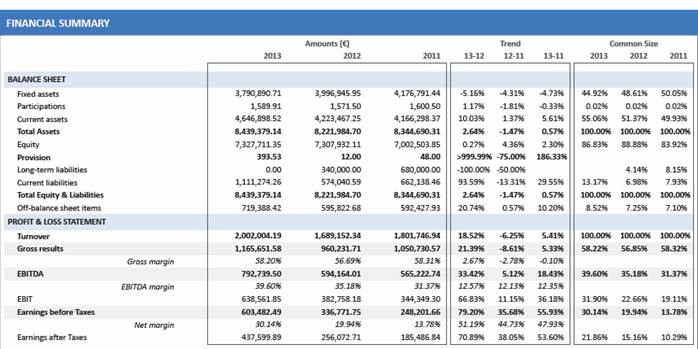
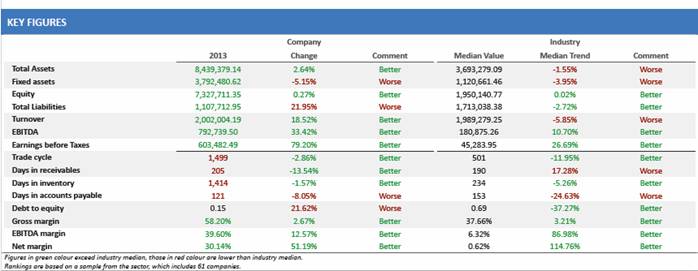
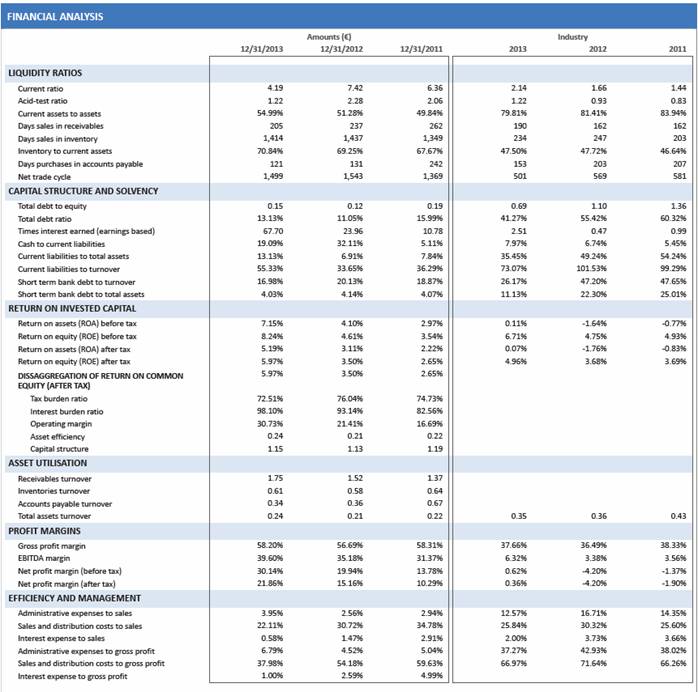
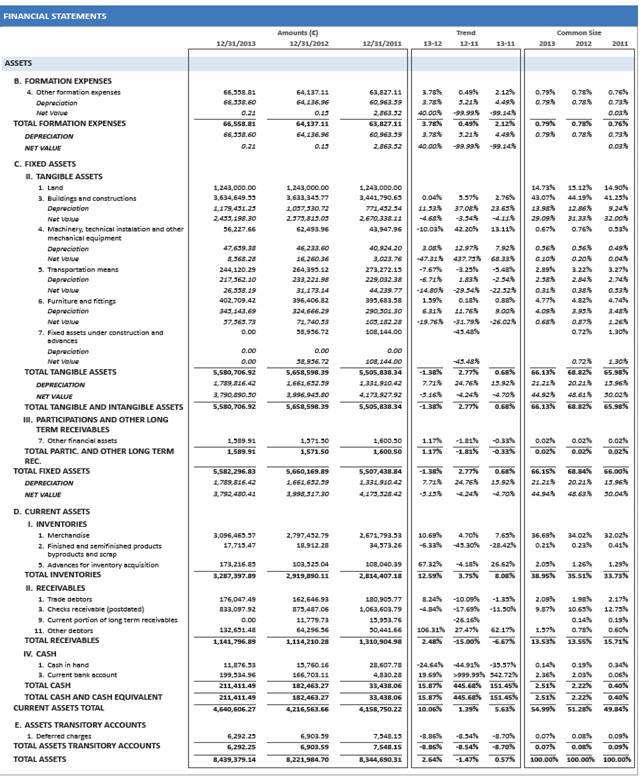
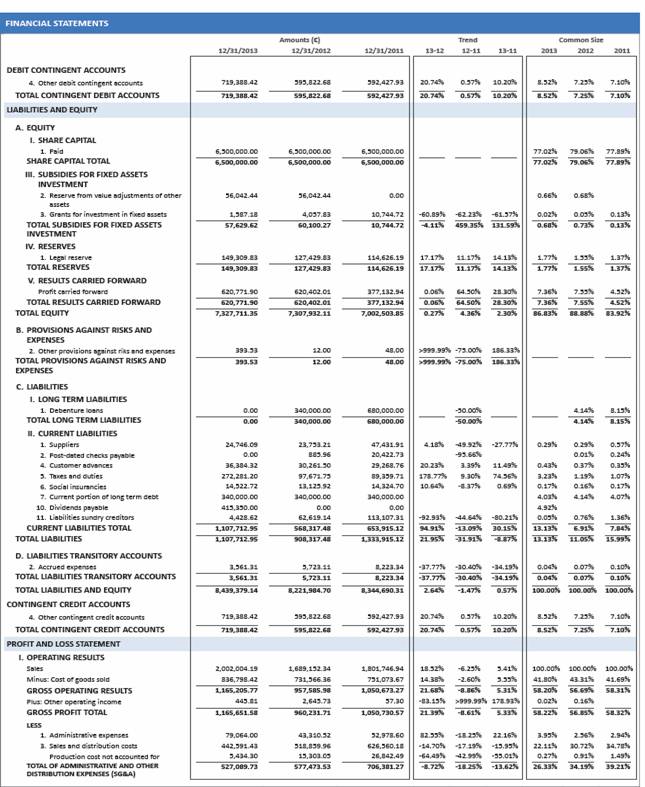
FINANCIAL BENCHMARKING ANALYSIS
Short term bank debt
decrease as percentage of total assets, at 4.03% , (4.14% in 2012) , whereas
the median ratio for the sector is estimated at 11.13% . As a percentage of
turnover it is estimated at low -and lower compared to 2012- levels, at 16.98%
, whereas the median ratio for the sector is estimated at 26.17% (short term
bank debt to sales).
Total liabilities
increase as percentage of total assets, at 13.13% , (11.05% in 2012) , whereas
the median ratio for the sector is estimated at 41.27% . Debt to equity ratio (leverage)
is estimated at very low -but increased compared to 2012- levels, at 0.15 to 1,
whereas the median ratio for the sector is estimated at 0.69 to 1. Interest
coverage by operating profit is estimated at rather high -and increased
compared to 2012- levels, at 67.70 times, whereas the median ratio for the
sector is estimated at 2.51 times.
Total current
assets grow as percentage of total assets, at 54.99% , (51.28% in 2012) ,
whereas the median ratio for the sector is estimated at 79.81% . In the same
time, current liabilities are relatevily low as a portion of total assets
(13.13%) driving the quick ratio to a very high level of 4.19 -but lower
compared to 2012- , whereas the median ratio for the sector is estimated at
2.14 . Inventory as percentage of total assets are 70.84% , (69.25% in 2012) ,
whereas the median ratio for the sector is estimated at 47.50% . In addition,
acid test ratio is at a moderate level at 1.22 -and lower compared to 2012- ,
whereas the median ratio for the sector is estimated at 1.22 .
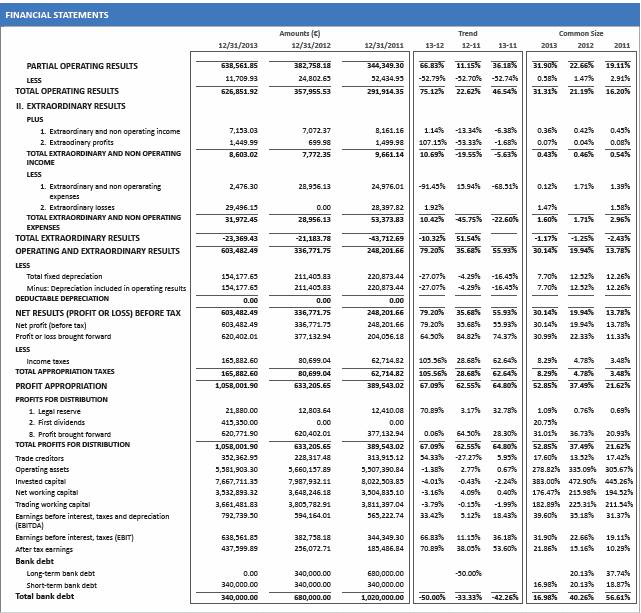
Trade cycle is estimated at 1,499 days, (501
days the median ratio for the sector) while its duration shortens compared to
2012 by 44 days . Total assets turnover
improves at 0.24 times (0.21 in 2012), which
compared to the sector (0.35 times) is relatively low.
Gross profit margin slightly improves at
58.20% , (from 56.69% in 2012) , which is very high compared to the median
ratio in the sector (37.66% ). EBITDA margin improves at 39.60% , (from 35.18%
in 2012) , which is very high compared to the median ratio in the sector (6.32%
). Return on equity (RoE) improves at 8.24% , (from 4.61% in 2012) , which is
sufficiently high compared to the median ratio in the sector (6.71%).
ACTIVITIES
The subject is
engaged with Imports and wholesale trade of tailoring supplies and clothing
fabrics
SECTOR: White
linen and fabric
NACE INDUSTRY
51.41 Wholesale
of textiles
PRODUCTS
KIND RELATION
Garment fabrics Import,
Trade
Tailoring supplies
Import,
Trade
EXPORTS
The subject
exports to Bulgaria and FYROM
IMPORTS
The subject
imports from China, Korea, Taiwan, Province of China
EMPLOYEES
NO OF EMPLOYEES: 15
BANKERS
EMPORIKI BANK OF GREECE S.A.
Area: THERMI
Bank Number: 0120445
SENIOR COMPANY PERSONNEL
NAME TAX
ID ID NUMBER DOC DATE START
DATE
Theodoros Kyr.
Pasmatzidis 036639200 ΑΕ206401 6755-2011
Board Chairman,
Chief Executive Officer
Efimia Kyr.
Pasmatzidou Χ772516
6755-2011
Board Vice
Chairman
Dimitrios Pas.
Adamidis 045417102 Φ 154215 6755-2011
Board Member
Kyriakos The.
Pasmatzidis 002152630 Ζ287004
Legal
Representative
SHAREHOLDERS
FULL NAME PERCENT
TAX ID ID NUMBER
Theodoros
Pasmatzidis 38.00% 036639200 ΑΕ206401
Kyriakos
Pasmatzidis 30.00% 002152630
Ζ287004
Efimia Pasmatzidou
25.00%
Χ772516
Evangelia
Karatziki 7.00%
Κ405964
PROPERTIES
The subject owns
LAND m2: 14000 and BUILDINGS m2: 4000
WAREHOUSE
Industrial Area,
Thermi 57001, Thessaloniki
OWNERSHIP: Owned, BUILDINGS
m2: 5000
WAREHOUSE
Industrial Area,,
Thermi 57001, Thessaloniki
OWNERSHIP: Owned,
BUILDINGS m2: 1601
WAREHOUSE
Industrial Area,
Thermi 57001, Thessaloniki
OWNERSHIP: Owned,
BUILDINGS m2: 1000
PAYMENTS
Outstanding
trading behavior. The company depicts smooth transaction track record, without
any detrimentals affecting its business.
GENERAL COMMENTS
Please note that the information provided in the report was obtained from
official and available sources.
Further information was not available.
FOREIGN EXCHANGE RATES
|
Currency |
Unit
|
Indian Rupees |
|
US Dollar |
1 |
Rs.60.44 |
|
|
1 |
Rs.98.64 |
|
Euro |
1 |
Rs.78.20 |
INFORMATION DETAILS
|
Analysis Done by
: |
DIV |
|
|
|
|
Report Prepared
by : |
TPT |
RATING EXPLANATIONS
|
RATING |
STATUS |
PROPOSED CREDIT LINE |
|
|
>86 |
Aaa |
Possesses an extremely sound financial base with the strongest
capability for timely payment of interest and principal sums |
Unlimited |
|
71-85 |
Aa |
Possesses adequate working capital. No caution needed for credit
transaction. It has above average (strong) capability for payment of interest
and principal sums |
Large |
|
56-70 |
A |
Financial & operational base are regarded healthy. General unfavourable
factors will not cause fatal effect. Satisfactory capability for payment of
interest and principal sums |
Fairly Large |
|
41-55 |
Ba |
Overall operation is considered normal. Capable to meet normal
commitments. |
Satisfactory |
|
26-40 |
B |
Capability to
overcome financial difficulties seems comparatively below average. |
Small |
|
11-25 |
Ca |
Adverse factors are apparent. Repayment of interest and principal sums
in default or expected to be in default upon maturity |
Limited with full
security |
|
<10 |
C |
Absolute credit risk exists. Caution needed to be exercised |
Credit not
recommended |
|
-- |
NB |
New Business |
-- |
This score serves as a reference to assess SC’s credit risk and
to set the amount of credit to be extended. It is calculated from a composite
of weighted scores obtained from each of the major sections of this report. The
assessed factors and their relative weights (as indicated through %) are as
follows:
Financial
condition (40%) Ownership
background (20%) Payment
record (10%)
Credit history
(10%) Market trend
(10%) Operational
size (10%)
This report is issued at your request without any
risk and responsibility on the part of MIRA INFORM PRIVATE LIMITED (MIPL)
or its officials.