MIRA INFORM REPORT
|
Report No. : |
318775 |
|
Report Date : |
23.04.2015 |
IDENTIFICATION DETAILS
|
Name : |
ICICI BANK LIMITED |
|
|
|
|
Formerly Known
As : |
INDUSTRIAL CREDIT AND INVESTMENTS CORPORATION OF INDIA LIMITED |
|
|
|
|
Registered
Office : |
Landmark, |
|
Tel No.: |
91-265-2324318 |
|
|
|
|
Country : |
India |
|
|
|
|
Financials (as
on) : |
31.03.2014 |
|
|
|
|
Date of
Incorporation : |
05.01.1994 |
|
|
|
|
Com. Reg. No.: |
04-021012 |
|
|
|
|
Capital
Investment / Paid-up Capital : |
Rs.11550.446
Million |
|
|
|
|
CIN No.: [Company Identification
No.] |
L65190GJ1994PLC021012 |
|
|
|
|
TAN No.: [Tax Deduction &
Collection Account No.] |
BRD100221E AHMI00471C |
|
|
|
|
PAN No.: [Permanent Account No.] |
Not Available |
|
|
|
|
Legal Form : |
It is a Public Limited Liability Bank.
The Bank's shares are listed on the Stock Exchanges. |
|
|
|
|
Line of Business
: |
Providing a wide range of banking and financial services
including commercial banking and treasury operations. |
|
|
|
|
No. of Employees
: |
Information
denied by the management. |
RATING & COMMENTS
|
MIRA’s Rating : |
Aaa (86) |
|
RATING |
STATUS |
PROPOSED CREDIT LINE |
|
|
>86 |
Aaa |
Possesses an extremely sound financial base with the strongest
capability for timely payment of interest and principal sums |
Unlimited |
|
Status : |
Excellent |
|
|
|
|
Payment Behaviour : |
Regular |
|
|
|
|
Litigation : |
Exist |
|
|
|
|
Comments : |
Subject is a well-established and largest private sector bank having excellent track record. It is a systemically important largest private sector bank with standalone balance sheet size of Rs.5938950.000 Million as on March 31,2014. The rating reflects IBL's status as the largest private sector bank and a systemically important institution, significant retail reach supported by widespread branch network, healthy capitalization levels and strong funding profile of the bank. Trade relations are reported be trustworthy. Payments are reported to be regular and as per commitment. In view of leading player in banking sector backed by experienced
management team the bank can be considered good for normal business dealings
at usual trade terms and conditions. |
NOTES :
Any query related to this report can be made
on e-mail : infodept@mirainform.com
while quoting report number, name and date.
EXTERNAL AGENCY RATING
|
Rating Agency Name |
CRISIL |
|
Rating |
Second-Loss facility: AAA |
|
Rating Explanation |
Highest degree of safety and carry lowest credit risk. |
|
Date |
06.04.2015 |
RBI DEFAULTERS’ LIST STATUS
Subject’s name is not enlisted as a defaulter
in the publicly available RBI Defaulters’ list.
EPF (Employee Provident Fund) DEFAULTERS’ LIST STATUS
Subject’s name is not enlisted as a defaulter
in the publicly available EPF (Employee Provident Fund) Defaulters’ list as of
31-03-2014.
INFORMATION DECLINED
MANAGEMENT NON CO-OPERATIVE [91-22-26531414]
LOCATIONS
|
Registered Office : |
Landmark, |
|
Tel. No.: |
91-265-2324318 / 2339923-27 |
|
Fax No.: |
91-265-2339926 |
|
E-Mail : |
|
|
Website : |
|
|
|
|
|
Head Office : |
Zenith House, 3rd Floor, Keshavrao Khade Marg, Mahalakshmi,
Mumbai - 400 034, |
|
|
|
|
Corporate Office : |
ICICI |
|
Tel. No.: |
91-22-26531414 |
|
Fax No.: |
91-22-26531122 |
|
E-Mail : |
|
|
|
|
|
Branch Office : |
Located At:
|
|
|
|
|
Overseas branches: |
Located at
|
DIRECTORS
As on 30.06.2014
|
Name : |
Mr. K.V. Kamath |
|
Designation : |
Chairman |
|
Qualification: |
B.E. (Mech.) (PGDBA) |
|
Date of Appointment : |
01.05.1996 |
|
Previous
Employment: |
Bakrie Group, Indonesia - Adviser to the Chairman |
|
|
|
|
Name : |
Ms. Chanda
Kochhar |
|
Designation : |
Managing Director and Chief Executive
Officer |
|
|
|
|
Name : |
Mr. Dileep Choksi |
|
Designation : |
Director |
|
|
|
|
Name : |
Mr. Homi Khusrokhan |
|
Designation : |
Director |
|
|
|
|
Name : |
Mr. Arvind Kumar |
|
Designation : |
Director |
|
|
|
|
Name : |
Ms. Swati Piramal |
|
Designation : |
Director |
|
|
|
|
Name : |
Mr. M. S. Ramachandran |
|
Designation : |
Director |
|
|
|
|
Name : |
Mr. Tushaar Shah |
|
Designation : |
Director |
|
|
|
|
Name : |
Mr. V. K. Sharma |
|
Designation : |
Director |
|
|
|
|
Name : |
Mr. V. Sridar |
|
Designation : |
Director |
|
|
|
|
Name : |
Mr. N. S. Kannan |
|
Designation : |
Executive Director and Chief Finance
Officer |
|
|
|
|
Name : |
Mr. K. Ramkumar |
|
Designation : |
Executive Director |
|
|
|
|
Name : |
Mr. Rajiv
Sabharwal |
|
Designation : |
Executive Director |
KEY EXECUTIVES
|
Name : |
Mr. Vijay Chandok |
|
Designation : |
President |
|
|
|
|
Name : |
Zarin Daruwala |
|
Designation : |
President |
|
|
|
|
Name : |
Mr. Sandeep Batra |
|
Designation : |
Group Compliance Officer and Company Secretary |
|
|
|
|
Senior General Manager : |
|
|
Name : |
Chief Financial Officer
Head-Group Internal Audit
Company Secretary
Group Compliance Officer
|
|
|
|
|
Audit Committee: |
|
|
Name: |
Mr. Homi
Khusrokhan, Chairman Mr. Dileep
Choksi, Alternate Chairman Mr. M. S.
Ramachandran Mr. V. Sridar |
|
|
|
|
Board Governance, Remuneration and Nomination Committee: |
|
|
Name: |
Mr. K. V.
Kamath, Chairman Mr. Homi
Khusrokhan Mr. M. S. Ramachandran |
|
|
|
|
Corporate Social
Responsibility Committee: |
|
|
Name : |
Mr. M. S.
Ramachandran, Chairman Mr. Arvind Kumar Mr. Tushaar Shah Ms. Chanda Kochhar |
|
|
|
|
Credit Committee: |
|
|
Name: |
Mr. K.V. Kamath,
Chairman Mr. Homi
Khusrokhan Mr. M. S.
Ramachandran Ms. Chanda Kochhar |
|
|
|
|
Customer Service
Committee: |
|
|
Name: |
Mr. M. S. Ramachandran Mr. V. Sridar Ms. Chanda Kochhar Mr. K. V. Kamath |
|
|
|
|
Fraud Monitoring Committee: |
|
|
Name: |
Mr. V. Sridar, Chairman Mr. K. V. Kamath Mr. Dileep
Choksi Mr. Homi
Khusrokhan Mr. Arvind Kumar Ms. Chanda
Kochhar Mr. Rajiv Sabharwal |
|
|
|
|
Information Technology Strategy Committee: |
|
|
Name: |
Mr. Homi Khusrokhan, Chairman Mr. K. V. Kamath Mr. V. Sridar Ms. Chanda Kochhar |
|
|
|
|
Stakeholders Relationship Committee: |
|
|
Name: |
Mr. Homi Khusrokhan, Chairman Mr. V. Sridar Mr. N. S. Kannan |
|
|
|
|
Committee of Executive Directors: |
|
|
Name: |
Ms. Chanda Kochhar, Chairperson Mr. N. S. Kannan Mr. K. Ramkumar Mr. Rajiv Sabharwal |
MAJOR SHAREHOLDERS / SHAREHOLDING PATTERN
AS ON 31.03.2015
|
Category of Shareholder |
Total
No. of Shares |
Total
Shareholding as a % of Total No. of Shares |
|
(A) Shareholding of Promoter and Promoter Group |
|
|
|
|
|
|
|
|
|
|
|
(B) Public Shareholding |
|
|
|
|
|
|
|
|
478001630 |
11.62 |
|
|
3510495 |
0.09 |
|
|
3625154 |
0.09 |
|
|
772187179 |
18.78 |
|
|
2375625940 |
57.76 |
|
|
6601490 |
0.16 |
|
|
4609825 |
0.11 |
|
|
1991665 |
0.05 |
|
|
3639551888 |
88.50 |
|
|
|
|
|
|
127086023 |
3.09 |
|
|
|
|
|
|
261951160 |
6.37 |
|
|
36746165 |
0.89 |
|
|
47356049 |
1.15 |
|
|
3000 |
0.00 |
|
|
3500605 |
0.09 |
|
|
13013801 |
0.32 |
|
|
3554026 |
0.09 |
|
|
73540 |
0.00 |
|
|
12431444 |
0.30 |
|
|
8345722 |
0.20 |
|
|
6290711 |
0.15 |
|
|
143200 |
0.00 |
|
|
473139397 |
11.50 |
|
Total Public shareholding (B) |
4112691285 |
100.00 |
|
Total (A)+(B) |
4112691285 |
100.00 |
|
(C) Shares held by Custodians and against which Depository Receipts
have been issued |
0 |
0.00 |
|
|
0 |
0.00 |
|
|
1684553360 |
0.00 |
|
|
1684553360 |
0.00 |
|
Total (A)+(B)+(C) |
5797244645 |
0.00 |


Shareholding of securities (including shares, warrants,
convertible securities) of persons belonging to the category Public and holding
more than 1% of the total number of shares
|
Sl. No. |
Name of the
Shareholder |
No. of Shares held |
Shares as % of
Total No. of Shares |
|
|
1 |
Deutsche Bank Trust Company Americas |
1684553360 |
29.06 |
|
|
2 |
Life Insurance Corporation of India |
470276753 |
8.11 |
|
|
3 |
Dodge & Cox International Stock Fund |
257911785 |
4.45 |
|
|
4 |
Europacific Growth Fund |
164528802 |
2.84 |
|
|
5 |
Carmignac Gestion A/c Carmignac Patrimoine |
90881374 |
1.57 |
|
|
6 |
Aberdeen Global Indian Equity (Mauritius) Limited |
62100000 |
1.07 |
|
|
|
Total |
2730252074 |
47.10 |
Shareholding of securities (including shares, warrants,
convertible securities) of persons (together with PAC) belonging to the
category “Public” and holding more than 5% of the total number of shares of the
company
|
Sl. No. |
Name(s) of the
shareholder(s) and the Persons Acting in Concert (PAC) with them |
No. of Shares |
Shares as % of
Total No. of Shares |
|
|
1 |
Deutsche Bank Trust Company Americas |
1684553360 |
29.06 |
|
|
2 |
Life Insurance Corporation of India |
470276753 |
8.11 |
|
|
|
Total |
2154830113 |
37.17 |
|
BUSINESS DETAILS
|
Line of Business : |
Providing a wide range of banking and financial services
including commercial banking and treasury operations. |
|
|
|
|
Brand Names : |
Not Divulged |
|
|
|
|
Agencies Held : |
Not Divulged |
|
|
|
|
Exports : |
Not Divulged |
|
|
|
|
Imports : |
Not Divulged |
|
|
|
|
Terms : |
Not Divulged |
PRODUCTION STATUS NOT AVAILABLE
GENERAL INFORMATION
|
Suppliers : |
|
||||||||||||||
|
|
|
||||||||||||||
|
Customers : |
|
||||||||||||||
|
|
|
||||||||||||||
|
No. of Employees : |
Information denied
by the management. |
||||||||||||||
|
|
|
||||||||||||||
|
Bankers : |
Reserve Bank of |
|
|
|
|
Banking
Relations : |
-- |
|
|
|
|
Statutory Auditors : |
|
|
Name : |
S.R. Batliboi
and Company Chartered Accountants |
|
Address : |
Express |
|
|
|
|
Subsidiaries: |
|
|
|
|
|
Associates/joint ventures/other
related entities: |
|
CAPITAL STRUCTURE
AS ON 30.06.2014
Authorised Capital : Rs.17750.000 Million.
Issued, Subscribed & Paid-up Capital : Rs.15094.489
Million.
As on 31.03.2014
Authorised Capital :
|
No. of Shares |
Type |
Value |
Amount |
|
1275000000 |
Equity Shares |
Rs.10/- each |
Rs.12750.000 Million |
|
15000000 |
Equity Shares |
Rs.100/- each |
Rs.1500.000 Million |
|
350 |
Preferences Shares |
Rs.10/- million each |
Rs.3500.000 Million |
|
|
TOTAL |
|
Rs.17750.000
Million |
Issued, Subscribed & Paid-up Capital :
|
No. of Shares |
Type |
Value |
Amount |
|
1153581715 |
Equity Shares |
Rs.10/- each
|
Rs.11535.817
Million |
|
1405540 |
Add: Equity Shares |
Rs.10/- each
|
Rs.14.055
Million |
|
154486 |
Less: Equity Shares |
Rs.10/- each |
Rs.1.545
Million |
|
|
TOTAL |
|
Rs.11548.327 Million |
|
266089 |
Add: Forfeited Equity Shares |
Rs.10/- each
|
Rs.2.119
Million |
|
|
TOTAL |
|
Rs.11550.446 Million |
Note:
These shares will be of such class and with such rights, privileges, conditions or restrictions as may be determined by the Bank in accordance with the Articles of Association of the Bank and subject to the legislative provisions in force for the time being in that behalf.
Pursuant to RBI circular the issued and paid-up preference shares are grouped
FINANCIAL DATA
[all figures are
in Rupees Million]
ABRIDGED BALANCE
SHEET
|
PARTICULAR |
31.03.2014 |
31.03.2013 |
31.03.2012 |
|
|
|
|
|
|
CAPITAL AND
LIABILITIES |
|
|
|
|
Capital |
11550.446 |
11536.362 |
11527.683 |
|
Employees stock options outstanding |
65.744 |
44.835 |
23.854 |
|
Reserves and Surplus |
720517.086 |
655478.392 |
592500.885 |
|
Deposits |
3319136.570 |
2926136.257 |
2554999.561 |
|
Borrowings |
1547590.539 |
1453414.944 |
1401649.073 |
|
Other Liabilities and Provisions |
347555.454 |
321336.021 |
329986.915 |
|
|
|
|
|
|
TOTAL CAPITAL
AND LIABILITIES |
5946415.839 |
5367946.811 |
4890687.971 |
|
|
|
|
|
|
ASSETS |
|
|
|
|
Cash and Balances with Reserve Bank of |
218218.262 |
190527.309 |
204612.935 |
|
Balances with Banks and Money at Call and Short Notice |
197077.695 |
223647.879 |
157680.199 |
|
Investments |
1770218.164 |
1713935.993 |
1595600.430 |
|
Advances |
3387026.492 |
2902494.351 |
2537276.579 |
|
Fixed Assets |
46781.360 |
46470.587 |
46146.870 |
|
Other Assets |
327093.866 |
290870.692 |
349370.958 |
|
|
|
|
|
|
TOTAL ASSETS |
5946415.839 |
5367946.811 |
4890687.971 |
PROFIT & LOSS
ACCOUNT
|
PARTICULAR |
31.03.2014 |
31.03.2013 |
31.03.2012 |
|
|
|
|
|
|
INCOME |
|
|
|
|
Interest Earned |
441781.528 |
400755.969 |
335426.522 |
|
Other Income |
104278.721 |
83457.012 |
75027.598 |
|
TOTAL INCOME |
546060.249 |
484212.981 |
410454.120 |
|
|
|
|
|
|
EXPENDITURE |
|
|
|
|
Interest Expended |
277025.886 |
262091.848 |
228084.964 |
|
Operating Expenses |
103088.614 |
90128.837 |
78504.433 |
|
Provision and contingencies |
67840.979 |
48737.569 |
39212.151 |
|
TOTAL
EXPENDITURE |
447955.479 |
400958.254 |
345801.548 |
|
|
|
|
|
|
PROFIT AND LOSS |
|
|
|
|
Net Profit for the Year |
98104.770 |
83254.727 |
64652.572 |
|
Profit Brought Forward |
99022.874 |
70542.323 |
50181.837 |
|
Total Profit /
(Loss) |
197127.644 |
153797.050 |
114834.409 |
|
|
|
|
|
|
APPROPRIATION /
TRANSFERS |
|
|
|
|
Transfer to Statutory Reserve |
24530.000 |
20820.000 |
16170.000 |
|
Transfer to Reserve Fund |
46.146 |
27.775 |
10.665 |
|
Transfer to Capital Reserve |
760.000 |
330.000 |
380.000 |
|
Transfer to Investment Reserve Account |
1270.000 |
0.000 |
0.000 |
|
Transfer to General Reserve |
0.000 |
0.000 |
0.000 |
|
Transfer to Revenue and Other Reserves |
0.000 |
0.000 |
3.154 |
|
Transfer to Special Reserve |
9000.000 |
7600.000 |
6500.000 |
|
Dividend (including Corporate Dividend Tax for the Previous Year Paid
During the Year) |
(539.685) |
2.491 |
4.284 |
|
Proposed Equity Share Dividend |
26562.812 |
23072.271 |
19020.400 |
|
Proposed Preference Share Dividend |
0.035 |
0.035 |
0.035 |
|
Corporate Dividend Tax |
2312.451 |
2921.604 |
2203.548 |
|
Balance Carried Over to Balance Sheet |
133185.885 |
99022.874 |
70542.323 |
|
|
|
|
|
|
TOTAL |
197127.644 |
153797.050 |
114834.409 |
|
|
|
|
|
|
Earnings per share |
|
|
|
|
Basic (Rs.) |
84.99 |
72.20 |
56.11 |
|
Diluted (Rs.) |
84.66 |
71.93 |
55.95 |
FINANCIAL ANALYSIS
[all figures are
in Rupees Million]
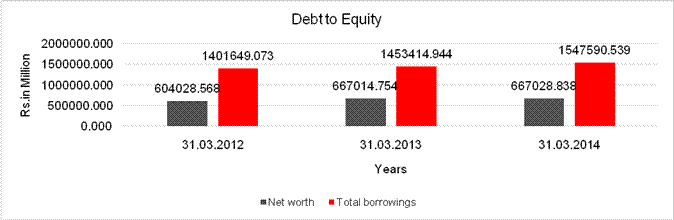
DEBT EQUITY RATIO
|
Particular |
31.03.2012 |
31.03.2013 |
31.03.2014 |
|
|
(Rs.
In Million) |
(Rs.
In Million) |
(Rs.
In Million) |
|
Share Capital |
11527.683 |
11536.362 |
11550.446 |
|
Reserves & Surplus |
592500.885 |
655478.392 |
655478.392 |
|
Net
worth |
604028.568 |
667014.754 |
667028.838 |
|
|
|
|
|
|
Borrowings |
1401649.073 |
1453414.944 |
1547590.539 |
|
Total
borrowings |
1401649.073 |
1453414.944 |
1547590.539 |
|
Debt/Equity
ratio |
2.321 |
2.179 |
2.320 |
YEAR-ON-YEAR GROWTH
|
Year
on Year Growth |
31.03.2012 |
31.03.2013 |
31.03.2014 |
|
|
(Rs.
In Million) |
(Rs.
In Million) |
(Rs.
In Million) |
|
Interest Earned |
335426.522 |
400755.969 |
441781.528 |
|
|
|
19.477 |
10.237 |

NET PROFIT MARGIN
|
Net
Profit Margin |
31.03.2012 |
31.03.2013 |
31.03.2014 |
|
|
(Rs.
In Million) |
(Rs.
In Million) |
(Rs.
In Million) |
|
Interest Earned |
335426.522 |
400755.969 |
441781.528 |
|
Profit |
64652.572 |
83254.727 |
98104.77 |
|
|
19.27% |
20.77% |
22.21% |

LOCAL AGENCY FURTHER INFORMATION
DETAILS OF CURRENT MATURITIES OF LONG TERM
DEBT: NOT AVAILABLE
|
Sr. No. |
Check List by Info Agents |
Available in
Report (Yes / No) |
|
1] |
Year of Establishment |
Yes |
|
2] |
Locality of the firm |
Yes |
|
3] |
Constitutions of the firm |
Yes |
|
4] |
Premises details |
No |
|
5] |
Type of Business |
Yes |
|
6] |
Line of Business |
Yes |
|
7] |
Promoter's background |
Yes |
|
8] |
No. of employees |
No |
|
9] |
Name of person contacted |
No |
|
10] |
Designation of contact
person |
No |
|
11] |
Turnover of firm for last
three years |
Yes |
|
12] |
Profitability for last
three years |
Yes |
|
13] |
Reasons for variation
<> 20% |
-- |
|
14] |
Estimation for coming
financial year |
No |
|
15] |
Capital in the business |
Yes |
|
16] |
Details of sister
concerns |
Yes |
|
17] |
Major suppliers |
No |
|
18] |
Major customers |
No |
|
19] |
Payments terms |
No |
|
20] |
Export / Import details (if
applicable) |
No |
|
21] |
Market information |
-- |
|
22] |
Litigations that the firm
/ promoter involved in |
Yes |
|
23] |
Banking Details |
Yes |
|
24] |
Banking facility details |
Yes |
|
25] |
Conduct of the banking
account |
-- |
|
26] |
Buyer visit details |
-- |
|
27] |
Financials, if provided |
Yes |
|
28] |
Incorporation details, if
applicable |
Yes |
|
29] |
Last accounts filed at
ROC |
Yes |
|
30] |
Major Shareholders, if
available |
Yes |
|
31] |
Date of Birth of Proprietor/Partner/Director,
if available |
Yes |
|
32] |
PAN of
Proprietor/Partner/Director, if available |
No |
|
33] |
Voter ID No of
Proprietor/Partner/Director, if available |
No |
|
34] |
External Agency Rating,
if available |
Yes |
LITIGATION DETAILS
CASE DETAILS
BENCH:-BOMBAY
|
Presentation Date:- |
05/01/2015 |
||||
|
Lodging No.:- |
SSL/8/2015 |
Filing Date:- |
05/01/2015 |
||
|
Petitioner:- |
THE FERTILISERS AND CHEMICALS TRAVANCORE LTD. |
|
Respondent:- |
ICICI BANK LTD. |
|
|
||||||||||||||||||||||||||||||
|
|
INDEX
OF CHARGES: NO CHARGES EXIST FOR COMPANY
BUSINESS OVERVIEW
ECONOMIC OUTLOOK
Fiscal 2014 was a challenging year for the Indian economy, with continued moderation in economic growth, persistent inflation, high interest rates and significant volatility in global and domestic financial markets. ICICI Bank calibrated its strategy to the environment, adopting a balanced approach to growth, profitability and risk management. They believe that India continues to have strong drivers for growth over the medium-to-long term, underpinned by its infrastructure and industrial investment potential and demographic advantage. They continue to focus on enhancing their capabilities to capitalise on the growth opportunities arising from the Indian economy and its international linkages. For a detailed discussion of economic developments in fiscal 2014, please refer “Management’s Discussion and Analysis”.
BUSINESS REVIEW
RETAIL BANKING
The preferences of Indian consumers are evolving rapidly with the increasing penetration of technology in the area of banking. New products, new channels and new service experiences are shaping the banking landscape of the future. ICICI Bank has always been a pioneer in the area of understanding customer needs and designing solutions in line with its philosophy of Khayaal Aapka.
The Bank continues its leadership in the area of technology to provide a superior customer experience. A new channel for banking has been introduced with the launch of the Bank’s Facebook app, ’Pockets from ICICI Bank’. This app allows customers to fulfil all banking needs while socialising with friends and relatives on Facebook. The Bank also upgraded its retail internet banking platform to enable a superior online experience. This platform allows users to personalise the home page so that all required information is visible with minimal clicks. Similarly, the Bank has taken a number of steps to empower customers at branches, including transaction kiosks and cash acceptance machines that enable them to undertake transactions on their own. The Bank has also scaled up the number of its 24x7 Touch Banking branches to 101 in 33 cities. Through Tab Banking, the Bank’s executives now assist customers in opening a bank account from the comfort of their homes and offices. The documentation required from customers is minimal since their executives use tablets to click photographs of the customers and also scan their documents. Tab Banking has generated high interest from prospective customers, demonstrating the success of this proposition. The Bank now plans to extend its journey of using tablets and digitisation to home loans and vehicle loans.
ICICI Bank has also brought various new products to Indian consumers. Many Indian consumers have apprehensions about security of online transactions. ICICI Bank, in partnership with Visa, has introduced Carbon, Asia’s first credit card powered by Visa CodeSure, making the card one of the safest for any usage, especially for nline shopping. This card brings unparalleled safety for online transactions by embedding an alpha-numeric LCD screen, a 12-button touch keypad and an in-built battery to generate dynamic one time passcodes. Various premium and feature-rich debit cards have also been introduced. The Bank also recognises the growing importance of electronic, chip-based and near-field communication (NFC) based payments and has institutionalised the first-ever inter-operable electronic toll collection solution in India on the Mumbai- Ahmedabad highway.
ICICI Bank has also worked towards making access to loans easier for customers. Customers can check their loan eligibility and print sanction letters instantly using the “Express Loans” programme. Prospective home buyers can view all housing projects approved by ICICI Bank on an interactive map. ICICI Bank customers can now also apply for multiple products in a single form without the need for multiple documentation, reducing processing delays.
The Bank has expanded its network to 3,753 branches and 11,315 ATMs. National Payments Corporation of India (NPCI) has awarded ICICI Bank with the ‘Best ATM Operational Excellence Award’ in the Private Sector- Foreign Bank category for the third consecutive year. ICICI Bank was also named the ‘Best Retail Bank in India’ by The Asian Banker. A number of the Bank’s initiatives have been recognised by many reputed forums such as Indian Banks Association (IBA), Celent, Institute of Development and Research in Banking Technology (IDRBT) and others. The Bank received awards for ‘Most Innovative Bank’ and ‘Most Innovative use of Multi-Channel Infrastructure’ at the Indian Banks Association’s BANCON Innovation Awards 2013.
All these initiatives have helped the Bank achieve robust growth in its retail business. The Bank’s mortgage loan and auto loan disbursements grew by 26.8% and 51.7%, respectively, in fiscal 2014. The Bank has also focused on growth in its business banking portfolio, which comprises lending to small businesses though the Bank’s extensive branch network. The Bank achieved healthy increase in the overall retail portfolio by 23.0% to Rs.1,320.11 billion. The Bank continues to see strong momentum in the acquisition of retail deposit customers and robust growth in the retail deposit base. The Bank’s savings account deposits grew by 15.7% in fiscal 2014, to Rs.991.33 billion.
Small and Medium
Enterprises
Small and Medium Enterprises (SMEs) are an important constituent of India’s economy and have become a thrust area for future growth. A strong SME sector is fundamental to building a resilient and dynamic corporate sector.
At ICICI Bank, they offer a full suite of banking products and solutions to SMEs for meeting their business and growth requirements. Their experience of partnering with SMEs has enabled us to develop nontraditional techniques of assessing credit risk unique to them. They also offer supply chain financing solutions and small ticket funding to the channel partners of large corporates. They have set up dedicated desks in 318 branches catering to SMEs and have specialised teams for current accounts, trade finance, cash management services and doorstep banking. They have also tailored their internet banking platform to cater to their unique banking needs.
Fiscal 2014 was a challenging period for SMEs due to the moderation in economic activity and significant fluctuations in the currency markets. They focused on calibrated portfolio growth and reducing concentration levels within the portfolio. They maintained a cautious outlook on some sectors with enhanced monitoring of existing relationships where required.
ICICI Bank has always viewed the SME segment as integral to India’s growth and will continue to partner with SMEs while building a healthy portfolio.
WHOLESALE BANKING
The Wholesale Banking Group’s core strategy has been to serve their corporate customers by providing comprehensive and tailored financial solutions for doing business in India and key overseas geographies. The group analyses business and financial requirements of clients and services them through a bouquet of products ranging from working capital finance, export finance, trade and commercial banking products to rupee and foreign currency term loans and structured finance products. Their Corporate Banking Group is the front-end relationship team which acts as a single point of contact for clients and services their requirements across businesses. The relationship team works closely with specific teams like commercial banking, loan syndication, project finance, structured finance and the markets group to develop suitable products that fulfill specific needs of clients.
The Commercial Banking Group offers comprehensive banking products and services to meet the trade, transaction banking and cash management needs of companies. The group works closely with the Corporate Banking Group to diversify the revenue streams from corporate clients and enhance the granularity and stability of revenues for the Bank. Superior customer service levels through their mega branches combined with technology-enabled solutions have helped in growing their transaction banking business.
The Syndications Group is a leading player in the loan syndication market. It specialises in structuring and syndicating large loans. It acts as an arranger and underwriter for a variety of loans across corporate and project finance transactions. It is an active player for India-linked loans in both the primary and secondary loan distribution market. The diversified pool of clients enables us to align the unique requirements of clients with the varying requirements of investors.
The Structured Finance Group designs innovative and customised products to meet the complex needs of their global clientele in synergy with the Corporate Banking Group and International Banking Group. The Structured Finance Group has successfully undertaken structured finance transactions in India, backed by the Bank’s extensive experience, underwriting capabilities, industry expertise and global presence. The relationship teams also work with the Markets Group to assist customers in addressing currency and market risk in their businesses by offering relevant products.
During fiscal 2014, the Wholesale Banking Group focused on proactive monitoring of the portfolio given the challenging economic environment, while continuing to grow its commercial and transaction banking business. Going forward, the Wholesale Banking Group will continue to offer comprehensive financial services across a spectrum of financial products to their clients and partner them while growing their portfolio with a focus on profitability and risk mitigation.
PROJECT FINANCE
The project finance environment has been challenging in recent years, with implementation delays and issues around access to raw material. These have impacted cash flow generation by projects and resulted in a significant slowdown in new investments. However, they expect to see improvement in the environment going forward.
In the power sector, the Government has modified the standard bid documents to make fuel a pass through for tariffs. The Government has approved setting up of a Coal Regulatory Authority which will make the sector competitive and increase private sector participation. Projects in regional and interregional transmission corridors are expected to be undertaken which would strengthen the national grid. The renewable energy segment has gained momentum with more states formulating policies to encourage new investments in this segment. In roads and ports sectors, they expect to see an increase in activity during fiscal 2015 with new projects likely to be awarded. The National Highway Authority of India (NHAI) is expected to award road projects primarily through engineering, procurement and construction (EPC) contracts to improve liquidity in the sector. The government has taken measures like rescheduling of premium for stressed projects, easing of exit norms and re-working the Model Concession Agreement in response to the changed economic scenario in order to revive private sector investment. In the port sector, award of new projects has picked up pace which would result in new capacity addition. In the airport sector, six key airports currently managed by the Airports Authority of India are expected to be privatised.
In the oil and gas sector, most of the activity is expected to be linked to demand for natural gas. The demand for gas from priority sectors such as power and fertiliser is likely to continue, maintaining pressure on domestic supplies of gas and resulting in increase in prices. Significant additions to LNG import capacity have been announced with commissioning expected over the next three to four years. Their expertise in major sectors along with innovative structuring capabilities has enabled us to cater to the long-term financing requirements of Indian corporates. Infrastructure development is a critical area to improve the economic potential of the country and they remain committed to partnering with companies in promoting viable projects.
INTERNATIONAL BANKING
Their international banking strategy is focused on specific growth drivers: providing end-to-end solutions for the international banking requirements of their Indian corporate clients; leveraging economic corridors between India and the rest of the world; and establishing ICICI Bank as the preferred bank for non-resident Indians in key global markets. Further, ICICI Bank’s International Banking Group seeks to partner with global corporations as they expand in India. They also seek to build stable and diversified international funding sources and strong syndication capabilities to support their corporate and investment banking business. Their international footprint consists of subsidiaries in the United Kingdom, Russia and Canada, branches in the United States, Singapore, Bahrain, Hong Kong, Sri Lanka, Dubai International Finance Centre and Qatar Financial Centre and representative offices in the United Arab Emirates, China, South Africa, Bangladesh, Thailand, Malaysia and Indonesia. The Bank’s wholly-owned subsidiary ICICI Bank UK Plc has nine branches in the United Kingdom and a branch each in Belgium and Germany. ICICI Bank Canada has nine branches. ICICI Bank Eurasia, their Russian subsidiary, is headquartered in Moscow with a branch in St. Petersburg.
During fiscal 2014, the global economic environment was characterised by gradual recovery in advanced economies and volatility in emerging economies. In this environment, they continued to focus on managing the risks in their international operations. They also focused on diversifying the mix of their funding profile in their international operations. They continued to focus on expanding their trade finance business and their relationships with global corporates doing business in India. India continues to remain the largest remittance receiving country in the world and ICICI Bank has a significant market share in remittances. This has been made possible through their diversified products, technology initiatives and service offerings to meet the requirements of the widely dispersed NRI diaspora. The emphasis in fiscal 2014 was on further expanding access to remittance services through new partnerships and channels and delivering a superior customer experience.
RURAL AND INCLUSIVE
BANKING
Rural India is complex and transforming rapidly with expansion in rural consumption, access to mobile telephony and social mobility among others. While agriculture continues to engage around half the country’s total workforce, the rural economy has grown to encompass both farm and non-farm sources of livelihood. The Bank’s vision is to emerge as a leading institution for enabling growth and inclusion in the rural economy. To accomplish its vision, the Bank’s strategy is to expand in the rural markets, leverage its strengths in technology and deliver relevant products and services to the rural and unbanked population through a multi-channel network.
A key pillar of their strategy is to provide branch banking access to the rural customers. In line with this philosophy, more than 75% of their new branches in fiscal 2014 were added in the rural and semi-urban areas, and 52% of the Bank’s overall branch network is now in these areas. 317 branches have been opened in unbanked villages in fiscal 2014. During fiscal 2014, the Bank launched “Branch on Wheels“, a mobile van based branch that aims at providing banking services to a cluster of remote unbanked villages. This initiative, a first of its kind by a private sector bank, has been launched in the three states of Maharashtra, Chattisgarh and Odisha. It offers all basic banking products and services including savings accounts, farmer loans, cash deposit/withdrawal, funds transfer/demand draft collections and an Automated Teller Machine (ATM).
As part of its endeavour to provide basic banking services to the unbanked, ICICI Bank offers holistic banking services through its Business Correspondent (BC) channel, including savings accounts, remittances, fixed and recurring deposits and credit. The Bank has opened 17.8 million basic saving bank deposit accounts at March 31, 2014, which is the highest among private sector banks. The Bank has reached out to over 15,500 villages through its branches and BC network. During fiscal 2014, the Bank continued to be a leading provider of Electronic Benefit Transfer (EBT) services which allows state Governments to transfer funds directly to the beneficiaries’ accounts thereby facilitating timely receipt of money by the beneficiaries and minimising leakages. The Bank has initiated EBT payment facilities in 72 districts across 13 states. As part of its urban financial inclusion initiatives, the Bank has processed about 5.0 million domestic migrant remittances till date. This service allows migrant workers to send money back to their families in a transparent and convenient manner. The Bank conducts village level financial literacy workshops called ‘Gram Samvad’ across the country for customer interactions and uses innovative and engaging methods like comic books and audio visual as media for promoting financial literacy.
key objective of the Bank’s strategy is to provide access to institutionalised credit to the rural population at their doorsteps through its relationship banking approach. The Bank provides a comprehensive range of loan products to farmers and customers in rural areas like Kisan Credit Cards (KCC), agri term loans, farm equipment loans, loans to Self Help Groups (SHG), commodity based financing to farmers and business credit for rural enterprises. The Bank has leveraged unique models to offer credit to different segments of the rural population. The Bank is also leveraging tablets and mobile applications to eliminate physical formats and capture data electronically at the farm gate. This has resulted in provision of doorstep services to the customer with faster turnaround time for credit delivery. The Bank has extended credit to over a million women through over 70,000 SHGs in 164 districts across seven states and is the fastest growing bank in the country in this segment. The Bank has doubled its overall rural customer base for loans to over 2.0 million in fiscal 2014.
MANAGEMENT’S
DISCUSSION AND ANALYSIS
BUSINESS ENVIRONMENT
Global economic growth remained subdued during fiscal 2014, while global financial markets witnessed volatility in response to the commencement of withdrawal of quantitative easing by the US Federal Reserve. Growth in the Indian economy remained below 5.0% for the second consecutive year, along with subdued investment activity and consumer demand. Uncertainties regarding the global recovery, concerns over domestic growth and volatility in financial markets were the key features of the economic environment in fiscal 2014.
India’s gross domestic product (GDP) grew by 4.6% during the first nine months of fiscal 2014 compared to a growth of 4.5% in the corresponding period of fiscal 2013. Growth was moderate due to a slowdown in industry and services sectors. Growth in the industrial sector was 0.6% during the first nine months of fiscal 2014, similar to the corresponding period of fiscal 2013. The services sector grew by 6.7% during the first nine months of fiscal 2014, compared to 7.2% in the corresponding period of fiscal 2013. The agriculture sector saw an improvement in growth to 3.6% during the first nine months of fiscal 2014, compared to 1.4% in the corresponding period of fiscal 2013. Private consumption recorded a growth of 2.5% while investments, as measured by gross fixed capital formation, declined by 1.0% during the first nine months of fiscal 2014, compared to a growth of 6.2% in private consumption and a decline of 0.1% in investments during the first nine months of fiscal 2013.
Inflation, measured by the Wholesale Price Index (WPI), increased from 4.8% in April 2013 to 7.5% in November 2013, and then eased to 5.7% in March 2014. Average WPI inflation during fiscal 2014 was 5.9%, compared to 7.4% average inflation during fiscal 2013. Inflation eased due to a moderation in the manufactured products segment, where average inflation in fiscal 2014 decreased to 2.9% compared to 5.4% in fiscal 2013. Fuel inflation remained flat at about 10.0% in fiscal 2014. However, food inflation increased from an average of 9.9% in fiscal 2013 to 12.8% in fiscal 2014. Retail inflation, measured by the Consumer Price Index (CPI), remained elevated at above 9.0% levels during the early part of fiscal 2014 and increased to a high of 11.2% in November 2013 before easing to 8.3% in March 2014. CPI inflation largely followed the trend in food inflation. Core CPI inflation, excluding food and fuel, remained steady at around 8.0% through fiscal 2014.
Conduct of monetary policy during fiscal 2014 could be demarcated into three distinct phases. In the early part of fiscal 2014, considering the easing inflation levels, Reserve Bank of India (RBI) reduced the repo rate by 25 basis points from 7.50% to 7.25% in May 2013. In the second phase, following the US Federal Reserve indicating a likely withdrawal of its quantitative easing programme in May 2013, there was a considerable outflow of portfolio funds from emerging market economies. India saw a significant outflow of foreign portfolio investments, particularly debt funds, leading to a sharp depreciation in the rupee. The rupee depreciated by 17.8% against the US dollar between June-August 2013 and touched a low of Rs.68.4 per US dollar on August 28, 2013 as compared to Rs.56.5 per US dollar at end-May 2013. In response to these developments, RBI changed its monetary policy stance. On July 15, 2013, with a view to stabilise the exchange rate, RBI increased the Marginal Standing Facility (MSF) rate, which is the rate at which banks borrow funds, in excess of the specified threshold, overnight from RBI against government securities, by 200 basis points from 8.25% to 10.25% while keeping the repo rate unchanged. The RBI also fixed the borrowing limit for banks under the Liquidity Adjustment Facility (LAF) at Rs.750.00 billion. Effective July 24, 2013, RBI announced a further reduction in the borrowing limit under LAF to 0.5% of net demand and time liabilities. In addition, effective July 27, 2013, the minimum daily cash reserve ratio balance required to be maintained by banks was increased to 99.0% of the stipulated fortnightly requirement from 70.0% earlier. The immediate impact of these measures on the market was a sharp increase in wholesale deposit rates and yields on government securities. Considering the impact of these measures to stabilise the exchange rate, RBI allowed certain adjustments on the investment portfolio of banks. The measures included increasing the limit for holding government securities in the held-tomaturity (HTM) category to 24.5% of net demand and time liabilities as against the earlier requirement of 24.0%, allowing banks to transfer securities from the available-for-sale and held-for-trading categories to the held-to-maturity category up to 24.5% of demand and time liabilities as a one-time measure at prices prevailing prior to the announcement of the July 15, 2013 measures, and giving banks the option to amortise net depreciation on the available-for-sale and held-for-trading portfolio over the remaining period of fiscal 2014.
The third phase of monetary policy action was from September 2013 when monetary operations were gradually normalised while focus shifted to addressing the elevated inflation levels. Following stability in the currency markets, RBI gradually reduced the MSF rate in stages by 150 basis points from 10.25% to 8.75% during September-October 2013. At the same time, the repo rate was increased by 50 basis points in stages from 7.25% to 7.75% reflecting concerns over elevated inflation levels. With these changes, monetary operations were normalised and the 100 basis points gap between the two rates was re-instated by end-October 2013. Further, in January 2014, RBI increased the repo rate by another 25 basis points to 8.0%.
India’s external sector environment improved during fiscal 2014 following policy interventions as well as improvement in exports. The high current account deficit of 4.8% of GDP in fiscal 2013 significantly reduced to 2.2% during the first nine months of fiscal 2014. During fiscal 2014, imports declined by 8.1%, particularly due to policy curbs on gold imports. Correspondingly, exports grew by 4.0% during fiscal 2014, leading to a contraction in the trade deficit by 27.2% during the year. Capital inflows also improved towards the later part of fiscal 2014. With a view to attract US dollar inflows and provide support to the currency, in September 2013 RBI opened a swap facility for banks for incremental foreign currency non-resident (bank) (FCNR (B)) US dollar deposits at a fixed rate of 3.5% per annum. The incremental non-resident dollar deposits mobilised under the swap facility were permitted to be deducted from the adjusted net bank credit for computation of priority sector lending targets and also from net demand and time liabilities for maintenance of cash reserve ratio and statutory liquidity ratio. The foreign currency borrowing limits of banks were also enhanced and banks were allowed to borrow up to 100.0% of their unimpaired Tier I capital as against 50.0% earlier. The borrowings under this route could be swapped with RBI at a concessional rate of 100 basis points below the prevailing swap rate. The swap facility was available from September 10, 2013 until November 30, 2013 and attracted an inflow of US$ 34.3 billion in the form of FCNR (B) deposits and bank borrowings during the period. Overall, the rupee depreciated by 10.5% during fiscal 2014 from Rs.54.4 per US$ at end-March 2013 to Rs.60.1 per US$ at end-March 2014, including an appreciation of 9.7% during September 2013-March 2014.
Indian equity markets improved during fiscal 2014, though there were periods of high volatility during the year. The benchmark equity index, the BSE Sensex, increased by 18.8% during fiscal 2014, moving from 18,836 at March 31, 2013 to a low of 17,906 on August 21, 2013 and subsequently rising to 22,386 at March 31, 2014. As per the Securities and Exchange Board of India, foreign institutional investment (FII) flows were significantly lower in fiscal 2014 with net inflows of around US$ 9.07 billion compared to net inflows of US$ 27.58 billion during fiscal 2013. There were net inflows of US$ 13.69 billion in equity and net outflows of US$ 4.62 billion in debt markets during fiscal 2014. Foreign direct investments improved marginally to US$ 20.98 billion and external commercial borrowings to US$ 5.81 billion during the first nine months of fiscal 2014, compared to US$ 19.78 billion and US$ 4.47 billion, respectively, during the corresponding period of fiscal 2013.
Non-food credit growth remained subdued during fiscal 2014, with a growth of 14.5% year-on-year at March 21, 2014 compared to 13.9% at March 22, 2013. Based on sector-wise credit data available as of February 21, 2014, year-on-year growth in credit to industry was 13.2% and to the services sector was 17.1%. Credit to the infrastructure sector grew by 13.1% compared to 19.7% at February 22, 2013. Retail loan growth increased to 16.5% from 14.6%. Deposit growth was 14.6% year-on-year at March 21, 2014, compared to 14.2% growth at March 22, 2013. Demand deposit growth improved to 8.8% year-on-year at March 21, 2014, compared to 5.9% at March 22, 2013.
First year retail premium underwritten in the life insurance sector (on weighted received premium basis) was Rs.454.29 billion in fiscal 2014 as compared to Rs.470.19 billion in fiscal 2013. Gross premium of the non-life insurance sector (excluding specialised insurance institutions) grew by 12.7% to Rs.728.53 billion during fiscal 2014 from Rs.646.53 billion during fiscal 2013. The average assets under management of mutual funds increased by 10.8% from Rs.8,166.57 billion in March 2013 to Rs.9,045.49 billion in March 2014.
Banking regulation underwent several changes during fiscal 2014 with several more measures proposed to be implemented going forward. In the second quarter monetary policy review announced on October 29, 2013, RBI outlined five areas that would be the focus for developmental measures to be announced in the short to medium term. These include the following:
• Strengthening and clarifying the monetary policy framework. In this regard, the recommendations of the Urjit Patel Committee to Revise and Strengthen Monetary Policy Framework were considered and implementation was initiated during fiscal 2014. Key proposals include adopting the consumer price index (CPI) as the key inflation measure for monetary policy action, keeping the economy on a disinflationary glide path with a target of 8.0% CPI inflation by January 2015 and 6.0% by January 2016, transition to a bi-monthly monetary policy cycle, and progressive reduction in banking system access to overnight liquidity under the LAF and corresponding increase in access to liquidity through term repos.
• Strengthening the banking structure through entry of new banks, branch expansion, encouraging new varieties of banks, and clarifying an organisational framework for foreign banks. In this regard, two new banks were given in-principle licenses during fiscal 2014.
• Broadening and deepening financial markets and increasing their liquidity and resilience.
• Expanding access to finance to small and medium enterprises, the unorganised sector, the poor and the remote underserved areas. RBI appointed a Committee on Comprehensive Financial Services for Small Businesses and Low-Income Households which submitted its recommendations in March 2014 and has proposed, among other things, allowing setting up of specialised payments and wholesale banks, and a new framework for priority sector lending.
• Strengthening real and financial restructuring and debt recovery from corporates and improving the system’s ability to deal with distress.
Some important regulatory developments impacting the banking sector during fiscal 2014 were:
• In May 2013, RBI issued guidelines on restructuring of advances. As per the guidelines, loans that are restructured (other than due to delay in project completion up to a specified period in the infrastructure sector and non-infrastructure sector) from April 1, 2015 onwards would be classified as non-performing. General provision on standard accounts restructured after June 1, 2013 was increased to 5.0%. The general provision required on standard accounts restructured prior to that date has been increased to 3.5% from March 31, 2014, and would further increase to 4.25% from March 31, 2015 and 5.0% from March 31, 2016;
• In June 2013, prudential norms pertaining to risk weights, provisioning and loan-to-value ratio for individual housing loans were revised. Accordingly, individual housing loans of up to Rs.7.5 million now attract risk weight of 50.0% with standard asset provisioning of 0.4%. For individual housing loans of above Rs.7.5 million, the loan-to-value ratio was set at 75.0% and risk weight was lowered from 125.0% to 75.0%;
• A new category of commercial real estate referred to as commercial real estate - residential housing was created within the commercial real estate category. Commercial real estate - residential housing attracts risk weight of 75.0% and standard asset provisioning of 0.75%. Commercial real estate excluding residential housing has risk weight of 100.0% and standard asset provisioning of 1.0%;
• In August 2013, RBI released a discussion paper on the structure of the banking system in India. The paper envisages changes in the structure of the banking system with a view to address specific issues such as enhancing competition, financing higher growth, providing specialised services, and expanding financial inclusion. The paper proposes to allow different types of banks along with differentiated licensing for niche services. It also proposes to have continuous licensing for entry of new banks as against the current system of block licensing. The paper also favors migration from the current bank-led universal banking model to a financial holding company structure;
• In the first half of fiscal 2014, RBI announced measures with regard to gold imports and financing of gold during the six months ended September 30, 2013. RBI restricted banks’ import of gold on consignment basis to only meet the needs of exporters of gold jewellery. Further, import of gold under all categories was mandated to be only on 100.0% cash margin basis. Advances against the security of gold coins per customer were restricted to gold coins weighing up to 50 grams;
• In October 2013, RBI liberalised the branch authorisation policy, doing away with the requirement of approvals to open branches in metropolitan regions. However, the total number of branches opened in Tier 1 centers during a year cannot exceed the total number of branches opened in Tier 2 to Tier 6 centers during a year. It was also specified that at least 25.0% of total new branches opened in a year should be in unbanked rural Tier 5 and Tier 6 centers;
• In November 2013, RBI decided to include incremental credit made after November 13, 2013, including export credit, to medium enterprises as part of priority sector advances. The facility was available up to March 31, 2014;
• In December 2013, RBI mandated banks to create deferred tax liability, or DTL, on Special Reserve, with the DTL up to March 31, 2013 permitted to be directly adjusted through reserves and DTL from the financial year ending March 31, 2014 onwards to be charged through the profit and loss account;
• In December 2013, RBI issued a draft framework on capital surcharges for domestic systemically important banks (D-SIBs). The higher capital requirements applicable to D-SIBs would be implemented in a phased manner from April 2016 to April 2019. D-SIBs would be required to have additional Common Equity Tier 1 capital ranging from 0.2% to 0.8 % of risk weighted assets;
In December 2013, RBI issued draft guidelines on implementation of counter-cyclical capital buffer (CCCB). According to the guidelines, the CCCB would range from 0% to 2.5% of risk weighted assets of the bank. The variation in the credit-to-GDP ratio from its long-term trend would be a key parameter for identifying business cycles
• In December 2013, RBI issued updated guidelines on stress testing. As per the guidelines, banks would have to carry out stress tests for credit risk and market risk to assess their ability to withstand shocks. Banks should be classified into three categories based on size of risk weighted assets. Complex and severe stress testing would be carried out by banks falling under Group A with risk weighted assets of more than Rs.2,000 billion
• In January 2014, RBI issued a Framework for Revitalising Distressed Assets in the Economy. The framework outlines an action plan for early identification of problem cases, timely restructuring of accounts which are considered to be viable, and taking prompt steps by banks for recovery or sale of unviable accounts. Accounts have to be categorised into ‘special mention accounts’ based on certain criteria. Formation of Joint Lenders’ Forum (JLF) would be mandatory which would formulate a corrective action plan. In case the JLF fails to agree on an action plan, it would result in accelerated provisioning. An independent evaluation of large value restructuring with a focus on viability and fair sharing of gains and losses between promoters and creditors have been mandated. The framework is effective from April 1, 2014
• In January 2014, RBI introduced incremental provisioning and capital requirements for banks’ exposure to entities with unhedged foreign currency exposure. Banks are required to make incremental provisioning (over and above standard asset provisioning) that would range between 0-80 basis points based on the likely loss due to exchange rate movement as a percentage of earnings before interest and depreciation (EBID). An additional risk weight of 25% would be applicable if the expected loss exceeds 75% of EBID, while for losses less than 75% there is no additional capital requirement. This guideline is effective from April 1, 2014
• In February 2014, RBI allowed banks to utilise up to 33% of counter-cyclical provisioning buffer/ floating provisions held by them as on March 31, 2013, for making specific provisions for non-performing assets. This would be over and above the utilisation for the purpose of making accelerated/additional provisions as proposed in the framework for Revitalising Distressed Assets in the Economy
• In February 2014, RBI issued guidelines indicating limits on intra-group transactions and exposures for banks’ transactions and exposures to the entities belonging to the bank’s own group. RBI has prescribed a single group entity exposure limit of 5.0% of paid-up capital and reserves for non-financial companies and 10.0% in case of regulated financial entities. Aggregate group exposure cannot exceed 20.0% of paid up capital and reserves • In March 2014, RBI released a notification amending the Basel III implementation schedule. The introduction of capital conservation buffer (CCB) was deferred by a year to March 31, 2016, and full implementation of Basel III capital regulations would be by March 31, 2019 from the earlier schedule of March 31, 2018. Additional Tier-1 (AT1) capital instruments issued before March 31, 2019 will have two specified triggers: 1) a lower pre-specified trigger at Common Equity Tier 1 (CET1) of 5.5% of risk weighted assets will apply before March 31, 2019; 2) trigger would be raised to CET1 of 6.125% of risk weighted assets (RWA) on or after March 31, 2019. Going forward, banks may issue AT1 capital instruments with conversion / permanent write-down features only. Similarly, with regard to write-off feature at point of non-viability (PONV) trigger, all non-equity capital instruments will have permanent write-off feature only.
OVERVIEW
Subject, incorporated in Vadodara, India is a publicly held
banking company engaged in providing a wide range of banking and financial
services including commercial banking and treasury operations. ICICI Bank is a
banking company governed by the Banking Regulation Act, 1949. The Bank also has
overseas branches in Bahrain, Dubai, Hong Kong, Qatar, Sri Lanka, Singapore,
United States of America and Offshore Banking Unit.
CONTINGENT LIABILITIES:
|
Particulars |
31.03.2014 [Rs. in Million] |
31.03.2013 [Rs. in Million] |
|
|
|
|
|
Claims against the Bank not acknowledged as debts |
42236.215 |
36373.051 |
|
Liability for partly paid investments |
65.787 |
128.050 |
|
Liability on account of outstanding forward exchange contracts1 |
2691373.680 |
2838503.955 |
|
Guarantees given
on behalf of constituents |
|
|
|
a) In India |
759132.326 |
717848.338 |
|
b) Outside India |
262927.479 |
226321.011 |
|
Acceptances, endorsements and other obligations |
505542.096 |
621180.725 |
|
Currency swaps1 |
594394.058 |
565474.647 |
|
Interest rate swaps, currency options and interest rate futures1. |
2919036.799 |
2855937.706 |
|
Other items for which the Bank is contingently liable |
39596.011 |
38125.663 |
|
TOTAL
|
7814304.451 |
7899893.146 |
UNCONSOLIDATED
FINANCIAL RESULTS
(Rs. In Million)
|
Particulars |
Three months
ended |
Nine months
ended |
|
|
31.12.2014 (Audited) |
31.09.2014 (Audited) |
31.12.2014 (Audited) |
|
|
Interest Earned/Net Income from sales/services |
124352.100 |
121505.600 |
363526.700 |
|
Interest / discount on Advances / bills |
90318.200 |
88740.400 |
262980.400 |
|
Income on Investments |
30119.900 |
29721.900 |
89613.700 |
|
Interest on Balances with RBI & other inter bank funds |
531.300 |
537.700 |
1561.700 |
|
Others |
3382.700 |
2505.600 |
9370.900 |
|
Other Income |
30916.700 |
27383.900 |
86798.700 |
|
Total Income |
155268.800 |
148889.500 |
450325.400 |
|
Interest Expended |
76235.500 |
74939.200 |
223924.800 |
|
Operating Expenses1 |
28663.400 |
26971.200 |
83884.400 |
|
Employee Cost |
11178.300 |
10863.900 |
34510.800 |
|
Other operating expenses |
17485.100 |
16107.300 |
49373.600 |
|
Total Expenditure for Banks |
104898.900 |
101910.400 |
307809.200 |
|
Operating Profit Before Provisions and Contingencies |
50369.900 |
46979.100 |
142516.200 |
|
Provisions (other than tax) and Contingencies |
9796.900 |
8494.900 |
25552.600 |
|
Exceptional Items |
0.000 |
0.000 |
0.000 |
|
Profit (+)/ Loss (-) from Ordinary Activities before Tax |
40573.300 |
38484.200 |
116963.600 |
|
Tax |
11682.600 |
11394.100 |
34430.100 |
|
Current Period Tax |
11689.300 |
10818.500 |
34156.300 |
|
Deferred Tax adjustment |
(6.700) |
575.600 |
273.800 |
|
Net Profit (+)/ Loss (-) from Ordinary Activities after
Tax |
28890.400 |
27090.100 |
82533.500 |
|
Extraordinary Items |
0.000 |
0.000 |
0.000 |
|
Net profit /Loss for the period |
28890.400 |
27090.100 |
82533.500 |
|
Paid up equity share capital (face value Rs. 10/-each) |
11585.100 |
11574.600 |
11585.100 |
|
Reserves excluding revolution reserves |
806548.500 |
777128.500 |
806548.500 |
|
|
|
|
|
|
A. Analytic ratios |
|
|
|
|
1. Public Shareholding |
|
|
|
|
Percentage of shares held by government of India |
0.06 |
0.05 |
0.06 |
|
Capital adequacy ratio |
16.39% |
16.64 |
16.39 |
|
Earning per shares |
|
|
|
|
Basic EPS before and after extraordinary items, net of tax expenses (not annualized for three months) |
4.99 |
4.68 |
14.27 |
|
Diluted EPS before and after extraordinary items, net of tax expenses (not annualized for three months) |
4.94 |
4.64 |
14.14 |
|
NPA Ratio |
|
|
|
|
Gross non-performing advances (net of write -off) |
130826.200 |
115467.000 |
130826.200 |
|
Net non-performing advances |
47731.000 |
39423.300 |
47731.000 |
|
% of gross non-performing advance (net of write-off) to gross advances |
3.40% |
3.12% |
3.40% |
|
% of net non-performing advance |
1.27% |
1.09% |
1.27% |
|
% of net non-performing advance to net advances |
1.90% |
1.82% |
1.85% |
|
Return on assets (annulaised) |
|
|
|
|
1. Public Shareholding |
|
|
|
|
- Number of shares |
5791523320 |
5786261175 |
5791523320 |
|
- Percentage of shareholding |
100 |
100 |
100 |
(Rs. In Million)
|
PARTICULAR |
Three months
ended |
Nine months
ended |
|
|
|
31.12.2014 (Audited) |
31.09.2014 (Audited) |
31.12.2014 (Audited) |
|
CAPITAL AND
LIABILITIES |
|
|
|
|
Capital |
11585.100 |
11574.600 |
11550.400 |
|
Employees stock options outstanding |
70.100 |
68.800 |
65.700 |
|
Reserves and Surplus |
806548.500 |
777128.500 |
720517.100 |
|
Deposits |
3553397.200 |
3520554.400 |
3319136.600 |
|
Borrowings |
1529947.000 |
1503491.900 |
1547590.500 |
|
Other Liabilities and Provisions |
269436.500 |
298609.300 |
347555.500 |
|
TOTAL CAPITAL
AND LIABILITIES |
6170984.400 |
6111427.500 |
5946415.800 |
|
|
|
|
|
|
ASSETS |
|
|
|
|
Cash and Balances with Reserve Bank of |
190798.200 |
192107.000 |
218218.200 |
|
Balances with Banks and Money at Call and Short Notice |
143113.300 |
281673.800 |
197077.700 |
|
Investments |
1763789.500 |
1735906.800 |
1770218.100 |
|
Advances |
3753450.700 |
3617573.300 |
3387026.500 |
|
Fixed Assets |
46495.700 |
46780.100 |
46781.400 |
|
Other Assets |
273337.000 |
237386.500 |
327093.900 |
|
TOTAL ASSETS |
6170984.400 |
6111427.500 |
5946415.800 |
|
PARTICULAR |
Three months
ended |
Nine months
ended |
|
|
|
31.12.2014 (Audited) |
31.09.2014 (Audited) |
31.12.2014 (Audited) |
|
Total Income |
230538.200 |
221503.900 |
653019.700 |
|
Net Profit |
32653.200 |
30646.200 |
91619.500 |
|
Earnings per shares |
|
|
|
|
Basic EPS (not annualized for three months) |
5.64 |
5.30 |
15.84 |
|
Diluted EPS (not annualized for three months) |
5.57 |
5.24 |
15.68 |
UNCONSOLIDATED SEGMENT RESULTS OF ICICI BANK LIMITED
(Rs. In Million)
|
Particulars |
Three months
ended |
Nine months
ended |
|
|
|
31.12.2014 (Audited) |
31.09.2014 (Audited) |
31.12.2014 (Audited) |
|
Segment revenue |
|
|
|
|
Retail Banking |
85660.800 |
80507.900 |
242906.100 |
|
Wholesale Banking |
83348.200 |
85389.600 |
249834.200 |
|
Treasury |
111629.400 |
106374.100 |
323424.000 |
|
Other Banking |
4076.500 |
3351.200 |
11597.500 |
|
Total Segment revenue |
284714.900 |
275622.800 |
827761.800 |
|
Less: Inter segment revenue |
129446.100 |
126733.300 |
377436.400 |
|
Income from
operations |
155268.800 |
148889.500 |
450325.400 |
|
|
|
|
|
|
Segment Results |
|
|
|
|
Retail Banking |
7148.900 |
8055.700 |
19838.800 |
|
Wholesale Banking |
16083.300 |
16973.300 |
48795.400 |
|
Treasury |
16473.300 |
12894.600 |
45437.500 |
|
Other Banking |
867.500 |
560.600 |
2891.900 |
|
Total Segment Results |
40573.000 |
38484.200 |
116963.600 |
|
Unallocated expenses |
0.000 |
0.000 |
0.000 |
|
Profit before tax |
40573.000 |
38484.200 |
116963.600 |
|
|
|
|
|
|
Capital Employed (segment assets – segment liabilities) |
|
|
|
|
Retail Banking |
(1407020.500) |
(1442461.100) |
(1407020.500) |
|
Wholesale Banking |
1544908.500 |
1466347.600 |
1544908.500 |
|
Treasury |
627448.800 |
717844.500 |
627448.800 |
|
Other Banking |
15415.200 |
12422.500 |
15415.200 |
|
Unallocated |
37451.700 |
34618.400 |
37451.700 |
|
Total |
818203.700 |
788771.900 |
818203.700 |
NOTE:
The above financial results have been approved by the Board of
Directors at its meeting held on January 30, 2015.
The financial statements have been prepared in accordance with Accounting
Standard (AS) 25 on 'Interim Financial Reporting'.
Pillar 3 (Market Discipline) disclosures (unaudited) as per RBI guidelines on
Composition of Capital Disclosure Requirements at December 31, 2014 for the
Group are available at http://www.icicibank.com/aboutus/invest-disclosure.html.
Other income includes net foreign exchange gain relating to overseas operations
of Rs. 1916.900 Million, Rs. 1651.300 Million and Rs. 2222.500 Million for
three months ended December 31, 2014, three months ended September 30, 2014 and
year ended March 31, 2014 respectively.
The shareholders of the Bank have approved the sub-division of each equity
share having a face value of Rs. 10 into five equity shares having a face value
of Rs. 2 each through postal ballot on November 20, 2014. The record date for
the sub-division was December 05, 2014. All shares and per share information in
the financial results reflect the effect of sub-division for each of period
presented.
During the three months ended December 31, 2014, the Bank has allotted 683,104
equity shares of Rs. 10/- each upto December 4, 2014 and after December 5,
2014, 1,846,625 equity shares of Rs. 2/- each were allotted pursuant to
exercise of employee stock options. The shares of face value Rs. 10/- each were
subdivided into shares of face value Rs. 2/- each effective December 5, 2014,
being the record date for sub-division.
Status of equity investors complaints/grievances fort eh three months ended December 31,, 2014.
|
Opening balance |
Addition |
Disposale |
Closing balance |
|
0 |
31 |
31 |
0 |
Previous period/year figures have been re-grouped/re-classified where necessary
to conform to current period classification.
The above unconsolidated financial results for the three months September 30,
2014, three months and nine month ended December 31, 2014 are audited by the
statutory auditors, B S R and Co. LLP, Chartered Accountants. The
unconsolidated financial results for the three months and nine months ended
December 31, 2013 and year ended March 31, 2014 have been audited by another
firm of chartered accountants.
Rs. 10.000 Million = 10 million.
CMT REPORT (Corruption, Money Laundering & Terrorism]
The Public Notice information has been collected from various sources
including but not limited to: The Courts,
1] INFORMATION ON
DESIGNATED PARTY
No exist designating subject or any of its beneficial owners,
controlling shareholders or senior officers as terrorist or terrorist
organization or whom notice had been received that all financial transactions
involving their assets have been blocked or convicted, found guilty or against
whom a judgement or order had been entered in a proceedings for violating
money-laundering, anti-corruption or bribery or international economic or
anti-terrorism sanction laws or whose assets were seized, blocked, frozen or
ordered forfeited for violation of money laundering or international
anti-terrorism laws.
2] Court Declaration :
No exist to suggest that subject is or was
the subject of any formal or informal allegations, prosecutions or other
official proceeding for making any prohibited payments or other improper
payments to government officials for engaging in prohibited transactions or
with designated parties.
3] Asset Declaration :
No records exist to suggest that the property or assets of the subject
are derived from criminal conduct or a prohibited transaction.
4] Record on Financial
Crime :
Charges or conviction
registered against subject: None
5] Records on Violation of
Anti-Corruption Laws :
Charges or
investigation registered against subject: None
6] Records on Int’l
Anti-Money Laundering Laws/Standards :
Charges or
investigation registered against subject: None
7] Criminal Records
No available
information exist that suggest that subject or any of its principals have been
formally charged or convicted by a competent governmental authority for any
financial crime or under any formal investigation by a competent government
authority for any violation of anti-corruption laws or international anti-money
laundering laws or standard.
8] Affiliation with
Government :
No record
exists to suggest that any director or indirect owners, controlling
shareholders, director, officer or employee of the company is a government
official or a family member or close business associate of a Government
official.
9] Compensation Package :
Our market
survey revealed that the amount of compensation sought by the subject is fair
and reasonable and comparable to compensation paid to others for similar
services.
10] Press Report :
No press reports / filings exists on
the subject.
CORPORATE GOVERNANCE
MIRA INFORM as part of its Due Diligence do provide comments on
Corporate Governance to identify management and governance. These factors often
have been predictive and in some cases have created vulnerabilities to credit
deterioration.
Our Governance Assessment focuses principally on the interactions
between a company’s management, its Board of Directors, Shareholders and other
financial stakeholders.
CONTRAVENTION
Subject is not known to have contravened any existing local laws,
regulations or policies that prohibit, restrict or otherwise affect the terms
and conditions that could be included in the agreement with the subject.
FOREIGN EXCHANGE RATES
|
Currency |
Unit
|
Indian Rupees |
|
US Dollar |
1 |
Rs.62.82 |
|
|
1 |
Rs.93.85 |
|
Euro |
1 |
Rs.67.59 |
INFORMATION DETAILS
|
Information
Gathered by : |
PPT |
|
|
|
|
Analysis Done by
: |
KAR |
|
|
|
|
Report Prepared
by : |
KVT |
SCORE & RATING EXPLANATIONS
|
SCORE FACTORS |
RANGE |
POINTS |
|
HISTORY |
1~10 |
9 |
|
PAID-UP CAPITAL |
1~10 |
9 |
|
OPERATING SCALE |
1~10 |
10 |
|
FINANCIAL CONDITION |
|
|
|
--BUSINESS SCALE |
1~10 |
10 |
|
--PROFITABILIRY |
1~10 |
10 |
|
--LIQUIDITY |
1~10 |
9 |
|
--LEVERAGE |
1~10 |
9 |
|
--RESERVES |
1~10 |
10 |
|
--CREDIT LINES |
1~10 |
10 |
|
--MARGINS |
-5~5 |
-- |
|
DEMERIT POINTS |
|
|
|
--BANK CHARGES |
YES/NO |
YES |
|
--LITIGATION |
YES/NO |
YES |
|
--OTHER ADVERSE INFORMATION |
YES/NO |
NO |
|
MERIT POINTS |
|
|
|
--SOLE DISTRIBUTORSHIP |
YES/NO |
NO |
|
--EXPORT ACTIVITIES |
YES/NO |
NO |
|
--AFFILIATION |
YES/NO |
YES |
|
--LISTED |
YES/NO |
YES |
|
--OTHER MERIT FACTORS |
YES/NO |
YES |
|
DEFAULTER |
|
|
|
--RBI |
YES/NO |
NO |
|
--EPF |
YES/NO |
NO |
|
TOTAL |
|
86 |
This score serves as a reference to assess
SC’s credit risk and to set the amount of credit to be extended. It is calculated
from a composite of weighted scores obtained from each of the major sections of
this report. The assessed factors and their relative weights (as indicated
through %) are as follows:
Financial
condition (40%) Ownership
background (20%) Payment record
(10%)
Credit history
(10%) Market trend (10%) Operational size
(10%)
RATING EXPLANATIONS
|
RATING |
STATUS |
PROPOSED CREDIT LINE |
|
|
>86 |
Aaa |
Possesses an extremely sound financial base with the strongest capability
for timely payment of interest and principal sums |
Unlimited |
|
71-85 |
Aa |
Possesses adequate working capital. No caution needed for credit
transaction. It has above average (strong) capability for payment of interest
and principal sums |
Large |
|
56-70 |
A |
Financial & operational base are regarded healthy. General
unfavourable factors will not cause fatal effect. Satisfactory capability for
payment of interest and principal sums |
Fairly Large |
|
41-55 |
Ba |
Overall operation is considered normal. Capable to meet normal
commitments. |
Satisfactory |
|
26-40 |
B |
Capability to overcome financial difficulties seems comparatively
below average. |
Small |
|
11-25 |
Ca |
Adverse factors are apparent. Repayment of interest and principal sums
in default or expected to be in default upon maturity |
Limited with
full security |
|
<10 |
C |
Absolute credit risk exists. Caution needed to be exercised |
Credit not
recommended |
|
-- |
NB |
New Business |
-- |
This report is issued at your request without any
risk and responsibility on the part of MIRA INFORM PRIVATE LIMITED (MIPL)
or its officials.