|
|
|


MIRA INFORM REPORT
|
Report No. : |
508655 |
|
Report Date : |
14.05.2018 |
IDENTIFICATION DETAILS
|
Name : |
QINGDAO SUNLONG INDUSTRIAL CO LTD |
|
|
|
|
Registered Office : |
Puji Central Industrial Park, Jiaozhou Qingdao Shandong Province, Pr |
|
|
|
|
Country : |
China |
|
|
|
|
Date of Incorporation : |
27.09.2017 |
|
|
|
|
Credibility Code : |
91370281MA3ELMA03P |
|
|
|
|
Legal Form : |
Wholly Foreign-Owned Enterprise |
|
|
|
|
Line of Business : |
The subject’s registered business scope includes manufacturing and
selling auto parts, machinery and equipment fittings, building template
accessories, scaffolding and accessories; wholesaling hardware tools, railway
fittings, electrical equipment fittings, fittings, valves and fittings,
building materials, electronic equipment, decorative materials; exporting
self-made products and technologies; importing mechanical equipment, spare
parts, raw and auxiliary materials and technology needed by the enterprise
(with permit if needed) |
|
|
|
|
No. of Employees : |
33 |
RATING & COMMENTS
(Mira Inform has adopted New Rating mechanism w.e.f. 23rd
January 2017)
|
MIRA’s Rating : |
NB |
|
Credit Rating |
Explanation |
Rating Comments |
|
NB |
New Business |
No recommendation can be done due to
business in infancy stage |
|
Status : |
New Business |
|
|
|
|
Payment Behaviour : |
Unknown |
|
|
|
|
Litigation : |
Clear |
NOTES :
Any query related to this report can be made
on e-mail : infodept@mirainform.com
while quoting report number, name and date.
ECGC Country Risk Classification List
|
Country Name |
Previous
Rating (30.09.2017) |
Current Rating (31.12.2017) |
|
China |
A2 |
A2 |
|
Risk Category |
ECGC
Classification |
|
Insignificant |
A1 |
|
Low Risk |
A2 |
|
Moderately Low Risk |
B1 |
|
Moderate Risk |
B2 |
|
Moderately High Risk |
C1 |
|
High Risk |
C2 |
|
Very High Risk |
D |
CHINA - ECONOMIC OVERVIEW
Since the late 1970s, China has moved from a closed, centrally planned
system to a more market-oriented one that plays a major global role. China has
implemented reforms in a gradualist fashion, resulting in efficiency gains that
have contributed to a more than tenfold increase in GDP since 1978. Reforms
began with the phaseout of collectivized agriculture, and expanded to include
the gradual liberalization of prices, fiscal decentralization, increased
autonomy for state enterprises, growth of the private sector, development of
stock markets and a modern banking system, and opening to foreign trade and
investment. China continues to pursue an industrial policy, state support of
key sectors, and a restrictive investment regime. Measured on a purchasing power
parity (PPP) basis that adjusts for price differences, China in 2016 stood as
the largest economy in the world, surpassing the US in 2014 for the first time
in modern history. China became the world's largest exporter in 2010, and the
largest trading nation in 2013. Still, China's per capita income is below the
world average.
After keeping its currency tightly linked to the US dollar for years,
China in July 2005 moved to an exchange rate system that references a basket of
currencies. From mid-2005 to late 2008, the renminbi appreciated more than 20%
against the US dollar, but the exchange rate remained virtually pegged to the
dollar from the onset of the global financial crisis until June 2010, when
Beijing announced it would allow a resumption of gradual liberalization. From
2013 until early 2015, the renminbi (RMB) appreciated roughly 2% against the
dollar, but the exchange rate fell 13% from mid-2015 until end-2016 amid strong
capital outflows in part stemming from the August 2015 official devaluation; in
2017 the RMB resumed appreciating against the dollar – roughly 7% from
end-of-2016 to end-of-2017. From 2013 to 2017, China had one of the fastest
growing economies in the world, averaging slightly more than 7% real growth per
year. In 2015, the People’s Bank of China announced it would continue to
carefully push for full convertibility of the renminbi, after the currency was
accepted as part of the IMF’s special drawing rights basket. However, since
late 2015 the Chinese Government has strengthened capital controls and
oversight of overseas investments to better manage the exchange rate and
maintain financial stability.
The Chinese Government faces numerous economic challenges including: (a)
reducing its high domestic savings rate and correspondingly low domestic
household consumption; (b) managing its high corporate debt burden to maintain
financial stability; (c) controlling off-balance sheet local government debt
used to finance infrastructure stimulus; (d) facilitating higher-wage job
opportunities for the aspiring middle class, including rural migrants and
college graduates, while maintaining competitiveness; (e) dampening speculative
investment in the real estate sector without sharply slowing the economy; (f)
reducing industrial overcapacity; and (g) raising productivity growth rates
through the more efficient allocation of capital and state-support for
innovation. Economic development has progressed further in coastal provinces
than in the interior, and by 2016 more than 169.3 million migrant workers and
their dependents had relocated to urban areas to find work. One consequence of
China’s population control policy known as the “one-child policy” - which was
relaxed in 2016 to permit all families to have two children - is that China is
now one of the most rapidly aging countries in the world. Deterioration in the
environment - notably air pollution, soil erosion, and the steady fall of the
water table, especially in the North - is another long-term problem. China
continues to lose arable land because of erosion and urbanization. The Chinese
Government is seeking to add energy production capacity from sources other than
coal and oil, focusing on natural gas, nuclear, and clean energy development.
In 2016, China ratified the Paris Agreement, a multilateral agreement to combat
climate change, and committed to peak its carbon dioxide emissions between 2025
and 2030.
The government's 13th Five-Year Plan, unveiled in March 2016, emphasizes
the need to increase innovation and boost domestic consumption to make the
economy less dependent on government investment, exports, and heavy industry.
However, China has made more progress on subsidizing innovation than
rebalancing the economy. Beijing has committed to giving the market a more
decisive role in allocating resources, but the Chinese Government’s policies
continue to favor state-owned enterprises and emphasize stability. Chinese
leaders in 2010 pledged to double China’s GDP by 2020, and the 13th Five Year
Plan includes annual economic growth targets of at least 6.5% through 2020 to
achieve that goal. In recent years, China has renewed its support for
state-owned enterprises in sectors considered important to "economic
security," explicitly looking to foster globally competitive industries.
Chinese leaders also have undermined some market-oriented reforms by
reaffirming the “dominant” role of the state in the economy, a stance that
threatens to discourage private initiative and make the economy less efficient
over time. The slight acceleration in economic growth in 2017—the first such
uptick since 2010—gives Beijing more latitude to pursue its economic reforms,
focusing on financial sector deleveraging and its Supply-Side Structural Reform
agenda, first announced in late 2015.
|
Source
: CIA |
Company name & address
Company Name : QINGDAO SUNLONG
INDUSTRIAL CO LTD
Address : Furi Road, Puji Central Industrial Park, Jiaozhou Qingdao
shandong PROVINCE,
PR CHINA
Telephone : 0086-532-86660331
Facsimile : --
Website : --
Email : --
Note: The correct phone
number should be the heading one.
REGISTRATION INFORMATION
Established Date : 2017-09-27
Credibility Code : 91370281MA3ELMA03P
Legal Form : Wholly
Foreign-Owned Enterprise
Registration Authority: Market
Supervision Bureau - Jiaozhou
Status : Active
Registered Capital : USD 3,000,000
Paid Up Capital : --
Turnover : --
Equities : --
Chief Executive : Yang Zhanhui
Business Line : Manufacturer
Manpower : 33
Tax Registration
Certificate No. : 91370281MA3ELMA03P
Organization Code : MA3ELMA0-3
HS code : 3722945909
Import &
Export code: --
Financial Condition : --
Business Size : Small Enterprise
Payment : Unknown
Registered Address
PUJI CENTRAL INDUSTRIAL PARK, JIAOZHOU QINGDAO SHANDONG PROVINCE, PR CHINA
Company Status: Wholly
foreign-owned enterprise
This form of business in PR China is defined as a legal person. It is a
limited co. established within the territories of PR China with capital
provided totally by the foreign investors. More than one foreign investor may
jointly invest in a wholly foreign-owned enterprise. The investing
party/parties solely exercise management, reap profit and bear risks and
liabilities by themselves. This form of companies usually have a limited
duration is extendible upon approval of Examination and Approval Authorities.
Premise
The subject operates from premises located at
the heading address, and this address houses its operating office and factory in
Qingdao. Our checks reveal that the subject rents the total premise, but the
square meters are unknown.
MANAGEMENT
|
Position |
Name |
Nationality |
|
Legal representative, General Manager
Executive Director |
Yang Zhanhui |
Chinese |
|
Supervisors |
Zhang Wenwen |
Chinese |
MAJOR
SHAREHOLDERS
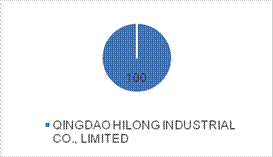
Name % Shareholding
Qingdao Hilong Industrial
Co., Limited (HK) 100
------------------------------------------
CR No.: 1830327
Legal form: Private company limited by shares
Established Date: 2012-11-2
KEY EVENTS
No Significant Changes.
BUSINESS OPERATIONS
The subject’s registered business scope includes manufacturing and
selling auto parts, machinery and equipment fittings, building template
accessories, scaffolding and accessories; wholesaling hardware tools, railway
fittings, electrical equipment fittings, fittings, valves and fittings,
building materials, electronic equipment, decorative materials; exporting
self-made products and technologies; importing mechanical equipment, spare
parts, raw and auxiliary materials and technology needed by the enterprise
(with permit if needed)
The subject is mainly engaged in
manufacturing and selling machinery products and parts.
Products:
Building tools and accessories
Hardware tools
Automotive and mechanical accessories
Etc.
The
subject sources its materials 70% from domestic market, and 30% from overseas
market. the subject sells 50% of its products in domestic market, and 50% to
overseas market.
The
buying terms of the subject include Check, T/T, L/C and Credit of 30-60 days. The
payment terms of the subject include Check, T/T, L/C and Credit of 30-60 days.
SUPPLIER & CUSTOMER
No record.
RELATED COMPANIES
No record.
NEGATIVE
INFORMATION
Lawsuit Record: No record.
Trade payment experience: The subject did not provide any name of trade/service suppliers and
we have no other sources to conduct the enquiry at present.
Delinquent payment record: None in our database.
Debt collection record: No overdue amount owed by the subject was placed to us for collection
within the last 6 years.
Customs
administrative penalty: No record.
Equity freeze
information: No record.
Administrative Penalty: No record.
MORTGAGE
There is no record of mortgage information at
present.
TRADEMARK
No record.
PATENT
No record.
BANKING
The subject declined to release its banking details.
ABBREVIATED FINANCIAL STATEMENT
Established newly in Yr2017, the subject’s
financial records for Yr2015 & 2016 are unarchived in the local AIC.
COMMENT
The subject was registered as a Wholly foreign-owned enterprise at local
Administration for Industry & Commerce (AIC - The official body of issuing
and renewing business license). The subject is
considered small-sized in its line with a short development history.
FOREIGN EXCHANGE RATES
|
Currency |
Unit
|
Indian Rupees |
|
US Dollar |
1 |
INR 67.22 |
|
|
1 |
INR 90.87 |
|
Euro |
1 |
INR 80.09 |
|
CNY |
1 |
INR 10.62 |
Note :
Above are approximate rates obtained from sources believed to be correct
INFORMATION DETAILS
|
Analysis Done by
: |
PRA |
|
|
|
|
Report Prepared
by : |
TPT |
RATING EXPLANATIONS
|
Credit Rating |
Explanation |
Rating Comments |
|
A++ |
Minimum Risk |
Business dealings permissible with minimum
risk of default |
|
A+ |
Low Risk |
Business dealings permissible with low
risk of default |
|
A |
Acceptable Risk |
Business dealings permissible with
moderate risk of default |
|
B |
Medium Risk |
Business dealings permissible on a regular
monitoring basis |
|
C |
Medium High Risk |
Business dealings permissible preferably
on secured basis |
|
D |
High Risk |
Business dealing not recommended or on
secured terms only |
|
NB |
New Business |
No recommendation can be done due to
business in infancy stage |
|
NT |
No Trace |
No recommendation can be done as the
business is not traceable |
NB is stated where there is insufficient information to facilitate rating. However, it is not to be considered as unfavourable.
This score serves as a reference to assess
SC’s credit risk and to set the amount of credit to be extended. It is
calculated from a composite of weighted scores obtained from each of the major
sections of this report. The assessed factors are as follows:
·
Financial
condition covering various ratios
·
Company
background and operations size
·
Promoters
/ Management background
·
Payment
record
·
Litigation
against the subject
·
Industry
scenario / competitor analysis
·
Supplier
/ Customer / Banker review (wherever available)
This report is issued at
your request without any risk and responsibility on the part of MIRA INFORM
PRIVATE LIMITED (MIPL) or its officials.